



 Chat with AI
Exam 18: Electrochemistry

Exam 1: Matter, Measurement, and Problem Solving120 Questions
Exam 2: Atoms and Elements116 Questions
Exam 3: Molecules, Compounds and Chemical Equations144 Questions
Exam 4: Chemical Quantities and Aqueous Reactions199 Questions
Exam 5: Gases157 Questions
Exam 6: Thermochemistry110 Questions
Exam 7: The Quantum-Mechanical Model of the Atom100 Questions
Exam 8: Periodic Properties of the Elements120 Questions
Exam 9: Chemical Bonding I: Lewis Theory125 Questions
Exam 10: Chemical Bonding II: Molecular Shapes, Valence Bond Theory, and109 Questions
Exam 11: Liquids, Solids, and Intermolecular Forces123 Questions
Exam 12: Solutions127 Questions
Exam 13: Chemical Kinetics125 Questions
Exam 14: Chemical Equilibrium112 Questions
Exam 15: Acids and Bases126 Questions
Exam 16: Aqueous Ionic Equilibrium148 Questions
Exam 17: Free Energy and Thermodynamics103 Questions
Exam 18: Electrochemistry115 Questions
Exam 19: Radioactivity and Nuclear Chemistry105 Questions
Select questions type


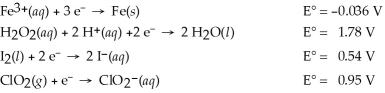

Use the standard half-cell potentials listed below to calculate the standard cell potential for the following reaction occurring in an electrochemical cell at 25°C.(The equation is balanced. )
Pb(s)+ Br2(l)→ Pb2+(aq)+ 2 Br⁻(aq)

(Multiple Choice)
4.9/5  (70)
(70) A galvanic cell consists of one half-cell that contains Ag(s)and Ag+(aq),and one half-cell that contains Cu(s)and Cu2+(aq).What species are produced at the electrodes under standard conditions?
Ag+(aq)+ e- → Ag(s)E° = +0.80 V
Cu2+(aq)+ 2 e- → Cu(s)E° = +0.34 V
(Multiple Choice)
4.9/5 (84)
(84) Balance the following redox reaction if it occurs in basic solution.What are the coefficients in front of Cr(OH)4⁻ and ClO⁻ in the balanced reaction?
Cr(OH)4⁻(aq)+ ClO⁻(aq)→ CrO42-(aq)+ Cl⁻(aq)
(Multiple Choice)
4.8/5 (79)
(79) Which of the following metal cations is the best oxidizing agent?
(Multiple Choice)
4.9/5 (92)
(92) What is undergoing oxidation in the redox reaction represented by the following cell notation?
Pb(s)∣ Pb2+(aq)∣∣ H+(aq)∣ H2(g)∣ Pt
(Multiple Choice)
4.8/5 (83)
(83) Balance the following redox reaction if it occurs in acidic solution.What are the coefficients in front of H⁺ and Fe3+ in the balanced reaction?
Fe2+(aq)+ MnO4⁻(aq)→ Fe3+(aq)+ Mn2+(aq)
(Multiple Choice)
4.9/5 (75)
(75) How many electrons are transferred in the following reaction? (The reaction is unbalanced. )
Mg(s)+ Al3+(aq)→ Al(s)+ Mg2+(aq)
(Multiple Choice)
4.9/5 (74)
(74) Calculate the cell potential for the following reaction that takes place in an electrochemical cell at 25°C.
Fe(s)∣ Fe3+(aq,0.0011 M)∣∣ Fe3+(aq,2.33 M)∣ Fe(s)

(Multiple Choice)
4.9/5 (88)
(88) What element is being oxidized in the following redox reaction?
Mg2+(aq)+ NH4+(aq)→ Mg(s)+ NO3⁻(aq)
(Multiple Choice)
4.8/5 (86)
(86) The standard emf for the cell using the overall cell reaction below is +2.20 V:
2Al(s)+ 3I2(s)→ 2Al3+(aq)+ 6I-(aq)
The emf generated by the cell when [Al3+] = 4.5 × 10⁻³ M and [I-] = 0.15 M is

(Multiple Choice)
4.9/5 (90)
(90) What is the difference between a voltaic cell and an electrolytic cell?
(Essay)
4.9/5 (70)
(70) What element is being oxidized in the following redox reaction?
Cr(OH)4⁻(aq)+ ClO⁻(aq)→ CrO42-(aq)+ Cl⁻(aq)
(Multiple Choice)
4.9/5 (79)
(79) Which of the following metals will dissolve in nitric acid but not hydrochloric? 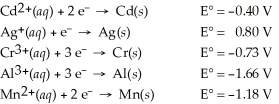
(Multiple Choice)
4.9/5 (87)
(87) Consider the galvanic cell,Zn(s)∣ Zn2+(aq)∣∣ Pb2+(aq)∣ Pb(s).Which one of the following changes to the cell would cause the cell potential to increase (i.e. ,become more positive)?
(Multiple Choice)
4.8/5 (84)
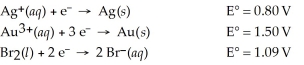
(84) Use the tabulated half-cell potentials below to calculate the equilibrium constant (K)for the following balanced redox reaction at 25°C.
2 Al(s)+ 3 Mg2+(aq)→ 2 Al3+(aq)+ 3 Mg(s)

(Multiple Choice)
4.9/5 (81)
(81) 
Balance the following redox reaction if it occurs in basic solution.What are the coefficients in front of ClO2 and H2O in the balanced reaction?
H2O2(l)+ ClO2(aq)→ ClO2⁻(aq)+ O2(g)
(Multiple Choice)
4.8/5 (78)
(78) What is the oxidizing agent in the redox reaction represented by the following cell notation?
Fe(s)∣ Fe3+(aq) Cl2(g)∣ Cl⁻(aq)∣ Pt
 (Multiple Choice)
4.7/5 (87)
(87) Determine the cell notation for the redox reaction given below.
Pb(s)+ 2 H⁺(aq)→ Pb2+(aq)+ H2(g)
(Multiple Choice)
4.8/5 (83)
(83) 
Filters
- Essay(0)
- Multiple Choice(0)
- Short Answer(0)
- True False(0)
- Matching(0)