



 Chat with AI
Exam 18: Electrochemistry

Exam 1: Matter, Measurement, and Problem Solving120 Questions
Exam 2: Atoms and Elements116 Questions
Exam 3: Molecules, Compounds and Chemical Equations144 Questions
Exam 4: Chemical Quantities and Aqueous Reactions199 Questions
Exam 5: Gases157 Questions
Exam 6: Thermochemistry110 Questions
Exam 7: The Quantum-Mechanical Model of the Atom100 Questions
Exam 8: Periodic Properties of the Elements120 Questions
Exam 9: Chemical Bonding I: Lewis Theory125 Questions
Exam 10: Chemical Bonding II: Molecular Shapes, Valence Bond Theory, and109 Questions
Exam 11: Liquids, Solids, and Intermolecular Forces123 Questions
Exam 12: Solutions127 Questions
Exam 13: Chemical Kinetics125 Questions
Exam 14: Chemical Equilibrium112 Questions
Exam 15: Acids and Bases126 Questions
Exam 16: Aqueous Ionic Equilibrium148 Questions
Exam 17: Free Energy and Thermodynamics103 Questions
Exam 18: Electrochemistry115 Questions
Exam 19: Radioactivity and Nuclear Chemistry105 Questions
Select questions type


Determine which of the following pairs of reactants will result in a spontaneous reaction at 25°C. 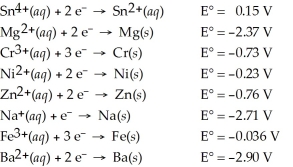
(Multiple Choice)
4.8/5  (75)
(75) What element is being reduced in the following redox reaction?
MnO4⁻(aq)+ H2C2O4(aq)→ Mn2+(aq)+ CO2(g)
(Multiple Choice)
4.9/5 (89)
(89) The standard cell potential (E°)of a voltaic cell constructed using the cell reaction below is 0.76 V:
Zn(s)+ 2H+(aq)→ Zn2+(aq)+ H2(g)
With PH2 = 1.0 atm and [Zn2+] = 1.0 M,the cell potential is 0.66 V.The concentration of H+ in the cathode compartment is ________ M.
(Multiple Choice)
4.8/5 (82)
(82) For the reaction below,determine the standard free energy change,ΔG°.
Cu(s)+ Sn2+(aq)→ Cu2+(aq)+ Sn(s)E°cell = -0.48 V
(Multiple Choice)
4.9/5 (80)
(80) What is the reduction half-reaction for the following overall galvanic cell reaction?
Zn2+(aq)+ 2 Ag(s)→ Zn(s)+ 2 Ag+(aq)
(Multiple Choice)
4.8/5 (68)
(68) How many electrons are transferred in the following reaction? (The reaction is unbalanced. )
Ca(s)+ Cr3+(aq)→ Cr(s)+ Ca2+(aq)
(Multiple Choice)
4.8/5 (79)
(79) Use the standard half-cell potentials listed below to calculate the standard cell potential for the following reaction occurring in an electrochemical cell at 25°C.(The equation is balanced. )
3 Cl2(g)+ 2 Fe(s)→ 6 Cl⁻(aq)+ 2 Fe3+(aq)

(Multiple Choice)
4.8/5 (91)
(91) A galvanic cell consists of a Mg2+/Mg half-cell and a standard hydrogen electrode.If the Mg2+/Mg half-cell standard cell functions as the anode,and the standard cell potential is 2.37 V,what is the standard reduction potential for the Mg2+/Mg half-cell?
(Multiple Choice)
4.8/5 (71)
(71) How many grams of chromium metal are plated out when a constant current of 8.00 A is passed through an aqueous solution containing Cr3+ ions for 320.minutes?
(Multiple Choice)
4.9/5 (78)
(78) Explain the significance of the standard hydrogen electrode (SHE)in the tabulation of standard reduction potentials of other species.
(Essay)
4.8/5 (83)
(83) The standard emf for the cell using the overall cell reaction below is +0.48 V:
Zn(s)+ Ni2+(aq)→ Zn2+(aq)+ Ni(s)
The emf generated by the cell when [Ni2+] = 2.50 M and [Zn2+] = 0.100 M is ________ V.
(Multiple Choice)
4.8/5 (84)
(84) What element is being reduced in the following redox reaction?
H2O2(l)+ ClO2(aq)→ ClO2⁻(aq)+ O2(g)
(Multiple Choice)
4.9/5 (64)
(64) 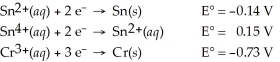
Use the standard half-cell potentials listed below to calculate the standard cell potential for the following reaction occurring in an electrochemical cell at 25°C.(The equation is balanced. )
Sn(s)+ 2 Ag⁺(aq)→ Sn2+(aq)+ 2 Ag(s)

(Multiple Choice)
4.9/5 (70)
(70) Determine the cell notation for the redox reaction given below.
3 Cl2(g)+ 2 Fe(s)→ 6 Cl⁻(aq)+ 2 Fe3+(aq)
(Multiple Choice)
4.7/5 (75)
(75) What mass of silver can be plated onto an object in 33.5 minutes at 8.70 A of current?
Ag⁺(aq)+ e⁻ → Ag(s)
(Multiple Choice)
4.8/5 (73)
(73) How long must a constant current of 50.0 A be passed through an electrolytic cell containing aqueous Cu2+ ions to produce 5.00 moles of copper metal?
(Multiple Choice)
4.8/5 (78)
(78) 
Filters
- Essay(0)
- Multiple Choice(0)
- Short Answer(0)
- True False(0)
- Matching(0)