



 Chat with AI
Exam 14: Firms in Competitive Markets

Exam 1: Ten Principles of Economics281 Questions
Exam 2: Thinking Like an Economist451 Questions
Exam 3: Interdependence and the Gains From Trade353 Questions
Exam 4: The Market Forces of Supply and Demand467 Questions
Exam 5: Elasticity and Its Application409 Questions
Exam 6: Supply, Demand, and Government Policies459 Questions
Exam 7: Consumers, Producers, and the Efficiency of Markets363 Questions
Exam 8: Application: The Costs of Taxation353 Questions
Exam 9: Application: International Trade333 Questions
Exam 10: Externalities352 Questions
Exam 11: Public Goods and Common Resources270 Questions
Exam 12: The Design of the Tax System397 Questions
Exam 13: The Costs of Production434 Questions
Exam 14: Firms in Competitive Markets381 Questions
Exam 15: Monopoly427 Questions
Exam 16: Monopolistic Competition416 Questions
Exam 17: Oligopoly325 Questions
Exam 18: The Markets for the Factors of Production361 Questions
Exam 19: Earnings and Discrimination335 Questions
Exam 20: Income Inequality and Poverty312 Questions
Exam 21: The Theory of Consumer Choice354 Questions
Exam 22: Frontiers of Microeconomics262 Questions
Exam 23: Measuring a Nations Income343 Questions
Exam 24: Measuring the Cost of Living358 Questions
Exam 25: Production and Growth335 Questions
Exam 26: Saving, investment, and the Financial System381 Questions
Exam 27: The Basic Tools of Finance336 Questions
Exam 28: Unemployment533 Questions
Exam 29: The Monetary System366 Questions
Exam 30: Money Growth and Inflation312 Questions
Exam 31: Open-Economy Macroeconomics: Basic Concepts346 Questions
Exam 32: A Macroeconomic Theory of the Open Economy300 Questions
Exam 33: Aggregate Demand and Aggregate Supply386 Questions
Exam 34: The Influence of Monetary and Fiscal Policy on Aggregate Demand334 Questions
Exam 35: The Short-Run Trade-Off Between Inflation and Unemployment306 Questions
Exam 36: Five Debates Over Macroeconomic Policy179 Questions
Select questions type


Scenario 14-3
As part of an estate settlement Mary received $1 million.She decided to use the money to purchase a small business in Anywhere,USA.Her business operates in a perfectly competitive industry.If Mary would have invested the $1 million in a risk-free bond fund she could have made $100,000 each year.She also quit her job with Lucky.Com Inc.to devote all of her time to her new business;her salary at Lucky.Com Inc.was $75,000 per year.
-Refer to Scenario 14-3.What are Mary's opportunity costs of operating her new business?
(Multiple Choice)
5.0/5  (82)
(82) A profit-maximizing firm will shut down in the short run when
(Multiple Choice)
5.0/5 (78)
(78) Figure 14-1  -Refer to Figure 14-1.Which of the four prices corresponds to a perfectly competitive firm earning positive economic profits in the short run?
 (Multiple Choice)
4.8/5 (63)
(63) A firm operating in a perfectly competitive industry will continue to operate if it earns zero economic profits because it is likely to be earning positive accounting profits.
(True/False)
4.9/5 (86)
(86) A certain competitive firm sells its output for $20 per unit.The 50th unit of output that the firm produces has a marginal cost of $22.Which of following is not necessarily true?
(Multiple Choice)
4.9/5 (71)
(71) Figure 14-8
In the figure below,panel (a)depicts the linear marginal cost of a firm in a competitive market,and panel (b)depicts the linear market supply curve for a market with a fixed number of identical firms. 
 -Refer to Figure 14-8.If there are 200 identical firms in this market,what level of output will be supplied to the market when price is $1.00?
 (Multiple Choice)
4.8/5 (81)
(81) Which of these types of costs can be ignored when an individual or a firm is making decisions?
(Multiple Choice)
4.7/5 (80)
(80) If a competitive firm is currently producing a level of output at which marginal cost exceeds marginal revenue,then
(Multiple Choice)
4.9/5 (82)
(82) At its current level of production a profit-maximizing firm in a competitive market receives $12.50 for each unit it produces and faces an average total cost of $10.At the market price of $12.50 per unit,the firm's marginal cost curve crosses the marginal revenue curve at an output level of 1,000 units.What is the firm's current profit? What is likely to occur in this market and why?
(Essay)
4.9/5 (101)
(101) In the short run,there are 500 identical firms in a competitive market.The firms do not use any resources that are available in limited quantities,and each of them has the following cost structure:
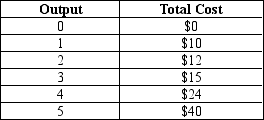 The long-run supply curve for this market is
 (Multiple Choice)
5.0/5 (67)
(67) Table 14-2
 -Refer to Table 14-2.Over what range of output is marginal revenue declining?
 (Multiple Choice)
4.8/5 (75)
(75) When determining whether to shut down in the short run,a competitive firm should
(Multiple Choice)
4.8/5 (95)
(95) A competitive firm has been selling its output for $20 per unit and has been maximizing its profit,which is positive.Then,the price rises to $25,and the firm makes whatever adjustments are necessary to maximize its profit at the now-higher price.Once the firm has adjusted,which of the following statements is correct?
(Multiple Choice)
4.9/5 (79)
(79) A corporation has been steadily losing money on one of its product lines,Wally's Widgets.The firm produces Wally's Widgets in a factory that cost $20 million to build 10 years ago.The firm is now considering an offer to buy that factory for $15 million.Which of the following statements about the decision to sell or not to sell is correct?
(Multiple Choice)
5.0/5 (88)
(88) Regardless of the cost structure of firms in a competitive market,in the long run
(Multiple Choice)
4.8/5 (85)
(85) 
Assume a firm is producing 800 units of output,and it sells each unit for $6.Its average total cost is $4.Its profit is
(Multiple Choice)
4.9/5 (71)
(71) Table 14-3
The following table presents cost and revenue information for Soper's Port Vineyard.
 -Refer to Table 14-3.What is the marginal revenue from selling the 3rd unit?
 (Multiple Choice)
4.9/5 (80)
(80) 
Filters
- Essay(0)
- Multiple Choice(0)
- Short Answer(0)
- True False(0)
- Matching(0)