



 Chat with AI
Exam 13: The Costs of Production

Exam 1: Ten Principles of Economics281 Questions
Exam 2: Thinking Like an Economist451 Questions
Exam 3: Interdependence and the Gains From Trade353 Questions
Exam 4: The Market Forces of Supply and Demand467 Questions
Exam 5: Elasticity and Its Application409 Questions
Exam 6: Supply, Demand, and Government Policies459 Questions
Exam 7: Consumers, Producers, and the Efficiency of Markets363 Questions
Exam 8: Application: The Costs of Taxation353 Questions
Exam 9: Application: International Trade333 Questions
Exam 10: Externalities352 Questions
Exam 11: Public Goods and Common Resources270 Questions
Exam 12: The Design of the Tax System397 Questions
Exam 13: The Costs of Production434 Questions
Exam 14: Firms in Competitive Markets381 Questions
Exam 15: Monopoly427 Questions
Exam 16: Monopolistic Competition416 Questions
Exam 17: Oligopoly325 Questions
Exam 18: The Markets for the Factors of Production361 Questions
Exam 19: Earnings and Discrimination335 Questions
Exam 20: Income Inequality and Poverty312 Questions
Exam 21: The Theory of Consumer Choice354 Questions
Exam 22: Frontiers of Microeconomics262 Questions
Exam 23: Measuring a Nations Income343 Questions
Exam 24: Measuring the Cost of Living358 Questions
Exam 25: Production and Growth335 Questions
Exam 26: Saving, investment, and the Financial System381 Questions
Exam 27: The Basic Tools of Finance336 Questions
Exam 28: Unemployment533 Questions
Exam 29: The Monetary System366 Questions
Exam 30: Money Growth and Inflation312 Questions
Exam 31: Open-Economy Macroeconomics: Basic Concepts346 Questions
Exam 32: A Macroeconomic Theory of the Open Economy300 Questions
Exam 33: Aggregate Demand and Aggregate Supply386 Questions
Exam 34: The Influence of Monetary and Fiscal Policy on Aggregate Demand334 Questions
Exam 35: The Short-Run Trade-Off Between Inflation and Unemployment306 Questions
Exam 36: Five Debates Over Macroeconomic Policy179 Questions
Select questions type




In the short run,if a firm produces nothing,total costs are zero.
(True/False)
4.8/5  (92)
(92) Figure 13-6  -Refer to Figure 13-6.Which of the figures represents the production function for a firm?
 (Multiple Choice)
4.9/5 (79)
(79) Table 13-8
Eileen's Elegant Earrings produces pairs of earrings for its mail order catalogue business.Each pair is shipped in a separate box.She rents a small room for $150 a week in the downtown business district that serves as her factory.She can hire workers for $275 a week.There are no implicit costs.
 -Refer to Table 13-8.What is the total cost associated with making 890 boxes of earrings per week?
 (Multiple Choice)
5.0/5 (83)
(83) Table 13-6
 -Refer to Table 13-6.What is the marginal cost of producing the fifth unit of output?
 (Multiple Choice)
4.8/5 (80)
(80) Figure 13-4  -Refer to Figure 13-4.Which curve is most likely to represent average total cost?
 (Multiple Choice)
4.8/5 (63)
(63) Figure 13-7 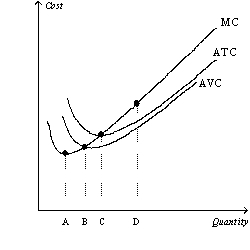 -Refer to Figure 13-7.Quantity C represents the output level where the firm
 (Multiple Choice)
4.9/5 (72)
(72) Table 13-1
Alyson's Pet Sitting Service
 -Refer to Table 13-1.What is the marginal product of the third worker?
 (Multiple Choice)
4.9/5 (90)
(90) If marginal cost is below average total cost,then average total cost
(Multiple Choice)
4.9/5 (87)
(87) Let L represent the number of workers hired by a firm and let Q represent that firm's quantity of output.Assume two points on the firm's production function are (L = 12,Q = 122)and (L = 13,Q = 132).Then the marginal product of the 13th worker is
(Multiple Choice)
4.9/5 (68)
(68) Scenario 13-2
Zach withdrew $400,000 out of his personal savings account and used it to start his new cookie business.The bank account pays 3 percent interest per year.During the first year of his business,Zach sold 6,000 boxes of cookies for $2.50 per box.Also during the first year,the cookie business made monetary outlays of $9,000.You may assume that there is no opportunity cost to Zach's time.
-Refer to Scenario 13-2.Zach's economic profit for the year was
(Multiple Choice)
4.9/5 (79)
(79) Which of the following costs of publishing a book is a fixed cost?
(Multiple Choice)
4.8/5 (89)
(89) Scenario 13-7
Farmer Jack is a watermelon farmer.If Jack plants no seeds on his farm,he gets no harvest.If he plants 1 bag of seeds,he gets 30 watermelons.If he plants 2 bags of seeds,he gets 50 watermelons.If he plants 3 bags of seeds he gets 60 watermelons.A bag of seeds costs $100,and the costs of seeds are his only costs.
-Refer to Scenario 13-7.What is the shape of Farmer Jack's marginal cost curve?
(Multiple Choice)
4.8/5 (85)
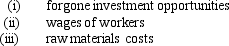
(85) Which of the following would be an example of an implicit cost?
(Multiple Choice)
4.9/5 (81)
(81) Figure 13-10  -Refer to Figure 13-10.The firm experiences diseconomies of scale if it changes its level of output from
 (Multiple Choice)
5.0/5 (90)
(90) The average total cost curve is unaffected by diminishing marginal product.
(True/False)
4.8/5 (69)
(69) Figure 13-9
The figure below depicts average total cost functions for a firm that produces automobiles.  -Refer to Figure 13-9.The firm experiences economies of scale at which output levels?
 (Multiple Choice)
5.0/5 (73)
(73) Table 13-4
Gallo Cork Factory
 -Refer to Table 13-4.Assume Gallo's currently employs 2 workers.What is the marginal product of labor when Gallo's adds a 3rd worker?
 (Multiple Choice)
4.9/5 (83)
(83) Scenario 13-5
Samantha has been working for a law firm and earning an annual salary of $80,000.She decides to open her own practice.Her annual expenses will include $15,000 for office rent,$3,000 for equipment rental,$1,000 for supplies,$1,200 for utilities,and a $35,000 salary for a secretary/bookkeeper.Samantha will cover her start-up expenses by cashing in a $20,000 certificate of deposit on which she was earning annual interest of $500.
-Refer to Scenario 13-5.Samantha's annual implicit costs will equal
(Multiple Choice)
4.9/5 (78)
(78) 
Filters
- Essay(0)
- Multiple Choice(0)
- Short Answer(0)
- True False(0)
- Matching(0)