



 Chat with AI
Exam 9: Application: International Trade

Exam 1: Ten Principles of Economics281 Questions
Exam 2: Thinking Like an Economist451 Questions
Exam 3: Interdependence and the Gains From Trade353 Questions
Exam 4: The Market Forces of Supply and Demand467 Questions
Exam 5: Elasticity and Its Application409 Questions
Exam 6: Supply, Demand, and Government Policies459 Questions
Exam 7: Consumers, Producers, and the Efficiency of Markets363 Questions
Exam 8: Application: The Costs of Taxation353 Questions
Exam 9: Application: International Trade333 Questions
Exam 10: Externalities352 Questions
Exam 11: Public Goods and Common Resources270 Questions
Exam 12: The Design of the Tax System397 Questions
Exam 13: The Costs of Production434 Questions
Exam 14: Firms in Competitive Markets381 Questions
Exam 15: Monopoly427 Questions
Exam 16: Monopolistic Competition416 Questions
Exam 17: Oligopoly325 Questions
Exam 18: The Markets for the Factors of Production361 Questions
Exam 19: Earnings and Discrimination335 Questions
Exam 20: Income Inequality and Poverty312 Questions
Exam 21: The Theory of Consumer Choice354 Questions
Exam 22: Frontiers of Microeconomics262 Questions
Exam 23: Measuring a Nations Income343 Questions
Exam 24: Measuring the Cost of Living358 Questions
Exam 25: Production and Growth335 Questions
Exam 26: Saving, investment, and the Financial System381 Questions
Exam 27: The Basic Tools of Finance336 Questions
Exam 28: Unemployment533 Questions
Exam 29: The Monetary System366 Questions
Exam 30: Money Growth and Inflation312 Questions
Exam 31: Open-Economy Macroeconomics: Basic Concepts346 Questions
Exam 32: A Macroeconomic Theory of the Open Economy300 Questions
Exam 33: Aggregate Demand and Aggregate Supply386 Questions
Exam 34: The Influence of Monetary and Fiscal Policy on Aggregate Demand334 Questions
Exam 35: The Short-Run Trade-Off Between Inflation and Unemployment306 Questions
Exam 36: Five Debates Over Macroeconomic Policy179 Questions
Select questions type


Suppose the Ivory Coast,a small country,imports wheat at the world price of $4 per bushel.If the Ivory Coast imposes a tariff of $1 per bushel on imported wheat,then,other things equal,the price of wheat in Ivory Coast will increase,but by less than $1.
(True/False)
4.9/5  (80)
(80) Figure 9-2  -Refer to Figure 9-2.Without trade,producer surplus is
 (Multiple Choice)
4.9/5 (87)
(87) Figure 9-17  -Refer to Figure 9-17.The imposition of the tariff
 (Multiple Choice)
4.9/5 (76)
(76) Figure 9-16.The figure below illustrates a tariff.On the graph,Q represents quantity and P represents price.  -Refer to Figure 9-16.The tariff
 (Multiple Choice)
4.8/5 (82)
(82) Figure 9-8.On the diagram below,Q represents the quantity of cars and P represents the price of cars.  -Refer to Figure 9-8.The country for which the figure is drawn
 (Multiple Choice)
4.8/5 (75)
(75) When the nation of Isoland opens up its steel market to international trade,that change
(Multiple Choice)
4.8/5 (62)
(62) Assume,for the U.S. ,that the domestic price of beef without international trade is lower than the world price of beef.This suggests that,in the production of beef,
(Multiple Choice)
4.8/5 (83)
(83) Spain is an importer of computer chips,taking the world price of $12 per chip as given.Suppose Spain imposes a $5 tariff on chips.As a result,
(Multiple Choice)
4.7/5 (74)
(74) The nation of Zelzar has decided to end its policy of not trading with the rest of the world.When it ends its trade restrictions,it discovers that it is importing incense,exporting steel,and neither importing nor exporting rugs.We can conclude that Zelzar's new free-trade policy has
(Multiple Choice)
4.8/5 (73)
(73) When a country that imports a particular good imposes a tariff on that good,
(Multiple Choice)
4.8/5 (78)
(78) Figure 9-15  -Refer to Figure 9-15.With trade and without a tariff,the price and domestic quantity demanded are
 (Multiple Choice)
4.8/5 (78)
(78) The imposition of a tariff on imported wine will increase the domestic price of wine,decrease the quantity of wine imported,and increase the quantity of wine produced domestically.
(True/False)
4.8/5 (80)
(80) Figure 9-13  -Refer to Figure 9-13.With trade,producer surplus is
 (Multiple Choice)
4.7/5 (69)
(69) Figure 9-19.On the diagram below,Q represents the quantity of textiles and P represents the price of textiles. 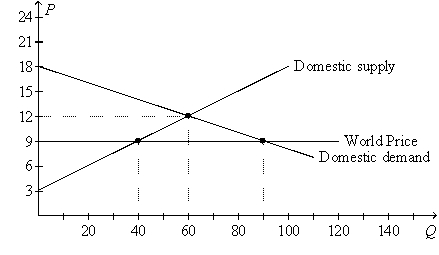 -Refer to Figure 9-19.With free trade,consumer surplus in the textile market amounts to
 (Multiple Choice)
4.8/5 (87)
(87) Suppose the United States exports cars to France and imports cheese from Switzerland.This situation suggests that
(Multiple Choice)
4.8/5 (89)
(89) Suppose a country abandons a no-trade policy in favor of a free-trade policy.If,as a result,the domestic price of beans increases to equal the world price of beans,then
(Multiple Choice)
4.8/5 (76)
(76) Several arguments for restricting trade have been advanced.Those arguments do not include
(Multiple Choice)
4.8/5 (75)
(75) If a country allows trade and,for a certain good,the domestic price without trade is lower than the world price,
(Multiple Choice)
4.8/5 (77)
(77) Figure 9-12  -Refer to Figure 9-12.Producer surplus after trade is
 (Multiple Choice)
4.9/5 (88)
(88) 
Filters
- Essay(0)
- Multiple Choice(0)
- Short Answer(0)
- True False(0)
- Matching(0)