



 Chat with AI
Exam 9: Application: International Trade

Exam 1: Ten Principles of Economics281 Questions
Exam 2: Thinking Like an Economist451 Questions
Exam 3: Interdependence and the Gains From Trade353 Questions
Exam 4: The Market Forces of Supply and Demand467 Questions
Exam 5: Elasticity and Its Application409 Questions
Exam 6: Supply, Demand, and Government Policies459 Questions
Exam 7: Consumers, Producers, and the Efficiency of Markets363 Questions
Exam 8: Application: The Costs of Taxation353 Questions
Exam 9: Application: International Trade333 Questions
Exam 10: Externalities352 Questions
Exam 11: Public Goods and Common Resources270 Questions
Exam 12: The Design of the Tax System397 Questions
Exam 13: The Costs of Production434 Questions
Exam 14: Firms in Competitive Markets381 Questions
Exam 15: Monopoly427 Questions
Exam 16: Monopolistic Competition416 Questions
Exam 17: Oligopoly325 Questions
Exam 18: The Markets for the Factors of Production361 Questions
Exam 19: Earnings and Discrimination335 Questions
Exam 20: Income Inequality and Poverty312 Questions
Exam 21: The Theory of Consumer Choice354 Questions
Exam 22: Frontiers of Microeconomics262 Questions
Exam 23: Measuring a Nations Income343 Questions
Exam 24: Measuring the Cost of Living358 Questions
Exam 25: Production and Growth335 Questions
Exam 26: Saving, investment, and the Financial System381 Questions
Exam 27: The Basic Tools of Finance336 Questions
Exam 28: Unemployment533 Questions
Exam 29: The Monetary System366 Questions
Exam 30: Money Growth and Inflation312 Questions
Exam 31: Open-Economy Macroeconomics: Basic Concepts346 Questions
Exam 32: A Macroeconomic Theory of the Open Economy300 Questions
Exam 33: Aggregate Demand and Aggregate Supply386 Questions
Exam 34: The Influence of Monetary and Fiscal Policy on Aggregate Demand334 Questions
Exam 35: The Short-Run Trade-Off Between Inflation and Unemployment306 Questions
Exam 36: Five Debates Over Macroeconomic Policy179 Questions
Select questions type


Figure 9-16.The figure below illustrates a tariff.On the graph,Q represents quantity and P represents price.  -Refer to Figure 9-16.The area C + D + E + F represents
 (Multiple Choice)
4.8/5  (70)
(70) Figure 9-19.On the diagram below,Q represents the quantity of textiles and P represents the price of textiles. 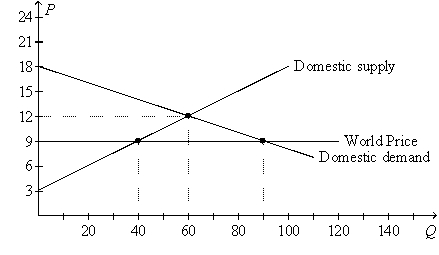 -Refer to Figure 9-19.With free trade,the country for which the figure is drawn will
 (Multiple Choice)
4.7/5 (89)
(89) Most economists view the United States as an ongoing experiment that raises serious doubts about the virtues of free trade.
(True/False)
4.9/5 (94)
(94) Scenario 9-1
The before-trade domestic price of tomatoes in the United States is $500 per ton.The world price of tomatoes is $600 per ton.The U.S.is a price-taker in the market for tomatoes.
-Refer to Scenario 9-1.If trade in tomatoes is allowed,the price of tomatoes in the United States
(Multiple Choice)
4.8/5 (97)
(97) Figure 9-9  -Refer to Figure 9-9.Consumer surplus in this market after trade is
 (Multiple Choice)
5.0/5 (86)
(86) The greater the elasticities of supply and demand,the smaller are the gains from trade.
(True/False)
4.9/5 (81)
(81) When the nation of Duxembourg allows trade and becomes an importer of software,
(Multiple Choice)
5.0/5 (80)
(80) A possible outcome of the multilateral approach to free trade is that such an approach can
(Multiple Choice)
4.8/5 (79)
(79) Figure 9-3.The domestic country is China.  -Refer to Figure 9-3.With no international trade,
 (Multiple Choice)
4.8/5 (79)
(79) Figure 9-1
The figure illustrates the market for wool in New Zealand.  -Refer to Figure 9-1.Relative to the no-trade situation,trade with the rest of the world results in
 (Multiple Choice)
4.8/5 (79)
(79) According to the principle of comparative advantage,all countries can benefit from trading with one another because trade allows each country to specialize in doing what it does best.
(True/False)
5.0/5 (82)
(82) Figure 9-11  -Refer to Figure 9-11.Consumer surplus in this market after trade is
 (Multiple Choice)
4.9/5 (75)
(75) When the nation of Brownland first permitted trade with other nations,domestic producers of wheat experienced an increase in producer surplus of $4 million and total surplus in Brownland's wheat market increased by $1 million.We can conclude that
(Multiple Choice)
4.9/5 (77)
(77) When a country abandons a no-trade policy,adopts a free-trade policy,and becomes an exporter of a particular good,
(Multiple Choice)
4.8/5 (91)
(91) Figure 9-17  -Refer to Figure 9-17.When the country moves from no trade to free trade,consumer surplus
 (Multiple Choice)
4.8/5 (76)
(76) Chile is an importer of computer chips,taking the world price of $12 per chip as given.Suppose Chile imposes a $7 tariff on chips.Which of the following outcomes is possible?
(Multiple Choice)
4.9/5 (84)
(84) The nation of Aviana soon will abandon its no-trade policy and adopt a free-trade policy.If the world price of goose meat is $3 per pound and the domestic price of goose meat without trade is $2 per pound,then Aviana should export goose meat.
(True/False)
4.8/5 (80)
(80) When a country that imports a particular good imposes an import quota on that good,
(Multiple Choice)
4.9/5 (86)
(86) 
Filters
- Essay(0)
- Multiple Choice(0)
- Short Answer(0)
- True False(0)
- Matching(0)