



 Chat with AI
Exam 6: Supply, Demand, and Government Policies

Exam 1: Ten Principles of Economics281 Questions
Exam 2: Thinking Like an Economist451 Questions
Exam 3: Interdependence and the Gains From Trade353 Questions
Exam 4: The Market Forces of Supply and Demand467 Questions
Exam 5: Elasticity and Its Application409 Questions
Exam 6: Supply, Demand, and Government Policies459 Questions
Exam 7: Consumers, Producers, and the Efficiency of Markets363 Questions
Exam 8: Application: The Costs of Taxation353 Questions
Exam 9: Application: International Trade333 Questions
Exam 10: Externalities352 Questions
Exam 11: Public Goods and Common Resources270 Questions
Exam 12: The Design of the Tax System397 Questions
Exam 13: The Costs of Production434 Questions
Exam 14: Firms in Competitive Markets381 Questions
Exam 15: Monopoly427 Questions
Exam 16: Monopolistic Competition416 Questions
Exam 17: Oligopoly325 Questions
Exam 18: The Markets for the Factors of Production361 Questions
Exam 19: Earnings and Discrimination335 Questions
Exam 20: Income Inequality and Poverty312 Questions
Exam 21: The Theory of Consumer Choice354 Questions
Exam 22: Frontiers of Microeconomics262 Questions
Exam 23: Measuring a Nations Income343 Questions
Exam 24: Measuring the Cost of Living358 Questions
Exam 25: Production and Growth335 Questions
Exam 26: Saving, investment, and the Financial System381 Questions
Exam 27: The Basic Tools of Finance336 Questions
Exam 28: Unemployment533 Questions
Exam 29: The Monetary System366 Questions
Exam 30: Money Growth and Inflation312 Questions
Exam 31: Open-Economy Macroeconomics: Basic Concepts346 Questions
Exam 32: A Macroeconomic Theory of the Open Economy300 Questions
Exam 33: Aggregate Demand and Aggregate Supply386 Questions
Exam 34: The Influence of Monetary and Fiscal Policy on Aggregate Demand334 Questions
Exam 35: The Short-Run Trade-Off Between Inflation and Unemployment306 Questions
Exam 36: Five Debates Over Macroeconomic Policy179 Questions
Select questions type


In an unregulated labor market,the wage adjusts to balance labor supply and labor demand.
(True/False)
4.9/5  (72)
(72) Figure 6-8  -Refer to Figure 6-8.Which of the following statements best relates the figure to the events that occurred in the United States in the 1970s?
 (Multiple Choice)
4.8/5 (86)
(86) Which of the following is the most likely explanation for the imposition of a price floor on the market for corn?
(Multiple Choice)
4.9/5 (78)
(78) Figure 6-16
Panel (a)Panel (b) 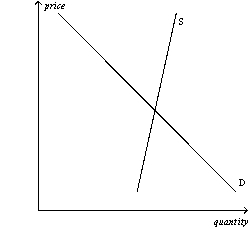
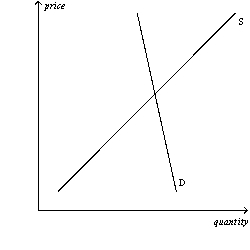 Panel (c)
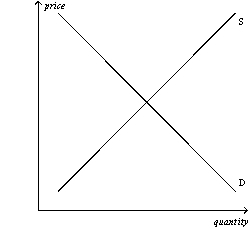 -Refer to Figure 6-16.In which market will the majority of the tax burden fall on buyers?
Panel (c)
-Refer to Figure 6-16.In which market will the majority of the tax burden fall on buyers? (Multiple Choice)
4.9/5 (79)
(79) Figure 6-7 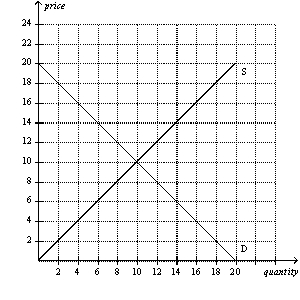 -Refer to Figure 6-7.Which of the following statements is correct?
 (Multiple Choice)
4.9/5 (79)
(79) A price floor set above the equilibrium price causes quantity supplied to exceed quantity demanded.
(True/False)
4.8/5 (87)
(87) If the equilibrium price of an airline ticket is $500 and the government imposes a price floor of $400 on airline tickets,then fewer airline tickets will be sold than at the market equilibrium.
(True/False)
4.7/5 (82)
(82) Which of the following is not a rationing mechanism used by landlords in cities with rent control?
(Multiple Choice)
4.9/5 (73)
(73) Using the graph shown,answer the following questions.
What was the equilibrium price in this market before the tax?
What is the amount of the tax?
How much of the tax will the buyers pay?
How much of the tax will the sellers pay?
How much will the buyer pay for the product after the tax is imposed?
How much will the seller receive after the tax is imposed?
As a result of the tax,what has happened to the level of market activity?
(Essay)
4.9/5 (70)
(70) Long lines and discrimination are examples of rationing methods that may naturally develop in response to a binding price ceiling.
(True/False)
4.8/5 (73)
(73) Figure 6-13
The vertical distance between points A and B represents the tax in the market.  -Refer to Figure 6-13.The amount of the tax per unit is
 (Multiple Choice)
4.7/5 (66)
(66) If a tax is levied on the sellers of a product,then the demand curve
(Multiple Choice)
4.9/5 (88)
(88) States in the U.S.may mandate minimum wages above the federal level.
(True/False)
4.9/5 (83)
(83) A binding minimum wage may not help all workers,but it does not hurt any workers.
(True/False)
4.9/5 (79)
(79) Which of the following is not a function of prices in a market system?
(Multiple Choice)
4.9/5 (85)
(85) One disadvantage of government subsidies over price controls is that subsidies
(Multiple Choice)
5.0/5 (76)
(76) Table 6-1
 -Refer to Table 6-1.Which of the following price ceilings would be binding in this market?
 (Multiple Choice)
4.7/5 (79)
(79) 
Filters
- Essay(0)
- Multiple Choice(0)
- Short Answer(0)
- True False(0)
- Matching(0)