



 Chat with AI
Exam 6: Supply, Demand, and Government Policies

Exam 1: Ten Principles of Economics281 Questions
Exam 2: Thinking Like an Economist451 Questions
Exam 3: Interdependence and the Gains From Trade353 Questions
Exam 4: The Market Forces of Supply and Demand467 Questions
Exam 5: Elasticity and Its Application409 Questions
Exam 6: Supply, Demand, and Government Policies459 Questions
Exam 7: Consumers, Producers, and the Efficiency of Markets363 Questions
Exam 8: Application: The Costs of Taxation353 Questions
Exam 9: Application: International Trade333 Questions
Exam 10: Externalities352 Questions
Exam 11: Public Goods and Common Resources270 Questions
Exam 12: The Design of the Tax System397 Questions
Exam 13: The Costs of Production434 Questions
Exam 14: Firms in Competitive Markets381 Questions
Exam 15: Monopoly427 Questions
Exam 16: Monopolistic Competition416 Questions
Exam 17: Oligopoly325 Questions
Exam 18: The Markets for the Factors of Production361 Questions
Exam 19: Earnings and Discrimination335 Questions
Exam 20: Income Inequality and Poverty312 Questions
Exam 21: The Theory of Consumer Choice354 Questions
Exam 22: Frontiers of Microeconomics262 Questions
Exam 23: Measuring a Nations Income343 Questions
Exam 24: Measuring the Cost of Living358 Questions
Exam 25: Production and Growth335 Questions
Exam 26: Saving, investment, and the Financial System381 Questions
Exam 27: The Basic Tools of Finance336 Questions
Exam 28: Unemployment533 Questions
Exam 29: The Monetary System366 Questions
Exam 30: Money Growth and Inflation312 Questions
Exam 31: Open-Economy Macroeconomics: Basic Concepts346 Questions
Exam 32: A Macroeconomic Theory of the Open Economy300 Questions
Exam 33: Aggregate Demand and Aggregate Supply386 Questions
Exam 34: The Influence of Monetary and Fiscal Policy on Aggregate Demand334 Questions
Exam 35: The Short-Run Trade-Off Between Inflation and Unemployment306 Questions
Exam 36: Five Debates Over Macroeconomic Policy179 Questions
Select questions type


Figure 6-7 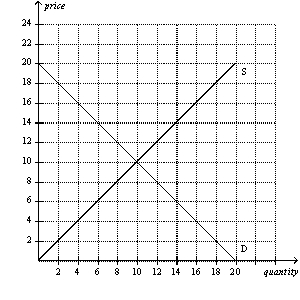 -Refer to Figure 6-7.Which of the following statements is correct?
 (Multiple Choice)
4.9/5  (80)
(80) The long-run effects of rent controls are a good illustration of the principle that
(Multiple Choice)
4.8/5 (89)
(89) When a tax is imposed on the sellers of a good,the supply curve shifts
(Multiple Choice)
4.9/5 (76)
(76) A $2.00 tax levied on the buyers of lawnmowers will shift the demand curve
(Multiple Choice)
4.8/5 (76)
(76) When a binding price floor is imposed on a market for a good,some people who want to sell the good cannot do so.
(True/False)
4.9/5 (80)
(80) At the equilibrium price,the quantity that buyers want to buy exactly equals the quantity that sellers want to sell.
(True/False)
4.9/5 (92)
(92) If a tax is imposed on a market with inelastic demand and elastic supply,then
(Multiple Choice)
4.8/5 (90)
(90) Figure 6-4  -Refer to Figure 6-4.Suppose a price floor of $7 is imposed on this market.As a result,
 (Multiple Choice)
4.9/5 (90)
(90) Suppose buyers of liquor are required to send $1.00 to the government for every bottle of liquor they buy.Further,suppose this tax causes the effective price received by sellers of liquor to fall by $0.60 per bottle.Which of the following statements is correct?
(Multiple Choice)
4.9/5 (75)
(75) If a tax is levied on the sellers of a product,then there will be a(n)
(Multiple Choice)
4.9/5 (82)
(82) Which of the following causes the price paid by buyers to be different than the price received by sellers?
(Multiple Choice)
4.8/5 (75)
(75) Figure 6-10  -Refer to Figure 6-10.The amount of the tax per unit is
 (Multiple Choice)
4.9/5 (78)
(78) Figure 6-11  -Refer to Figure 6-11.How much tax revenue does this tax generate for the government?
 (Multiple Choice)
4.7/5 (80)
(80) The minimum wage is more often binding for teenagers than for other members of the labor force.
(True/False)
5.0/5 (70)
(70) 
Filters
- Essay(0)
- Multiple Choice(0)
- Short Answer(0)
- True False(0)
- Matching(0)