



 Chat with AI
Exam 2: Thinking Like an Economist

Exam 1: Ten Principles of Economics281 Questions
Exam 2: Thinking Like an Economist451 Questions
Exam 3: Interdependence and the Gains From Trade353 Questions
Exam 4: The Market Forces of Supply and Demand467 Questions
Exam 5: Elasticity and Its Application409 Questions
Exam 6: Supply, Demand, and Government Policies459 Questions
Exam 7: Consumers, Producers, and the Efficiency of Markets363 Questions
Exam 8: Application: The Costs of Taxation353 Questions
Exam 9: Application: International Trade333 Questions
Exam 10: Externalities352 Questions
Exam 11: Public Goods and Common Resources270 Questions
Exam 12: The Design of the Tax System397 Questions
Exam 13: The Costs of Production434 Questions
Exam 14: Firms in Competitive Markets381 Questions
Exam 15: Monopoly427 Questions
Exam 16: Monopolistic Competition416 Questions
Exam 17: Oligopoly325 Questions
Exam 18: The Markets for the Factors of Production361 Questions
Exam 19: Earnings and Discrimination335 Questions
Exam 20: Income Inequality and Poverty312 Questions
Exam 21: The Theory of Consumer Choice354 Questions
Exam 22: Frontiers of Microeconomics262 Questions
Exam 23: Measuring a Nations Income343 Questions
Exam 24: Measuring the Cost of Living358 Questions
Exam 25: Production and Growth335 Questions
Exam 26: Saving, investment, and the Financial System381 Questions
Exam 27: The Basic Tools of Finance336 Questions
Exam 28: Unemployment533 Questions
Exam 29: The Monetary System366 Questions
Exam 30: Money Growth and Inflation312 Questions
Exam 31: Open-Economy Macroeconomics: Basic Concepts346 Questions
Exam 32: A Macroeconomic Theory of the Open Economy300 Questions
Exam 33: Aggregate Demand and Aggregate Supply386 Questions
Exam 34: The Influence of Monetary and Fiscal Policy on Aggregate Demand334 Questions
Exam 35: The Short-Run Trade-Off Between Inflation and Unemployment306 Questions
Exam 36: Five Debates Over Macroeconomic Policy179 Questions
Select questions type


Which of the following statements best captures the relationship between microeconomics and macroeconomics?
(Multiple Choice)
4.7/5  (78)
(78) Figure 2-14  -Refer to Figure 2-14.The opportunity cost of moving from point A to point D is 10 dishwashers.
 (True/False)
4.9/5 (80)
(80) Figure 2-14
-Refer to Figure 2-14.Unemployment could cause this economy to produce at point B.
-Refer to Figure 2-14.Unemployment could cause this economy to produce at point B. (True/False)
4.9/5 (81)
(81) Economists use one standard set of assumptions to answer all economic questions.
(True/False)
4.9/5 (85)
(85) In the circular-flow diagram,firms own the factors of production and use them to produce goods and services.
(True/False)
4.7/5 (72)
(72) In the circular-flow diagram,which of the following items flows from firms to households through the markets for goods and services?
(Multiple Choice)
4.8/5 (94)
(94) The field of economics is traditionally divided into two broad subfields,
(Multiple Choice)
4.9/5 (75)
(75) Economists acting as scientists make positive statements,while economists acting as policy advisers make normative statements.
(True/False)
4.9/5 (85)
(85) While the scientific method is applicable to studying natural sciences,it is not applicable to studying a nation's economy.
(True/False)
4.9/5 (82)
(82) In the circular-flow diagram,which of the following items does not flow from firms to households?
(Multiple Choice)
4.8/5 (94)
(94) If Steven's income decreases and,as a result,he chooses to buy fewer bagels per month at each price,then his demand curve will
(Multiple Choice)
4.9/5 (96)
(96) Figure 2-6  -Refer to Figure 2-6.This economy cannot produce at which point(s)?
 (Multiple Choice)
4.7/5 (67)
(67) Figure 2-14
-Refer to Figure 2-14.Points A,B,and D represent efficient outcomes for this economy.
-Refer to Figure 2-14.Points A,B,and D represent efficient outcomes for this economy. (True/False)
4.9/5 (79)
(79) The prairie dog has always been considered a problem for American cattle ranchers.They dig holes that cattle and horses can step in,and they eat grass necessary for cattle.Recently,ranchers have discovered that there is a demand for prairie dogs as pets.In some areas,prairie dogs can sell for as high as $150 each.Cattlemen are now fencing off prairie dog towns on their land so these towns will not be disturbed by their cattle.
Draw a rancher's production possibilities frontier showing increasing opportunity cost of cattle production in terms of prairie dog production.Using a separate graph for each situation,show what would happen to the initial production possibilities frontier in each of the following situations:
a.
The outcome is efficient,with ranchers choosing to produce equal numbers of cattle and prairie dogs.
b.
As a protest against the government introducing the gray wolf back into the wild in their state,ranchers decide to withhold 25 percent of the available grassland for grazing.
c.
The price of prairie dogs increases to $200 each,so ranchers decide to allot additional land for prairie dogs.
d.
The government grants new leases to ranchers,giving them 10,000 new acres of grassland each for grazing.
e.
A drought destroys most of the available grass for grazing of cattle,but not for prairie dogs since they also eat plant roots.
(Essay)
5.0/5 (74)
(74) It is difficult for economists to make observations and develop theories,but it is easy for economists to run experiments to generate data to test their theories.
(True/False)
4.7/5 (79)
(79) An example of a price that changes only infrequently is the price of
(Multiple Choice)
4.8/5 (80)
(80) The following table contains some production possibilities for an economy for a given month.
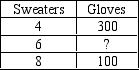 If the production possibilities frontier is bowed outward,then "?" could be
 (Multiple Choice)
4.8/5 (82)
(82) 
Filters
- Essay(0)
- Multiple Choice(0)
- Short Answer(0)
- True False(0)
- Matching(0)