



 Chat with AI
Exam 2: Thinking Like an Economist

Exam 1: Ten Principles of Economics281 Questions
Exam 2: Thinking Like an Economist451 Questions
Exam 3: Interdependence and the Gains From Trade353 Questions
Exam 4: The Market Forces of Supply and Demand467 Questions
Exam 5: Elasticity and Its Application409 Questions
Exam 6: Supply, Demand, and Government Policies459 Questions
Exam 7: Consumers, Producers, and the Efficiency of Markets363 Questions
Exam 8: Application: The Costs of Taxation353 Questions
Exam 9: Application: International Trade333 Questions
Exam 10: Externalities352 Questions
Exam 11: Public Goods and Common Resources270 Questions
Exam 12: The Design of the Tax System397 Questions
Exam 13: The Costs of Production434 Questions
Exam 14: Firms in Competitive Markets381 Questions
Exam 15: Monopoly427 Questions
Exam 16: Monopolistic Competition416 Questions
Exam 17: Oligopoly325 Questions
Exam 18: The Markets for the Factors of Production361 Questions
Exam 19: Earnings and Discrimination335 Questions
Exam 20: Income Inequality and Poverty312 Questions
Exam 21: The Theory of Consumer Choice354 Questions
Exam 22: Frontiers of Microeconomics262 Questions
Exam 23: Measuring a Nations Income343 Questions
Exam 24: Measuring the Cost of Living358 Questions
Exam 25: Production and Growth335 Questions
Exam 26: Saving, investment, and the Financial System381 Questions
Exam 27: The Basic Tools of Finance336 Questions
Exam 28: Unemployment533 Questions
Exam 29: The Monetary System366 Questions
Exam 30: Money Growth and Inflation312 Questions
Exam 31: Open-Economy Macroeconomics: Basic Concepts346 Questions
Exam 32: A Macroeconomic Theory of the Open Economy300 Questions
Exam 33: Aggregate Demand and Aggregate Supply386 Questions
Exam 34: The Influence of Monetary and Fiscal Policy on Aggregate Demand334 Questions
Exam 35: The Short-Run Trade-Off Between Inflation and Unemployment306 Questions
Exam 36: Five Debates Over Macroeconomic Policy179 Questions
Select questions type


Since 1946,the president of the United States has received guidance from the Council of Economic Advisers.
(True/False)
4.8/5  (77)
(77) A survey of professional economists revealed that more than three-fourths of them agreed with fourteen economic propositions.Which of the following is not one of those propositions?
(Multiple Choice)
4.9/5 (81)
(81) Which of the following areas of study typifies microeconomics as opposed to macroeconomics?
(Multiple Choice)
4.9/5 (72)
(72) Points on the production possibilities frontier represent efficient levels of production.
(True/False)
4.9/5 (80)
(80) When studying the effects of changes in public policy,economists believe that
(Multiple Choice)
4.7/5 (81)
(81) Which of the following is a correct statement about production possibilities frontiers?
(Multiple Choice)
4.8/5 (75)
(75) Two variables that have a positive correlation move in the same direction.
(True/False)
4.9/5 (82)
(82) Figure 2-13  -Refer to Figure 2-13.The movement from point B to point C is a(n)
 (Multiple Choice)
4.8/5 (78)
(78) Figure 2-14  -Refer to Figure 2-14.Point B represents an inefficient outcome for this economy.
 (True/False)
4.9/5 (72)
(72) A macroeconomist - as opposed to a microeconomist - might study
(Multiple Choice)
4.8/5 (62)
(62) Just like models constructed in other areas of science,economic models
(Multiple Choice)
4.9/5 (83)
(83) Figure 2-8
Panel (a)Panel (b) 
 -Refer to Figure 2-8,Panel (a).The opportunity cost of one cup of coffee is highest when the economy produces
 (Multiple Choice)
4.9/5 (86)
(86) Figure 2-10 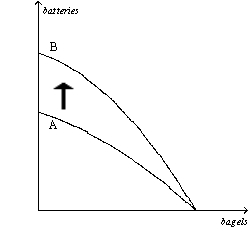 -Refer to Figure 2-10.The shift of the production possibilities frontier from A to B illustrates
 (Multiple Choice)
5.0/5 (94)
(94) When an economist evaluates a positive statement,he or she is primarily
(Multiple Choice)
4.9/5 (62)
(62) Figure 2-3  -Refer to Figure 2-3.Efficient production is represented by which point(s)?
 (Multiple Choice)
4.8/5 (80)
(80) 
Filters
- Essay(0)
- Multiple Choice(0)
- Short Answer(0)
- True False(0)
- Matching(0)