



 Chat with AI
Exam 23: Mass Spectrometry

Exam 1: The Analytical Process20 Questions
Exam 2: Chemical Measurements21 Questions
Exam 3: Tools of the Trade19 Questions
Exam 4: Experimental Error20 Questions
Exam 5: Statistics22 Questions
Exam 6: Quality Assurance and Calibration Methods20 Questions
Exam 7: Chemical Equilibrium20 Questions
Exam 8: Let the Titrations Begin20 Questions
Exam 9: Activity and the Systematic Treatment of Equilibrium20 Questions
Exam 10: Monoprotic Acid-Base Equilibria20 Questions
Exam 11: Polyprotic Acid-Base Equilibria20 Questions
Exam 12: Acid-Base Titrations20 Questions
Exam 13: Edta Titrations20 Questions
Exam 14: Advanced Topics in Equilibrium20 Questions
Exam 15: Fundamentals of Electrochemistry20 Questions
Exam 16: Electrodes and Potentiometry20 Questions
Exam 17: Redox Titrations20 Questions
Exam 18: Electroanalytical Techniques20 Questions
Exam 19: Fundamentals of Spectrophotometry23 Questions
Exam 20: Applications of Spectrophotometry20 Questions
Exam 21: Spectrophotometers20 Questions
Exam 22: Atomic Spectroscopy20 Questions
Exam 23: Mass Spectrometry20 Questions
Exam 24: Introduction to Analytical Separations20 Questions
Exam 25: Gas Chromatography20 Questions
Exam 26: High-Performance Liquid Chromatography20 Questions
Exam 27: Chromatographic Methods and Capillary Electrophoresis20 Questions
Exam 28: Gravimetric and Combustion Analysis20 Questions
Exam 29: Sample Preparation19 Questions
Select questions type


Which is NOT a chromatography-mass spectrometry interface?

Free
(Multiple Choice)
4.8/5  (77)
(77) Correct Answer: Verified
C
The molecular ion peak for a compound is 180 Da.The number of nitrogen atoms in the compound can be:
Free
(Multiple Choice)
4.8/5 (78)
(78) Correct Answer:Verified
VerifiedE
Which statements are true for the various ion selection techniques?
I Time-of-flight MS - Ions expelled from the source all have the same kinetic energy.For ions of different masses but equivalent kinetic energies,the lighter ions travel faster than heavier ions,separating the ions.
II Quadrupole MS - A constant voltage and a radio-frequency oscillating voltage is applied to the four metal rods.The electric field deflects ions in complex trajectories as the ions migrate from source to detector,allowing only one particular m/z to reach the detector.
III Three-dimensional quadrupole ion-trap MS - A constant-frequency radio-frequency voltage is applied to the central ring electrode causes ions to circulate in stable,three-dimensional orbits in the cavity,with the lowest m/z in the outermost orbits.Increasing the amplitude of the radio-frequency voltage destabilizes m/z ion orbits one value at a time.
IV Magnetic sector MS - Ions are accelerated into the magnetic sector with equivalent kinetic energies.Ions are selected by passing through a magnetic field;lighter ions are deflected the most and the heavier ions are deflected the least.The magnetic field is varied to select individual m/z.
Free
(Multiple Choice)
4.9/5 (83)
(83) Correct Answer:Verified
VerifiedB
When identifying the molecular ion peak,  ,all of the following must be kept in mind,except:
 (Multiple Choice)
4.8/5 (68)
(68) Calculate the number of rings and double bonds for the chemical formula C25H32N2O3.
(Short Answer)
4.9/5 (73)
(73) Calculate the number of rings and bonds for the chemical formula C23H28N2O5S2.
(Short Answer)
4.9/5 (82)
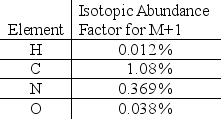
(82) The mass spectrum of an unknown compound has a molecular ion peak at 194 m/z.The proposed chemical formula for the compound is C8H10N4O2.The M+1 peak has a relative abundance of 10.1%.Does the intensity of the M+1 peak support the proposed chemical formula?
(Essay)
4.9/5 (74)
(74) Calculate the resolving power for m/z = 283.980 if the width of half height is 0.076 m/z.
(Short Answer)
4.7/5 (81)
(81) The resolving power for a mass spectrometer can be calculated using the equations 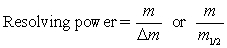 Which of the following statements are NOT true regarding resolving power?
I m is the larger value of m/z
II m is the difference between the two m/z peaks
III m1/2 is the width of the peak at half maximum height
IV m is the smaller value of m/z
V m1/2 is the average mass for the two peaks
Which of the following statements are NOT true regarding resolving power?
I m is the larger value of m/z
II m is the difference between the two m/z peaks
III m1/2 is the width of the peak at half maximum height
IV m is the smaller value of m/z
V m1/2 is the average mass for the two peaks (Multiple Choice)
4.8/5 (84)
(84) Analytes must be ionized prior to entering the mass filter in a mass spectrometer.Electron ionization and chemical ionization are two ionization techniques.Which of the following statements are INCORRECT regarding either technique?
I Electron ionization uses an electron beam to create molecular ions,M+.
II Chemical ionization uses an electron beam to ionize reagent gas.
III Electron ionization gives very little fragmentation of the molecular ion.
IV The ionized reagent gas in chemical ionization undergoes a complex set of chemical reactions before protonating the analyte to create MH+.
V Both ionization techniques give identical mass spectra.
(Multiple Choice)
4.9/5 (75)
(75) How many rings and double bonds are there for the compound C11H7NO2Cl2?
(Multiple Choice)
5.0/5 (88)
(88) Ion mobility spectrometry________________________________________and____________________ .
(Multiple Choice)
4.9/5 (72)
(72) The three essential components of any mass spectrometer are:
I ion source.
II decelerator.
III detector.
IV mass separator.
V accelerator.
(Multiple Choice)
4.8/5 (84)
(84) Which is true for mass spectrometry of proteins?
I MALDI and electrospray are major methods for introducing proteins into the gas phase.
II The equation 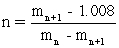 is used to determine the number of H+ bound to a protein from the mass spectrum.
III Once n is known;the molecular mass of the protein is calculated,molecular mass = nmn.
IV Electron-transfer dissociation is a mass spectrometry technique to sequence proteins.
is used to determine the number of H+ bound to a protein from the mass spectrum.
III Once n is known;the molecular mass of the protein is calculated,molecular mass = nmn.
IV Electron-transfer dissociation is a mass spectrometry technique to sequence proteins. (Multiple Choice)
4.7/5 (80)
(80) Electrospray ionization is one of many techniques interfacing chromatography with mass spectroscopy.Which is NOT true for electrospray ionization?
(Multiple Choice)
4.8/5 (86)
(86) Calculate the resolving power for a mass spectrometer that successfully separates m/z 125.135 from 125.293.
(Short Answer)
4.9/5 (87)
(87) Analytes on the surface of an object can be sampled using an open-air sampling technique by vaporizing and ionizing the analyte directly from the surface under atmospheric conditions.Which of the following statements are true for these techniques?
I Direct analysis in real time generates excited He which produces protonated water clusters from distilled water.The water clusters protonate the analyte.
II Low-temperature plasma generates excited-state species in plasma,which ionizes the analyte.
III Desorption electrospray ionization directs micron-sized droplets of analyte-free solvent with electrospray,dissolving the analyte in the droplets.
IV All techniques dislodge analyte from the surface,collecting the ions for later mass spectrometer analysis.
(Multiple Choice)
4.7/5 (83)
(83) Which is true for using mass spectroscopy as a chromatography detector?
I Selected ion monitoring observes only one to four m/z to create a selected ion chromatogram.
II Extracted ion chromatogram records the entire mass spectrum for the compounds coming off the column,picking one m/z from the collected mass spectra to create the chromatogram.
III Reconstructed total ion chromatogram records the total ion current below a certain m/z to generate the chromatogram.
IV Selected reaction monitoring creates a chromatogram using a triple quadrupole mass spectrometer.Quadrupole 1 selects the precursor ion.In quadrupole 2,the precursor ion is fragmented through collisions with N2 or Ar gas.All fragment ions pass to quadrupole 3,which selects one ion fragment to monitor.
(Multiple Choice)
4.8/5 (72)
(72) 
Filters
- Essay(0)
- Multiple Choice(0)
- Short Answer(0)
- True False(0)
- Matching(0)