



 Chat with AI
Exam 22: Atomic Spectroscopy

Exam 1: The Analytical Process20 Questions
Exam 2: Chemical Measurements21 Questions
Exam 3: Tools of the Trade19 Questions
Exam 4: Experimental Error20 Questions
Exam 5: Statistics22 Questions
Exam 6: Quality Assurance and Calibration Methods20 Questions
Exam 7: Chemical Equilibrium20 Questions
Exam 8: Let the Titrations Begin20 Questions
Exam 9: Activity and the Systematic Treatment of Equilibrium20 Questions
Exam 10: Monoprotic Acid-Base Equilibria20 Questions
Exam 11: Polyprotic Acid-Base Equilibria20 Questions
Exam 12: Acid-Base Titrations20 Questions
Exam 13: Edta Titrations20 Questions
Exam 14: Advanced Topics in Equilibrium20 Questions
Exam 15: Fundamentals of Electrochemistry20 Questions
Exam 16: Electrodes and Potentiometry20 Questions
Exam 17: Redox Titrations20 Questions
Exam 18: Electroanalytical Techniques20 Questions
Exam 19: Fundamentals of Spectrophotometry23 Questions
Exam 20: Applications of Spectrophotometry20 Questions
Exam 21: Spectrophotometers20 Questions
Exam 22: Atomic Spectroscopy20 Questions
Exam 23: Mass Spectrometry20 Questions
Exam 24: Introduction to Analytical Separations20 Questions
Exam 25: Gas Chromatography20 Questions
Exam 26: High-Performance Liquid Chromatography20 Questions
Exam 27: Chromatographic Methods and Capillary Electrophoresis20 Questions
Exam 28: Gravimetric and Combustion Analysis20 Questions
Exam 29: Sample Preparation19 Questions
Select questions type


Graphite furnace employs temperature programming to produce elemental vapor.The program begins by raising the furnace temperature to initiate____________________ ,where water is removed from the sample.Next,the temperature of the furnace is then raised to begin the____________________ process,where organic material is removed.The temperature of the furnace is raised again to____________________ the sample,creating the elemental vapor required for spectroscopy.

Free
(Multiple Choice)
4.8/5  (81)
(81) Correct Answer: Verified
C
Which of the following statements are true regarding the effect of flame temperature on atomic absorbance and atomic emission spectroscopy?
I Varying the flame temperature by 10 K hardly affects the ground-state population of the analyte and would not noticeably affect the analyte signal in atomic absorption.
II Varying the flame temperature by 10 K hardly affects the excited-state population of the analyte and would not noticeably affect the analyte signal in atomic emission.
III Varying the flame temperature by 10 K affects the ground-state population of the analyte and will noticeably affect the analyte signal in atomic absorption.
IV Varying the flame temperature by 10 K affects the excited-state population of the analyte and will noticeably affect the analyte signal in atomic emission.
Free
(Multiple Choice)
4.7/5 (70)
(70) Correct Answer:Verified
VerifiedB
____________________ occurs for inductively coupled plasma-mass spectroscopy when the interfering species has the same mass-to-charge ratio as the analyte ion.
Free
(Multiple Choice)
4.8/5 (69)
(69) Correct Answer:Verified
VerifiedC
Which of the following statements are true for chemical interference?
I Releasing agents are added to the sample to reduce chemical interference.
II Chemical interference occurs when a component of the sample reduces the extent of atomization of the analyte.
III Higher temperature flames will reduce chemical interference.
IV Chemical interference occurs when a component of the sample emits light at or close to the same frequency as the analyte.
V Releasing agents will preferentially react with the analyte,protecting the analyte from components of the sample that will ionize the analyte.
(Multiple Choice)
4.9/5 (78)
(78) All of the following are background correction techniques for atomic spectroscopy,except:
(Multiple Choice)
4.9/5 (81)
(81) Which is NOT true of the flame atomic absorbance spectroscopy of iron?
(Multiple Choice)
4.7/5 (67)
(67) Fluctuations in flame temperature affect the reproducibility of atomic emission experiments more so than atomic absorbance experiments.Which of the following statements explain this phenomenon?
I As temperature increases there is an increase in emission intensity resulting from an increase in the excited state population;the apparent concentration is greater than the actual concentration.
II As temperature decreases there is a decrease in emission intensity resulting from an increase in the excited state population;the apparent concentration is greater than the actual concentration.
III As temperature increases there is a decrease in emission intensity resulting from a decrease in the excited state population;the apparent concentration is less than the actual concentration.
IV As temperature decreases there is a decrease in emission intensity resulting from a decrease in the excited state population;the apparent concentration is less than the actual concentration.
(Multiple Choice)
4.8/5 (82)
(82) Which of the following is(are)NOT true for ionization interference?
I Ionization interference can occur with alkali metals at relatively low temperature and for analyses for other elements at higher temperature.
II Ionization suppressors decrease the extent of ionization of analyte.
III Ionization suppressors are more easily ionized than the analyte,the large number of electrons produced prevent ionization of the analyte.
IV Ionization interference occurs when a component of the sample prevents ionization of the sample.
(Multiple Choice)
4.8/5 (69)
(69) Which of the following statements are true of atomic emission spectroscopy (AES)?
I Atoms are promoted to an excited state with a laser.
II Atoms are promoted to an excited state by gaining energy from collisions with other atoms or from the high thermal energy of the flame.
III The intensity of emitted light is proportional to analyte concentration.
IV Plasma often replaces flame in AES.
(Multiple Choice)
4.8/5 (84)
(84) Inductively coupled argon plasma does not suffer from many of the interferences encountered with flame atomic spectroscopy.Which of the statements below are NOT advantages of plasma over flame?
(Multiple Choice)
4.7/5 (67)
(67) Hollow-cathode lamps emit light with very sharp linewidths.Which mechanisms are responsible for broadening atomic emission line widths?
I pressure broadening
II ionization effect
III matrix effect
IV Doppler effect
(Multiple Choice)
4.9/5 (87)
(87) ____________________ is any effect that changes the signal while analyte concentration remains unchanged.
(Multiple Choice)
4.8/5 (77)
(77) Laser ablation is an inductively coupled plasma sampling technique.Which of the following is true for laser ablation?
I Laser ablation destroys the entire sample.
II A laser pulse is focused onto a small area,producing an explosion of atoms,electrons,and ions in the gas phase.
III Depth profiling of the sample is possible with repeated laser pulses probing deeper and deeper into the sample.
IV Nanogram amounts of material are ablated per pulse.
V Ablation products are swept to the plasma with H2 gas.
(Multiple Choice)
4.8/5 (78)
(78) There is no universal flame temperature for flame-based atomic spectroscopy that gives optimal results for all elements.________________________________________gives a____________________.
(Multiple Choice)
4.8/5 (73)
(73) All of the following are true for hollow-cathode tubes,except:
(Multiple Choice)
4.8/5 (72)
(72) To measure calcium in a breakfast cereal,0.6590 grams of crushed cereal were reacted for 1 hour in warm 1 M HNO3.The reaction mixture was filtered and the filtrate transferred to a 100 mL volumetric flask.A series of eight standards are prepared by transferring 5.00 mL aliquots to 50-mL volumetric flasks to which increasing volumes of standard Ca2+ (containing 20.0 g/mL)is added,diluting to the final volume with distilled deionized H2O.The samples were then analyzed by flame atomic absorption.Use the data and graph below to find the percent by mass calcium in the cereal.
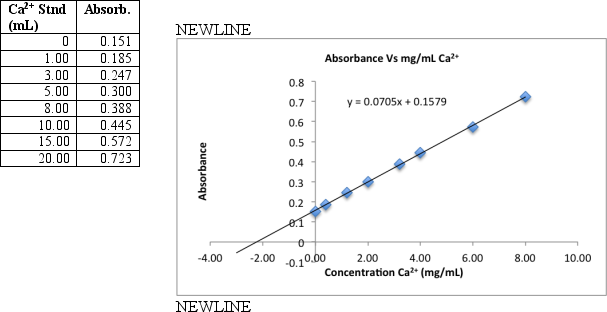
(Short Answer)
5.0/5 (86)
(86) The dynamic reaction cell reduces isobaric interference with thermodynamically favorable reactions that remove interfering species with the same mass-to-charge ratio.Which of the reactions does not remove interfering species for 52Cr+ or 56Fe2+?
(Multiple Choice)
4.8/5 (78)
(78) The energy difference between the ground and excited state and temperature has the following effect on the excited-state population: As the energy difference between the ground state and excited state decreases,the excited-state population________________________________________.As the temperature of the flame increases,the excited-state population____________________ .
(Multiple Choice)
4.9/5 (80)
(80) 
Filters
- Essay(0)
- Multiple Choice(0)
- Short Answer(0)
- True False(0)
- Matching(0)