



 Chat with AI
Exam 5: Statistics

Exam 1: The Analytical Process20 Questions
Exam 2: Chemical Measurements21 Questions
Exam 3: Tools of the Trade19 Questions
Exam 4: Experimental Error20 Questions
Exam 5: Statistics22 Questions
Exam 6: Quality Assurance and Calibration Methods20 Questions
Exam 7: Chemical Equilibrium20 Questions
Exam 8: Let the Titrations Begin20 Questions
Exam 9: Activity and the Systematic Treatment of Equilibrium20 Questions
Exam 10: Monoprotic Acid-Base Equilibria20 Questions
Exam 11: Polyprotic Acid-Base Equilibria20 Questions
Exam 12: Acid-Base Titrations20 Questions
Exam 13: Edta Titrations20 Questions
Exam 14: Advanced Topics in Equilibrium20 Questions
Exam 15: Fundamentals of Electrochemistry20 Questions
Exam 16: Electrodes and Potentiometry20 Questions
Exam 17: Redox Titrations20 Questions
Exam 18: Electroanalytical Techniques20 Questions
Exam 19: Fundamentals of Spectrophotometry23 Questions
Exam 20: Applications of Spectrophotometry20 Questions
Exam 21: Spectrophotometers20 Questions
Exam 22: Atomic Spectroscopy20 Questions
Exam 23: Mass Spectrometry20 Questions
Exam 24: Introduction to Analytical Separations20 Questions
Exam 25: Gas Chromatography20 Questions
Exam 26: High-Performance Liquid Chromatography20 Questions
Exam 27: Chromatographic Methods and Capillary Electrophoresis20 Questions
Exam 28: Gravimetric and Combustion Analysis20 Questions
Exam 29: Sample Preparation19 Questions
Select questions type


A biosensor was developed to measure aqueous arsenic concentration.To determine the accuracy of the sensor,the sensor was tested against a standard reference sample.The biosensor results agree with the standard reference sample when:

Free
(Multiple Choice)
4.8/5  (80)
(80) Correct Answer: Verified
B
The Gaussian distribution is characterized by the____________________ and the____________________.
Free
(Multiple Choice)
4.9/5 (101)
(101) Correct Answer:Verified
VerifiedC
The absorbance for a dye sample of unknown concentration is measured and the corrected absorbance is 0.5482.Calculate the concentration of the dye sample. 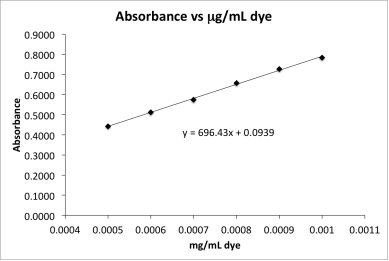
Free
(Multiple Choice)
4.9/5 (76)
(76) Correct Answer:Verified
VerifiedA
A pair of students standard a sodium hydroxide solution using KHP and obtain the following concentrations: 0.1028 M,0.1031 M,0.1200 M,0.1030 M and 0.1026 M.The students suspect that 0.1200 M is an outlier.Is 0.1200 M an outlier and what is the average concentration of the sodium hydroxide solution?
(Multiple Choice)
4.8/5 (78)
(78) The density of a solution is measured six times with the results of 1.098,1.100,1.089,1.095,1.097 and 1.101 g/mL.Calculate the 95% confidence interval for the density.
(Multiple Choice)
4.9/5 (81)
(81) Doubling the number of calibration curve data points decreases the standard uncertainty in the slope and y-intercept by a factor of:
(Multiple Choice)
4.9/5 (81)
(81) The molarity of a sodium hydroxide solution was determined by titration against KHP to be 0.1025 M,0.1087 M,0.1100 M,0.1052 M,and 0.0997 M for pooled class data.The TA suspects that 0.0997 M is an outlier.Can the TA throw out the data point? Show all work.
(Essay)
4.9/5 (79)
(79) The molarity of a sodium hydroxide solution was determined by titration against KHP to be 0.1025 M,0.1087 M,0.1100 M,0.0951 M,and 0.0997 M.Calculate the 95% confidence level for the molarity sodium hydroxide.
(Essay)
4.8/5 (79)
(79) For the statements below,which is(are)TRUE for confidence intervals?
I As the percentage confidence increases,the confidence interval range decreases.
II Confidence intervals are calculated using the calculated mean and standard deviation of a set of n measurements;and the results of the F test.
III The 95% confidence interval will include the true population mean for 95% of the sets of n measurements.
(Multiple Choice)
4.8/5 (86)
(86) A technician determines the concentration of calcium in milk using two instrumental methods.For method A,= 95.03 ppm,s = 0.40 (n = 8)and for method B,= 94.96 ppm,s = 0.72 (n = 6).Is the difference in standard deviation significant at the 95% confidence level? Show all work.
(Short Answer)
5.0/5 (74)
(74) The null hypothesis for the comparison of two means using the t test is:
(Multiple Choice)
4.9/5 (78)
(78) A technician determines the concentration of calcium in milk using two instrumental methods.If Fcalculated > Ftable for the two sets of calcium data,what conclusion(s)can the technician make?
I The difference in standard deviations for the two instrumental methods is significant.
II The difference in standard deviations for the two instrumental methods is not significant.
III The data comes from populations with the same standard deviation.
IV The data does not come from populations with the same standard deviation.
(Multiple Choice)
4.7/5 (82)
(82) A researcher has developed a new analytical method to determine the percent by mass iron in solids.To test the new method,the researcher purchases a standard reference material sample that is 2.85% iron by mass.Analysis of the iron standard returns values of 2.75%,2.89%,2.77%,2.81%,and 2.87%.Are the results of the new method significantly different from the standard reference sample?
(Essay)
4.9/5 (85)
(85) To determine if two methods result in statistically different results for calcium,a technician analyzes a calcium sample five times with each method.If the F test determines the standard deviations are significantly different,which set of equations must the technician use to calculate t.
(Multiple Choice)
4.8/5 (80)
(80) A technician determines the concentration of calcium in milk using two instrumental methods.If Fcalculated < Ftable for the two sets of calcium data,what conclusion(s)can the technician make?
I The difference in standard deviations for the two instrumental methods is significant.
II The difference in standard deviations for the two instrumental methods is not significant.
III The data comes from populations with the same standard deviation.
IV The data does not come from populations with the same standard deviation.
(Multiple Choice)
4.9/5 (83)
(83) The concentration and absorbance data below was collected for compound X.The least squares line for concentration versus absorbance is y = 6.83x + 0.0881.If a sample of compound X of unknown concentration has a corrected average absorbance of 0.6521 (three replicate measurements)calculate the concentration compound X and the uncertainty in the concentration.
 Concentration (mg/mL)
Absorbance
0.050
0.4426
0.075
0.5744
0.100
0.7841
Concentration (mg/mL)
Absorbance
0.050
0.4426
0.075
0.5744
0.100
0.7841 (Essay)
4.8/5 (77)
(77) Which of the statements below are TRUE regarding the mean and standard deviation?
I As the number of measurements increases,approaches if there is no random error.
II The square of the standard deviation is the average deviation.
III The mean is the center of the Gaussian distribution.
IV The standard deviation measures the width of the Gaussian distribution.
(Multiple Choice)
4.8/5 (93)
(93) A data point may be excluded when:
I Gcalculated is greater than Gtable.
II Gcalculated is less than Gtable.
III your TA or supervisor says to disregard the datum.
IV the datum is the result of a faulty procedure.
(Multiple Choice)
4.7/5 (92)
(92) Which of the following are true for the method of least squares?
I The method of least squares draws the "best" straight line through experimental data points.
II The equation for a straight line is y = bx + m.
III Deviations in y are minimized because the uncertainty in y is assumed to be greater than the uncertainty in x.
IV The slope and y-intercept are calculated using determinants.
(Multiple Choice)
4.7/5 (89)
(89) 
Filters
- Essay(0)
- Multiple Choice(0)
- Short Answer(0)
- True False(0)
- Matching(0)