



 Chat with AI
Exam 18: Electroanalytical Techniques

Exam 1: The Analytical Process20 Questions
Exam 2: Chemical Measurements21 Questions
Exam 3: Tools of the Trade19 Questions
Exam 4: Experimental Error20 Questions
Exam 5: Statistics22 Questions
Exam 6: Quality Assurance and Calibration Methods20 Questions
Exam 7: Chemical Equilibrium20 Questions
Exam 8: Let the Titrations Begin20 Questions
Exam 9: Activity and the Systematic Treatment of Equilibrium20 Questions
Exam 10: Monoprotic Acid-Base Equilibria20 Questions
Exam 11: Polyprotic Acid-Base Equilibria20 Questions
Exam 12: Acid-Base Titrations20 Questions
Exam 13: Edta Titrations20 Questions
Exam 14: Advanced Topics in Equilibrium20 Questions
Exam 15: Fundamentals of Electrochemistry20 Questions
Exam 16: Electrodes and Potentiometry20 Questions
Exam 17: Redox Titrations20 Questions
Exam 18: Electroanalytical Techniques20 Questions
Exam 19: Fundamentals of Spectrophotometry23 Questions
Exam 20: Applications of Spectrophotometry20 Questions
Exam 21: Spectrophotometers20 Questions
Exam 22: Atomic Spectroscopy20 Questions
Exam 23: Mass Spectrometry20 Questions
Exam 24: Introduction to Analytical Separations20 Questions
Exam 25: Gas Chromatography20 Questions
Exam 26: High-Performance Liquid Chromatography20 Questions
Exam 27: Chromatographic Methods and Capillary Electrophoresis20 Questions
Exam 28: Gravimetric and Combustion Analysis20 Questions
Exam 29: Sample Preparation19 Questions
Select questions type


The____________________ is the electrode at which the reaction of interest occurs.

Free
(Multiple Choice)
4.8/5  (82)
(82) Correct Answer: Verified
E
For a three-electrode cell the working electrode is the electrode at which the reaction of interest occurs.The____________________ is used to measure the potential of the working electrode and the____________________ is the current-supporting partner of the working electrode.
Free
(Multiple Choice)
4.8/5 (79)
(79) Correct Answer:Verified
VerifiedB
Which is NOT true of electrogravimetric analysis?
Free
(Multiple Choice)
4.8/5 (76)
(76) Correct Answer:Verified
VerifiedE
Which statement(s)is(are)defined INCORRECTLY?
I Ohmic potential is the voltage to overcome the electrical resistance of the solution in an electrochemical cell when a current is flowing.
II Concentrational polarization occurs when the concentrations of the reactants or products at the surface of an electrode is greater than those in the bulk solution.
III Overpotential is the voltage required to overcome the activation energy for a reaction at only the cathode.
IV E = E(cathode)- E(anode)- IR - overpotentials - concentration polarization
(Multiple Choice)
4.9/5 (91)
(91) Which is NOT true for square wave voltammetry,stripping analysis,and cyclic voltammetry?
(Multiple Choice)
4.9/5 (77)
(77) Which of the following statement(s)is(are)TRUE for coulometry?
I Coulometric methods count electrons used in a chemical reaction to measure analyte.
II Coulometry employs either constant-current or constant-potential conditions.
III An advantage of coulometric methods is high precision and a disadvantage is low sensitivity.
IV Coulometric titrations are constant-potential methods.
V Constant-potential methods utilizing a three-electrode cell are more selective than constant-current methods.
(Multiple Choice)
4.9/5 (87)
(87) Electrolysis of 200 mL of a solution of an unknown metal increased the cathode mass by 0.0434 grams when a current of 0.50 A passed through the cell for 5 minutes.Further research determined the charge on the metal to be +2.What is the identity of the metal?
(Multiple Choice)
4.7/5 (72)
(72) ____________________ is a set of techniques that observes the relationship between current and voltage during an electrochemical process.
(Multiple Choice)
4.9/5 (80)
(80) Sodium sulfate cells generate hydrogen and oxygen gas when a current is passed through the cell.For the following data,calculate the potential required for the cell to generate partial pressures of 0.25 atm for oxygen and 0.50 atm for hydrogen.At the cathode surface the pH is 10 and at the anode surface the pH is 4.A current of 0.32 amps passes through the solution,which has a resistance of 3 .The overpotentials for the anode and cathode are 0.580 V and 0.584 V respectively.
O2 + 4 H+ + 4 e- ⇋ 2 H2O Eo = 1.2291 V
2 H2O + 2 e- ⇋ H2 + 2 OH- Eo = -0.8280 V
(Short Answer)
4.7/5 (80)
(80) A technician is tasked with testing the newly purchased chloride autotitrator.He prepares a solution that is 3.4238 mg NaCl/mL solution,taking a 25.00 mL aliquot for titration.To minimize any problems with the in situ generation of silver cation titrant,a fresh silver anode is installed and the instrument is set to titrate with a constant current of 500.0 mA.The instrument took 286.3 seconds to reach the end point.Calculate the percent error for the instrument.
(Essay)
4.8/5 (83)
(83) Molecules have three ways to reach the surface of an electrode: diffusion,convection,and migration.The rotating disk electrode uses which of these three methods to control the flux of analyte that reaches the electrode?
(Multiple Choice)
4.9/5 (78)
(78) During electrolysis,electrons flow from the____________________ terminal of the power supply into the____________________of the electrolysis cell.Electrons flow from the____________________ into the____________________ terminal of the power supply to complete the circuit.
(Multiple Choice)
4.7/5 (86)
(86) When a potential is applied to a solution that is 0.10 M Ni2+ and 0.20 M Fe2+,which metal will be reduced first and at what potential? Is it possible to remove the metal from solution with 99.99% efficiency before the second metal begins to be reduced from solution?
Ni2+ + 2 e- ⇋ Ni,Eo = -0.236 V
Fe2+ + 2 e- ⇋ Fe,Eo = -0.44 V
(Essay)
4.8/5 (66)
(66) Sulfide in a water sample is titrated with electrolytically generated Fe2+.If a 10.00 mL aliquot of the water sample requires a current of 0.75 A for 5.4 minutes to reach the end point,what is the molarity sulfide in the water sample?
(Short Answer)
4.8/5 (79)
(79) ____________________ measures the electric current flowing between a pair of electrodes driving an electrolysis reaction.The amount of current is proportional to the concentration of the analyte.
(Multiple Choice)
4.9/5 (86)
(86) A current of 0.500 A flows through a cell containing Fe2+ for 10.0 minutes.Calculate the maximum moles of Fe that can be removed from solution? Assume constant current over time.
(Multiple Choice)
4.9/5 (73)
(73) The Karl Fischer titration measures the traces of water in samples such as transformer oils,foods,polymers,and so forth.Which of the following is NOT true for the chemistry involved?
I The anode solution contains iodide;an alcohol,ROH;a base,B;sulfur dioxide;and possibly other organic compounds.
II ROH + SO2 + B → BH+ +  III I2 is generated from I− at the cathode.
IV H2O + I2 +
 + 2 B →
 + 2 BH+I-
V Two moles of e− corresponds to one mole H2O
III I2 is generated from I− at the cathode.
IV H2O + I2 + + 2 B → + 2 BH+I-
V Two moles of e− corresponds to one mole H2O (Multiple Choice)
4.8/5 (85)
(85) An experiment measured the cathodic current for five solutions of known  concentration using cyclic voltammetry.The collected data are plotted and the best line fit applied.If an unknown ferricyanide solution has a cathodic current of 17.38 A,calculate the concentration ferricyanide in the unknown.
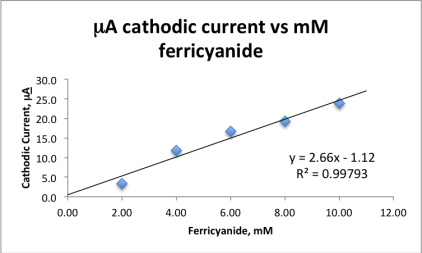
concentration using cyclic voltammetry.The collected data are plotted and the best line fit applied.If an unknown ferricyanide solution has a cathodic current of 17.38 A,calculate the concentration ferricyanide in the unknown. (Short Answer)
4.8/5 (79)
(79) Which are true for polarography?
I Polarography is amperometry conducted with a dropping Hg electrode.
II The diffusion current in the plateau region of the polarographic wave is proportional to the concentration of the analyte and is used for quantitative analysis.
III The half-wave potential for maximum current is characteristic of a given analyte in a given medium and can be used for qualitative analysis for the analyte.
IV Fresh Hg drops give reproducible results.
V Polarography is used to primarily to study oxidations Hg may reduce when studying reductions.
(Multiple Choice)
4.8/5 (75)
(75) 
Filters
- Essay(0)
- Multiple Choice(0)
- Short Answer(0)
- True False(0)
- Matching(0)