



 Chat with AI
Exam 13: Chemical Kinetics

Exam 1: Units of Measurement for Physical and Chemical Change179 Questions
Exam 2: Atoms and Elements167 Questions
Exam 3: Molecules, Compounds, and Nomenclature178 Questions
Exam 4: Chemical Reactions and Stoichiometry230 Questions
Exam 5: Gases154 Questions
Exam 6: Thermochemistry156 Questions
Exam 7: The Quantum-Mechanical Model of the Atom173 Questions
Exam 8: Periodic Properties of the Elements127 Questions
Exam 9: Chemical Bonding I: Lewis Theory143 Questions
Exam 10: Chemical Bonding Ii: Molecular Shapes, Valence Bond Theory, and Molecular Orbital Theory168 Questions
Exam 11: Liquids, Solids, and Intermolecular Forces132 Questions
Exam 12: Solutions159 Questions
Exam 13: Chemical Kinetics162 Questions
Exam 14: Chemical Equilibrium123 Questions
Exam 15: Acids and Bases148 Questions
Exam 16: Aqueous Ionic Equilibrium161 Questions
Exam 17: Gibbs Energy and Thermodynamics111 Questions
Exam 18: Electrochemistry126 Questions
Exam 19: Radioactivity and Nuclear Chemistry115 Questions
Exam 20: Organic Chemistry I: Structures109 Questions
Exam 21: Organic Chemistry II: Reactions96 Questions
Exam 22: Biochemistry55 Questions
Exam 23: Chemistry of the Nonmetals50 Questions
Exam 24: Metals and Metallury49 Questions
Exam 25: Transition Metals and Coordination Compounds55 Questions
Select questions type


The first-order decomposition of cyclopropane has a rate constant of 6.7 × 10⁻⁴ s-1. If the initial concentration of cyclopropane is 1.33 mol L-1, what is the concentration of cyclopropane after 644 s?
(Multiple Choice)
4.9/5  (67)
(67) Calculate the frequency factor, A, for a reaction with a rate constant of 7834 s-1 and an activation energy, Ea, of 68.4 kJ mol-1 at 305 K.
(Multiple Choice)
4.8/5 (84)
(84) If a reaction carried out at 61 ◦C has an activation energy, Ea, of 67.3 kJ mol-1, a rate constant of 791 s-1, and a frequency factor, A, of 2.65 × 10¹³, what is the value of R? k = A 
(Multiple Choice)
4.7/5 (88)
(88) How many half-lives are required for the concentration of reactant to decrease to 25% of its original value?
(Multiple Choice)
4.7/5 (77)
(77) Hydrogen iodide decomposes at 800 K via a second-order process to produce hydrogen and iodine according to the following chemical equation: 2HI(g)→ H2(g)+ I2(g)
At 800 K it takes 142 seconds for the initial concentration of HI to decrease from 6.75 × 10⁻² mol L-1 to 3.50 × 10⁻² mol L-1. What is the rate constant for the reaction at this temperature?
(Multiple Choice)
4.8/5 (82)
(82) Given the following rate law, how does the rate of reaction change if the concentration of Y is doubled? Rate = k [X][Y]2
(Multiple Choice)
4.8/5 (83)
(83) Calculate the activation energy, Ea, for a reaction with a frequency factor, A, of 9.3 × 10¹⁰ s-1 and a rate constant of 1.06 × 10³ s-1 at 273 K.
(Multiple Choice)
4.8/5 (82)
(82) For a reaction that follows the general rate law, Rate = k[A][B]2, what will happen to the rate of reaction if the concentration of A is increased by a factor of 5.00?
(Multiple Choice)
4.9/5 (65)
(65) The decomposition of dinitrogen pentoxide is described by the chemical equation 2N2O5(g)→ 4NO2(g)+ O2(g).
If the rate of disappearance of N2O5 is equal to 1.60 mol min-1 at a particular moment, what is the rate of appearance of NO2 at that moment?
(Multiple Choice)
4.9/5 (80)
(80) Given the following balanced equation, determine the rate of reaction with respect to [O2]. 2SO2(g)+ O2(g)→ 2SO3(g)
(Multiple Choice)
5.0/5 (84)
(84) Without performing complex calculations, determine the order of a reaction that has the following initial rates for the specified starting concentration: 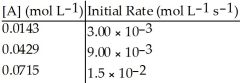
(Multiple Choice)
4.8/5 (77)
(77) What is the activation energy for a reaction that has a rate constant of 5.68 × 10⁻⁸ s-1 at 298 K and 1.73 × 10⁻⁵ s-1 at 348 K?
(Multiple Choice)
4.9/5 (89)
(89) Which of the following represents the equation for a first-order half-life?
(Multiple Choice)
4.8/5 (69)
(69) What is the difference between average reaction rate and instantaneous reaction rate?
(Essay)
5.0/5 (80)
(80) What are the units of k in the following rate law? Rate = k[X]2
(Multiple Choice)
4.8/5 (101)
(101) The second-order decomposition of NO2 has a rate constant of 0.255 L mol-1 s-1. How much NO2 decomposes in 4.00 s if the initial concentration of NO2 (1.00 L volume)is 1.33 mol L-1?
(Multiple Choice)
4.7/5 (85)
(85) A reaction is found to have an activation energy of 38.0 kJ mol-1. If the rate constant for this reaction is 1.60 × 10² L mol-1 s-1 at 249 K, what is the rate constant at 436 K?
(Multiple Choice)
4.9/5 (68)
(68) Is the activation energy for a forward reaction the same as the activation energy for the reverse of the same reaction? Use a sketch of a reaction energy diagram.
(Essay)
4.8/5 (86)
(86) 
Filters
- Essay(0)
- Multiple Choice(0)
- Short Answer(0)
- True False(0)
- Matching(0)