



 Chat with AI
Exam 13: Chemical Kinetics

Exam 1: Units of Measurement for Physical and Chemical Change179 Questions
Exam 2: Atoms and Elements167 Questions
Exam 3: Molecules, Compounds, and Nomenclature178 Questions
Exam 4: Chemical Reactions and Stoichiometry230 Questions
Exam 5: Gases154 Questions
Exam 6: Thermochemistry156 Questions
Exam 7: The Quantum-Mechanical Model of the Atom173 Questions
Exam 8: Periodic Properties of the Elements127 Questions
Exam 9: Chemical Bonding I: Lewis Theory143 Questions
Exam 10: Chemical Bonding Ii: Molecular Shapes, Valence Bond Theory, and Molecular Orbital Theory168 Questions
Exam 11: Liquids, Solids, and Intermolecular Forces132 Questions
Exam 12: Solutions159 Questions
Exam 13: Chemical Kinetics162 Questions
Exam 14: Chemical Equilibrium123 Questions
Exam 15: Acids and Bases148 Questions
Exam 16: Aqueous Ionic Equilibrium161 Questions
Exam 17: Gibbs Energy and Thermodynamics111 Questions
Exam 18: Electrochemistry126 Questions
Exam 19: Radioactivity and Nuclear Chemistry115 Questions
Exam 20: Organic Chemistry I: Structures109 Questions
Exam 21: Organic Chemistry II: Reactions96 Questions
Exam 22: Biochemistry55 Questions
Exam 23: Chemistry of the Nonmetals50 Questions
Exam 24: Metals and Metallury49 Questions
Exam 25: Transition Metals and Coordination Compounds55 Questions
Select questions type


The rate constant for a zero-order reaction is 0.54 L mol-1 s-1. What is the half-life of this reaction if the initial concentration is 0.27 mol L-1?
(Multiple Choice)
4.9/5  (69)
(69) Given the following balanced equation, determine the rate of reaction with respect to [NH3]. N2(g)+ 3H2(g)→ 2NH3(g)
(Multiple Choice)
4.9/5 (86)
(86) Given the following balanced equation, determine the rate of reaction with respect to [H2]. N2(g)+ 3H2(g)→ 2NH3(g)
(Multiple Choice)
5.0/5 (80)
(80) The elementary reaction 2NO2(g)→ 2NO(g)+ O2(g)
Is second order in NO2 and the rate constant at 501 K is 7.93 × 10⁻³ L mol-1 s-1. The reaction half-life at this temperature when [NO2]0 = 0.45 mol L-1 is ________ s.
(Multiple Choice)
4.7/5 (77)
(77) The first-order reaction, SO2Cl2 → SO2 + Cl2, has a half-life of 8.75 hours at 593 K. How long will it take for the concentration of SO2Cl2 to fall to 16.5% of its initial value?
(Multiple Choice)
4.7/5 (92)
(92) Calculate the activation energy, Ea, for a reaction with a frequency factor, A, of 8.12 × 10⁹ s-1 and a rate constant of 3.05 × 10⁴ s-1 at 375 K.
(Multiple Choice)
4.9/5 (75)
(75) In aqueous solution, hypobromite ion, BrO-, reacts to produce bromate ion, BrO3-, and bromide ion, Br-, according to the following chemical equation: 3BrO-(aq)→ BrO3-(aq)+ 2BR-(aq)
A plot of 1/[BrO-] vs. time is linear and the slope is equal to 0.056 L mol-1 s-1. If the initial concentration of BrO- is 0.80 mol L-1, how long will it take one-half of the BrO- ion to react?
(Multiple Choice)
4.7/5 (105)
(105) Without performing complex calculations, determine the order of a reaction that has the following initial rates for the specified starting concentration: 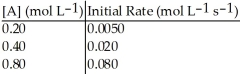
(Multiple Choice)
4.9/5 (94)
(94) Which of the following reactions would you predict to have the largest orientation factor?
(Multiple Choice)
4.8/5 (92)
(92) A reaction with an activation energy of 65.4 kJ mol-1 has a rate constant of 1.15 s-1 at 354 K. At what temperature will the rate constant be double?
(Multiple Choice)
4.9/5 (85)
(85) Write a balanced reaction for which the following rate relationships are true. Rate = 
 =
 = -


= = - (Multiple Choice)
4.9/5 (81)
(81) The rate constant for a first-order reaction is 0.54 L mol-1 s-1. What is the half-life of this reaction if the initial concentration is 0.27 mol L-1?
(Multiple Choice)
4.8/5 (70)
(70) What data should be plotted to show that experimental concentration data fit a first-order reaction?
(Multiple Choice)
4.7/5 (72)
(72) The first-order reaction, SO2Cl2 → SO2 + Cl2, has a rate constant equal to 2.20 × 10⁻⁵ s-1 at 593 K. What percentage of the initial amount of SO2Cl2 will remain after 6.00 hours?
(Multiple Choice)
4.8/5 (86)
(86) The rate of disappearance of HBr in the gas phase reaction 2HBr(g)→ H2 (g)+ Br2 (g)
Is 0.130 mol L-1 s-1 at 150 °C. The rate of reaction is ________ mol L-1 s-1.
(Multiple Choice)
4.8/5 (73)
(73) Without performing complex calculations, determine the order of a reaction that has the following initial rates for the specified starting concentration: 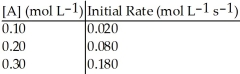
(Multiple Choice)
4.9/5 (90)
(90) Given the following balanced equation, determine the rate of reaction with respect to [SO2]. 2SO2(g)+ O2(g)→ 2SO3(g)
(Multiple Choice)
4.7/5 (83)
(83) 
Filters
- Essay(0)
- Multiple Choice(0)
- Short Answer(0)
- True False(0)
- Matching(0)