



 Chat with AI
Exam 22: Biochemistry

Exam 1: Units of Measurement for Physical and Chemical Change179 Questions
Exam 2: Atoms and Elements167 Questions
Exam 3: Molecules, Compounds, and Nomenclature178 Questions
Exam 4: Chemical Reactions and Stoichiometry230 Questions
Exam 5: Gases154 Questions
Exam 6: Thermochemistry156 Questions
Exam 7: The Quantum-Mechanical Model of the Atom173 Questions
Exam 8: Periodic Properties of the Elements127 Questions
Exam 9: Chemical Bonding I: Lewis Theory143 Questions
Exam 10: Chemical Bonding Ii: Molecular Shapes, Valence Bond Theory, and Molecular Orbital Theory168 Questions
Exam 11: Liquids, Solids, and Intermolecular Forces132 Questions
Exam 12: Solutions159 Questions
Exam 13: Chemical Kinetics162 Questions
Exam 14: Chemical Equilibrium123 Questions
Exam 15: Acids and Bases148 Questions
Exam 16: Aqueous Ionic Equilibrium161 Questions
Exam 17: Gibbs Energy and Thermodynamics111 Questions
Exam 18: Electrochemistry126 Questions
Exam 19: Radioactivity and Nuclear Chemistry115 Questions
Exam 20: Organic Chemistry I: Structures109 Questions
Exam 21: Organic Chemistry II: Reactions96 Questions
Exam 22: Biochemistry55 Questions
Exam 23: Chemistry of the Nonmetals50 Questions
Exam 24: Metals and Metallury49 Questions
Exam 25: Transition Metals and Coordination Compounds55 Questions
Select questions type


What type of lipid is the following compound? 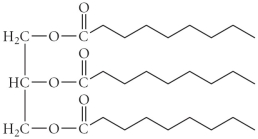

Free
(Multiple Choice)
4.9/5  (86)
(86) Correct Answer: Verified
E
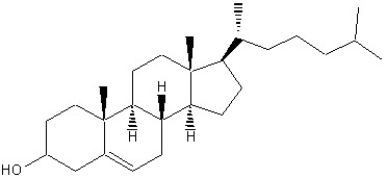
What type of lipid is the following compound? 
Free
(Multiple Choice)
4.8/5 (78)
(78) Correct Answer:Verified
VerifiedD
What is the difference between an a-glycosidic linkage and a b-glycosidic linkage? What implication does this have for the strength of the intermolecular forces between molecules?
(Essay)
4.9/5 (85)
(85) Which one of the following amino acids contains a polar side chain?
(Multiple Choice)
5.0/5 (80)
(80) Which of the following form between glycerol and fatty acids to form triglycerides?
(Multiple Choice)
4.7/5 (85)
(85) In the sequence His-Tyr-Val-Pro, which amino acid contains the N-terminal group?
(Multiple Choice)
4.8/5 (83)
(83) The following is part of a DNA sequence. What is its complementary sequence? AGTTCGAGCCT
(Multiple Choice)
4.8/5 (86)
(86) 
Which one of the following amino acids contains a hydrophobic side chain?
(Multiple Choice)
4.9/5 (87)
(87) Which of the following shows all of the tripeptides that can be formed from one molecule each of lysine (Lys), threonine (Thr), and histidine (His)?
(Multiple Choice)
4.8/5 (86)
(86) Which of the following fatty acids is most likely to be a solid at room temperature?
(Multiple Choice)
4.8/5 (75)
(75) Why does the melting point of fatty acids decrease with the number of double bonds present?
(Essay)
4.8/5 (81)
(81) 
Filters
- Essay(0)
- Multiple Choice(0)
- Short Answer(0)
- True False(0)
- Matching(0)