



 Chat with AI
Exam 5: Gases

Exam 1: Units of Measurement for Physical and Chemical Change179 Questions
Exam 2: Atoms and Elements167 Questions
Exam 3: Molecules, Compounds, and Nomenclature178 Questions
Exam 4: Chemical Reactions and Stoichiometry230 Questions
Exam 5: Gases154 Questions
Exam 6: Thermochemistry156 Questions
Exam 7: The Quantum-Mechanical Model of the Atom173 Questions
Exam 8: Periodic Properties of the Elements127 Questions
Exam 9: Chemical Bonding I: Lewis Theory143 Questions
Exam 10: Chemical Bonding Ii: Molecular Shapes, Valence Bond Theory, and Molecular Orbital Theory168 Questions
Exam 11: Liquids, Solids, and Intermolecular Forces132 Questions
Exam 12: Solutions159 Questions
Exam 13: Chemical Kinetics162 Questions
Exam 14: Chemical Equilibrium123 Questions
Exam 15: Acids and Bases148 Questions
Exam 16: Aqueous Ionic Equilibrium161 Questions
Exam 17: Gibbs Energy and Thermodynamics111 Questions
Exam 18: Electrochemistry126 Questions
Exam 19: Radioactivity and Nuclear Chemistry115 Questions
Exam 20: Organic Chemistry I: Structures109 Questions
Exam 21: Organic Chemistry II: Reactions96 Questions
Exam 22: Biochemistry55 Questions
Exam 23: Chemistry of the Nonmetals50 Questions
Exam 24: Metals and Metallury49 Questions
Exam 25: Transition Metals and Coordination Compounds55 Questions
Select questions type


A compound is found to be 30.45% N and 69.55 % O by mass. If 1.63 g of this compound occupy 389 mL at 0.00 °C and 1.0332 bar, what is the molecular formula of the compound?

Free
(Multiple Choice)
4.7/5  (74)
(74) Correct Answer: Verified
E
Determine the volume of O2 (at STP)formed when 50.0 g of KClO3 decomposes according to the following reaction. The molar mass for KClO3 is 122.55 g mol-1. 2KClO3(s)→ 2KCl(s)+ 3O2(g)
Free
(Multiple Choice)
4.8/5 (70)
(70) Correct Answer:Verified
VerifiedD
How many moles of molecular oxygen are required to produce a pressure of 0.413 bar in a 650 mL container with a temperature of 245 K?
Free
(Multiple Choice)
4.7/5 (81)
(81) Correct Answer:Verified
VerifiedA
The volume of a gas is proportional to the temperature of a gas. What is this known as?
(Multiple Choice)
4.8/5 (86)
(86) If a sample of 0.29 moles of Ar occupies 3.8 L under certain conditions, what volume will 0.66 moles occupy under the same conditions?
(Multiple Choice)
4.8/5 (74)
(74) A gas occupies 3.33 L at 2.23 bar. What is the volume at 2.50 bar?
(Multiple Choice)
4.7/5 (85)
(85) Determine the theoretical yield and the percent yield if 21.8 g of K2CO3 is produced from reacting 27.9 g KO2 with 29.0 L of CO2 (at STP). The molar mass of KO2 is 71.10 g mol-1 and K2CO3 is 138.21 g mol-1. 4KO2(s)+ 2CO2(g)→ 2K2CO3(s)+ 3O2(g)
(Multiple Choice)
4.9/5 (83)
(83) The density of a gas is 1.146 g L-1 at STP. What is the gas?
(Multiple Choice)
4.8/5 (71)
(71) A syringe initially holds a sample of gas with a volume of 285 mL at 355 K and 1.88 bar. To what temperature must the gas in the syringe be heated/cooled to have a volume of 435 mL at 2.50 bar?
(Multiple Choice)
4.8/5 (79)
(79) A 0.465 g sample of an unknown compound occupies 245 mL at 298 K and 1.24 bar. What is the molar mass of the unknown compound?
(Multiple Choice)
4.9/5 (82)
(82) A gas mixture consists of N2, O2, and Ne, where the mole fraction of N2 is 0.55 and the mole fraction of Ne is 0.25. If the mixture is at STP in a 5.0 L container, how many molecules of O2 are present?
(Multiple Choice)
4.8/5 (81)
(81) Which of the gases in the graph below has the smallest molar mass? 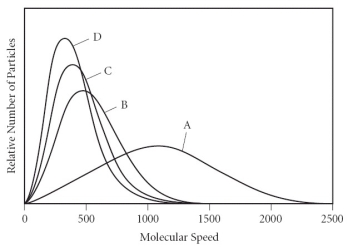
(Multiple Choice)
4.8/5 (79)
(79) A mixture of 10.0 g of Ne and 10.0 g Ar have a total pressure of 1.6 bar. What is the partial pressure of Ne?
(Multiple Choice)
5.0/5 (76)
(76) Which of the following compounds will behave LEAST like an ideal gas at low temperatures?
(Multiple Choice)
4.9/5 (87)
(87) An unknown ideal gas was added to an evacuated 775 mL container at a temperature of 267.2 K. If 0.381 moles were added, what is the final pressure?
(Multiple Choice)
4.7/5 (87)
(87) 
Filters
- Essay(0)
- Multiple Choice(0)
- Short Answer(0)
- True False(0)
- Matching(0)