



 Chat with AI
Exam 8: Application: The Costs of Taxation

Exam 1: Ten Principles of Economics347 Questions
Exam 2: Thinking Like an Economist535 Questions
Exam 3: Interdependence and the Gains From Trade442 Questions
Exam 4: The Market Forces of Supply and Demand569 Questions
Exam 5: Elasticity and Its Application503 Questions
Exam 6: Supply, Demand, and Government Policies556 Questions
Exam 7: Consumers, Producers, and the Efficiency of Markets460 Questions
Exam 8: Application: The Costs of Taxation422 Questions
Exam 9: Application: International Trade409 Questions
Exam 10: Measuring a Nations Income428 Questions
Exam 11: Measuring the Cost of Living436 Questions
Exam 12: Production and Growth417 Questions
Exam 13: Saving, Investment, and the Financial System473 Questions
Exam 14: The Basic Tools of Finance419 Questions
Exam 15: Unemployment571 Questions
Exam 16: The Monetary System423 Questions
Exam 17: Money Growth and Inflation388 Questions
Exam 18: Open-Economy Macroeconomic Models448 Questions
Exam 19: A Macroeconomic Theory of the Open Economy374 Questions
Exam 20: Aggregate Demand and Aggregate Supply471 Questions
Exam 21: The Influence of Monetary and Fiscal Policy on Aggregate Demand416 Questions
Exam 22: The Short-Run Trade-Off Between Inflation and Unemployment400 Questions
Exam 23: Six Debates Over Macroeconomic Policy235 Questions
Select questions type


Scenario 8-1
Erin would be willing to pay as much as $100 per week to have her house cleaned. Ernesto's opportunity cost of cleaning Erin's house is $70 per week.
-Refer to Scenario 8-1. If Ernesto cleans Erin's house for $80, Ernesto's producer surplus is
(Multiple Choice)
4.9/5  (78)
(78) Figure 8-6
The vertical distance between points A and B represents a tax in the market. 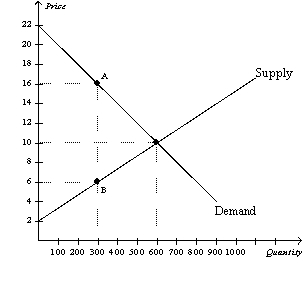 -Refer to Figure 8-6. When the tax is imposed in this market, consumer surplus is
 (Multiple Choice)
4.9/5 (73)
(73) Normally, both buyers and sellers of a good become worse off when the good is taxed.
(True/False)
4.9/5 (78)
(78) Figure 8-3
The vertical distance between points A and C represents a tax in the market. 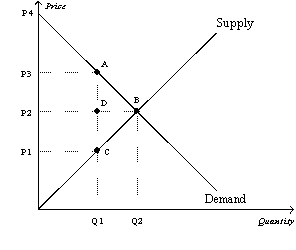 -Refer to Figure 8-3. Which of the following equations is valid for the tax revenue that the tax provides to the government?
 (Multiple Choice)
4.8/5 (84)
(84) Assume that for good X the supply curve for a good is a typical, upward-sloping straight line, and the demand curve is a typical downward-sloping straight line. If the good is taxed, and the tax is tripled, the
(Multiple Choice)
4.9/5 (83)
(83) Taxes cause deadweight losses because they prevent buyers and sellers from realizing some of the gains from trade.
(True/False)
4.8/5 (74)
(74) Figure 8-11 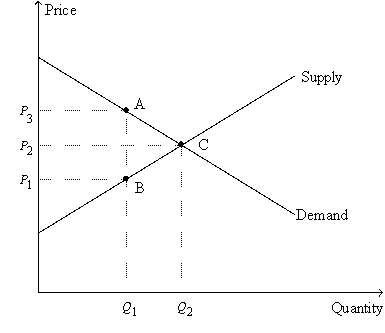 -Refer to Figure 8-11. The tax revenue that the government collects equals
 (Multiple Choice)
5.0/5 (86)
(86) A tax of $0.25 is imposed on each bag of potato chips that is sold. The tax decreases producer surplus by $600 per day, generates tax revenue of $1,220 per day, and decreases the equilibrium quantity of potato chips by 120 bags per day. The tax
(Multiple Choice)
4.9/5 (72)
(72) Assume the price of gasoline is $2.40 per gallon, and the equilibrium quantity of gasoline is 12 million gallons per day with no tax on gasoline. Starting from this initial situation, which of the following scenarios would result in the largest deadweight loss?
(Multiple Choice)
4.8/5 (84)
(84) Figure 8-19. The figure represents the relationship between the size of a tax and the tax revenue raised by that tax. 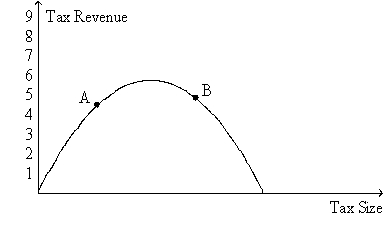 -Refer to Figure 8-19. If the economy is at point A on the curve, then a small increase in the tax rate will
 (Multiple Choice)
4.9/5 (85)
(85) Figure 8-3
The vertical distance between points A and C represents a tax in the market.
-Refer to Figure 8-3. The amount of the tax on each unit of the good is
-Refer to Figure 8-3. The amount of the tax on each unit of the good is (Multiple Choice)
4.9/5 (69)
(69) Figure 8-1 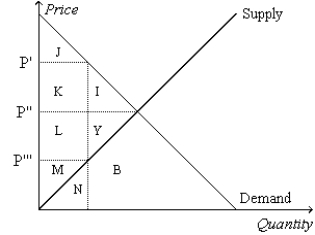 -Refer to Figure 8-1. Suppose the government imposes a tax of P' - P'''. Total surplus after the tax is measured by the area
 (Multiple Choice)
4.8/5 (82)
(82) Figure 8-9
The vertical distance between points A and C represent a tax in the market. 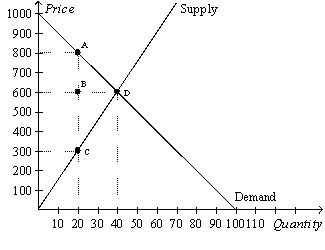 -Refer to Figure 8-9. The imposition of the tax causes the price received by sellers to decrease by
 (Multiple Choice)
4.9/5 (75)
(75) Which of the following events always would increase the size of the deadweight loss that arises from the tax on gasoline?
(Multiple Choice)
4.8/5 (77)
(77) Figure 8-17
The vertical distance between points A and B represents the original tax.  -Refer to Figure 8-17. The original tax can be represented by the vertical distance AB. Suppose the government is deciding whether to lower the tax to CD or raise it to FG. Which of the following statements is correct?
 (Multiple Choice)
4.8/5 (78)
(78) Figure 8-2
The vertical distance between points A and B represents a tax in the market. 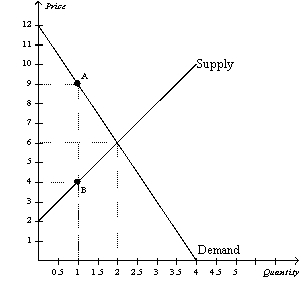 -Refer to Figure 8-2. The loss of consumer surplus associated with some buyers dropping out of the market as a result of the tax is
 (Multiple Choice)
4.8/5 (84)
(84) When the government places a tax on a product, the cost of the tax to buyers and sellers
(Multiple Choice)
4.9/5 (74)
(74) John has been in the habit of mowing Willa's lawn each week for $20. John's opportunity cost is $15, and Willa would be willing to pay $25 to have her lawn mowed. What is the maximum tax the government can impose on lawn mowing without discouraging John and Willa from continuing their mutually beneficial arrangement?
(Essay)
4.8/5 (72)
(72) 
Filters
- Essay(0)
- Multiple Choice(0)
- Short Answer(0)
- True False(0)
- Matching(0)