



 Chat with AI
Exam 8: Application: The Costs of Taxation

Exam 1: Ten Principles of Economics347 Questions
Exam 2: Thinking Like an Economist535 Questions
Exam 3: Interdependence and the Gains From Trade442 Questions
Exam 4: The Market Forces of Supply and Demand569 Questions
Exam 5: Elasticity and Its Application503 Questions
Exam 6: Supply, Demand, and Government Policies556 Questions
Exam 7: Consumers, Producers, and the Efficiency of Markets460 Questions
Exam 8: Application: The Costs of Taxation422 Questions
Exam 9: Application: International Trade409 Questions
Exam 10: Measuring a Nations Income428 Questions
Exam 11: Measuring the Cost of Living436 Questions
Exam 12: Production and Growth417 Questions
Exam 13: Saving, Investment, and the Financial System473 Questions
Exam 14: The Basic Tools of Finance419 Questions
Exam 15: Unemployment571 Questions
Exam 16: The Monetary System423 Questions
Exam 17: Money Growth and Inflation388 Questions
Exam 18: Open-Economy Macroeconomic Models448 Questions
Exam 19: A Macroeconomic Theory of the Open Economy374 Questions
Exam 20: Aggregate Demand and Aggregate Supply471 Questions
Exam 21: The Influence of Monetary and Fiscal Policy on Aggregate Demand416 Questions
Exam 22: The Short-Run Trade-Off Between Inflation and Unemployment400 Questions
Exam 23: Six Debates Over Macroeconomic Policy235 Questions
Select questions type


Assume the supply curve for cigars is a typical, upward-sloping straight line, and the demand curve for cigars is a typical, downward-sloping straight line. Suppose the equilibrium quantity in the market for cigars is 1,000 per month when there is no tax. Then a tax of $0.50 per cigar is imposed. The effective price paid by buyers increases from $1.50 to $1.90 and the effective price received by sellers falls from $1.50 to $1.40. The government's tax revenue amounts to $475 per month. Which of the following statements is correct?
(Multiple Choice)
4.7/5  (84)
(84) Figure 8-9
The vertical distance between points A and C represent a tax in the market. 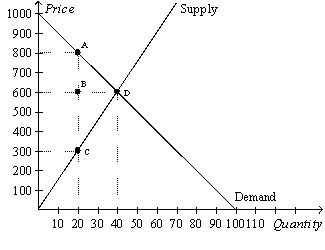 -Refer to Figure 8-9. The consumer surplus with the tax is
 (Multiple Choice)
4.8/5 (82)
(82) Figure 8-3
The vertical distance between points A and C represents a tax in the market. 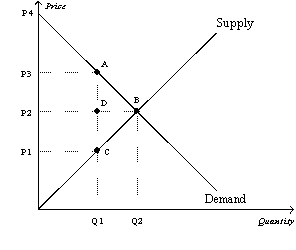 -Refer to Figure 8-3. The equilibrium price before the tax is imposed is
 (Multiple Choice)
4.8/5 (66)
(66) Figure 8-2
The vertical distance between points A and B represents a tax in the market. 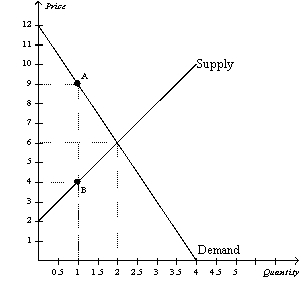 -Refer to Figure 8-2. The loss of consumer surplus as a result of the tax is
 (Multiple Choice)
4.8/5 (81)
(81) Economists disagree on whether labor taxes have a small or large deadweight loss.
(True/False)
4.8/5 (89)
(89) Figure 8-5
Suppose that the government imposes a tax of P3 - P1. 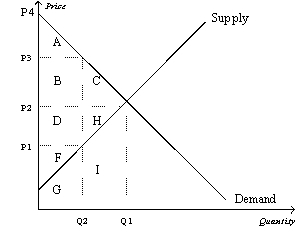 -Refer to Figure 8-5. After the tax is levied, consumer surplus is represented by area
 (Multiple Choice)
4.9/5 (81)
(81) In which of the following instances would the deadweight loss of the tax on cartons of cigarettes increase by a factor of 9?
(Multiple Choice)
4.9/5 (73)
(73) If the tax on a good is tripled, the deadweight loss of the tax
(Multiple Choice)
4.8/5 (78)
(78) Figure 8-5
Suppose that the government imposes a tax of P3 - P1.
-Refer to Figure 8-5. The tax causes a reduction in consumer surplus that is represented by area
-Refer to Figure 8-5. The tax causes a reduction in consumer surplus that is represented by area (Multiple Choice)
4.9/5 (78)
(78) Figure 8-6
The vertical distance between points A and B represents a tax in the market. 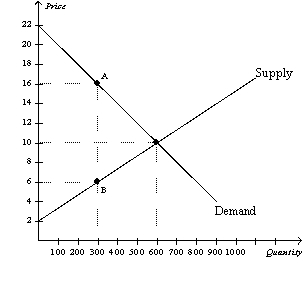 -Refer to Figure 8-6. Without a tax, consumer surplus in this market is
 (Multiple Choice)
4.7/5 (74)
(74) Figure 8-5
Suppose that the government imposes a tax of P3 - P1.
-Refer to Figure 8-5. The loss in total welfare that results from the tax is represented by area
-Refer to Figure 8-5. The loss in total welfare that results from the tax is represented by area (Multiple Choice)
4.8/5 (97)
(97) If a tax shifts the supply curve upward (or to the left), we can infer that the tax was levied on
(Multiple Choice)
4.9/5 (77)
(77) Figure 8-6
The vertical distance between points A and B represents a tax in the market.
-Refer to Figure 8-6. When the tax is imposed in this market, buyers effectively pay what amount of the $10 tax?
-Refer to Figure 8-6. When the tax is imposed in this market, buyers effectively pay what amount of the $10 tax? (Multiple Choice)
4.7/5 (82)
(82) The most important tax in the U.S. economy is the tax on corporations' profits.
(True/False)
4.8/5 (82)
(82) Figure 8-17
The vertical distance between points A and B represents the original tax.  -Refer to Figure 8-17. If the government changed the per-unit tax from $5.00 to $2.50, then the price paid by buyers would be $7.50, the price received by sellers would be $5, and the quantity sold in the market would be 1.5 units. Compared to the original tax rate, this lower tax rate would
 (Multiple Choice)
4.8/5 (84)
(84) Figure 8-6
The vertical distance between points A and B represents a tax in the market.
-Refer to Figure 8-6. When the tax is imposed in this market, the price buyers effectively pay is
-Refer to Figure 8-6. When the tax is imposed in this market, the price buyers effectively pay is (Multiple Choice)
4.9/5 (74)
(74) Figure 8-8
Suppose the government imposes a $10 per unit tax on a good.  -Refer to Figure 8-8. One effect of the tax is to
 (Multiple Choice)
4.9/5 (75)
(75) Figure 8-10 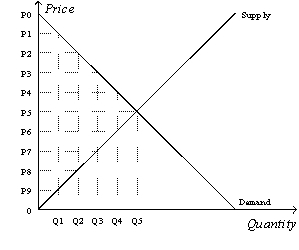 -Refer to Figure 8-10. Suppose the government imposes a tax that reduces the quantity sold in the market after the tax to Q2. Without the tax, the producer surplus is
 (Multiple Choice)
4.9/5 (74)
(74) 
Filters
- Essay(0)
- Multiple Choice(0)
- Short Answer(0)
- True False(0)
- Matching(0)