



 Chat with AI
Exam 8: Application: The Costs of Taxation

Exam 1: Ten Principles of Economics347 Questions
Exam 2: Thinking Like an Economist535 Questions
Exam 3: Interdependence and the Gains From Trade442 Questions
Exam 4: The Market Forces of Supply and Demand569 Questions
Exam 5: Elasticity and Its Application503 Questions
Exam 6: Supply, Demand, and Government Policies556 Questions
Exam 7: Consumers, Producers, and the Efficiency of Markets460 Questions
Exam 8: Application: The Costs of Taxation422 Questions
Exam 9: Application: International Trade409 Questions
Exam 10: Measuring a Nations Income428 Questions
Exam 11: Measuring the Cost of Living436 Questions
Exam 12: Production and Growth417 Questions
Exam 13: Saving, Investment, and the Financial System473 Questions
Exam 14: The Basic Tools of Finance419 Questions
Exam 15: Unemployment571 Questions
Exam 16: The Monetary System423 Questions
Exam 17: Money Growth and Inflation388 Questions
Exam 18: Open-Economy Macroeconomic Models448 Questions
Exam 19: A Macroeconomic Theory of the Open Economy374 Questions
Exam 20: Aggregate Demand and Aggregate Supply471 Questions
Exam 21: The Influence of Monetary and Fiscal Policy on Aggregate Demand416 Questions
Exam 22: The Short-Run Trade-Off Between Inflation and Unemployment400 Questions
Exam 23: Six Debates Over Macroeconomic Policy235 Questions
Select questions type


Figure 8-10 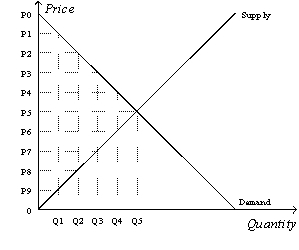 -Refer to Figure 8-10. Suppose the government imposes a tax that reduces the quantity sold in the market after the tax to Q2. The price that buyers pay is
 (Multiple Choice)
4.7/5  (85)
(85) In the market for widgets, the supply curve is the typical upward-sloping straight line, and the demand curve is the typical downward-sloping straight line. The equilibrium quantity in the market for widgets is 200 per month when there is no tax. Then a tax of $5 per widget is imposed. As a result, the government is able to raise $750 per month in tax revenue. We can conclude that the equilibrium quantity of widgets has fallen by
(Multiple Choice)
4.9/5 (65)
(65) When a tax is imposed on a good for which the supply is relatively elastic and the demand is relatively inelastic,
(Multiple Choice)
4.8/5 (79)
(79) Figure 8-2
The vertical distance between points A and B represents a tax in the market. 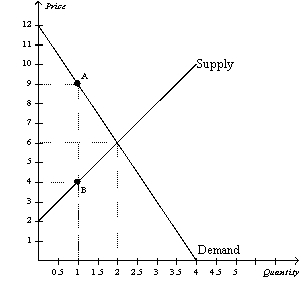 -Refer to Figure 8-2. The loss of producer surplus for those sellers of the good who continue to sell it after the tax is imposed is
 (Multiple Choice)
4.8/5 (72)
(72) If the labor supply curve is nearly vertical, a tax on labor
(Multiple Choice)
4.8/5 (93)
(93) The elasticities of the supply and demand curves in the market for cigarettes affect how much a tax distorts that market.
(True/False)
4.9/5 (80)
(80) Figure 8-1 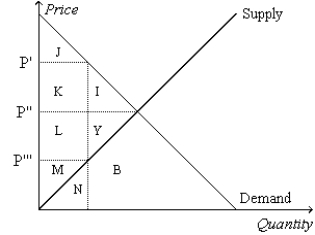 -Refer to Figure 8-1. Suppose the government imposes a tax of P' - P'''. The area measured by J+K+I represents
 (Multiple Choice)
4.9/5 (61)
(61) The more elastic the supply, the larger the deadweight loss from a tax, all else equal.
(True/False)
4.9/5 (81)
(81) If T represents the size of the tax on a good and Q represents the quantity of the good that is sold, total tax revenue received by government can be expressed as
(Multiple Choice)
4.9/5 (80)
(80) For a good that is taxed, the area on the relevant supply-and-demand graph that represents government's tax revenue is a
(Multiple Choice)
4.8/5 (84)
(84) Figure 8-9
The vertical distance between points A and C represent a tax in the market. 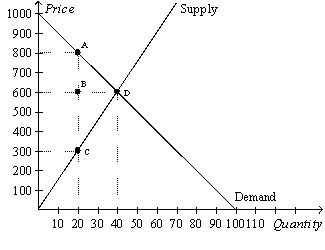 -Refer to Figure 8-9. The loss of producer surplus as a result of the tax is
 (Multiple Choice)
4.7/5 (76)
(76) Andre walks Julia's dog once a day for $50 per week. Julia values this service at $60 per week, while the opportunity cost of Andre's time is $30 per week. The government places a tax of $35 per week on dog walkers. Before the tax, what is the total surplus?
(Multiple Choice)
4.9/5 (73)
(73) Suppose the government increases the size of a tax by 40 percent. The deadweight loss from that tax
(Multiple Choice)
4.9/5 (78)
(78) Figure 8-9
The vertical distance between points A and C represent a tax in the market.
-Refer to Figure 8-9. The loss of consumer surplus as a result of the tax is
-Refer to Figure 8-9. The loss of consumer surplus as a result of the tax is (Multiple Choice)
4.9/5 (84)
(84) Suppose a tax of $1 per unit is imposed on a good. The more elastic the supply of the good, other things equal, the
(Multiple Choice)
4.7/5 (73)
(73) 
Filters
- Essay(0)
- Multiple Choice(0)
- Short Answer(0)
- True False(0)
- Matching(0)