



 Chat with AI
Exam 8: Application: The Costs of Taxation

Exam 1: Ten Principles of Economics347 Questions
Exam 2: Thinking Like an Economist535 Questions
Exam 3: Interdependence and the Gains From Trade442 Questions
Exam 4: The Market Forces of Supply and Demand569 Questions
Exam 5: Elasticity and Its Application503 Questions
Exam 6: Supply, Demand, and Government Policies556 Questions
Exam 7: Consumers, Producers, and the Efficiency of Markets460 Questions
Exam 8: Application: The Costs of Taxation422 Questions
Exam 9: Application: International Trade409 Questions
Exam 10: Measuring a Nations Income428 Questions
Exam 11: Measuring the Cost of Living436 Questions
Exam 12: Production and Growth417 Questions
Exam 13: Saving, Investment, and the Financial System473 Questions
Exam 14: The Basic Tools of Finance419 Questions
Exam 15: Unemployment571 Questions
Exam 16: The Monetary System423 Questions
Exam 17: Money Growth and Inflation388 Questions
Exam 18: Open-Economy Macroeconomic Models448 Questions
Exam 19: A Macroeconomic Theory of the Open Economy374 Questions
Exam 20: Aggregate Demand and Aggregate Supply471 Questions
Exam 21: The Influence of Monetary and Fiscal Policy on Aggregate Demand416 Questions
Exam 22: The Short-Run Trade-Off Between Inflation and Unemployment400 Questions
Exam 23: Six Debates Over Macroeconomic Policy235 Questions
Select questions type


The deadweight loss from a tax of $5 per unit will be smallest in a market with
(Multiple Choice)
4.9/5  (72)
(72) To fully understand how taxes affect economic well-being, we must
(Multiple Choice)
4.8/5 (82)
(82) Figure 8-5
Suppose that the government imposes a tax of P3 - P1. 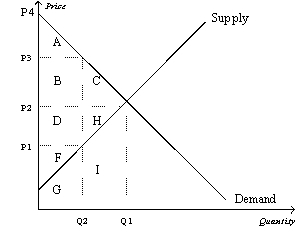 -Refer to Figure 8-5. The benefit to the government is measured by
 (Multiple Choice)
4.9/5 (82)
(82) Suppose a tax of $3 per unit is imposed on a good. The supply curve is a typical upward-sloping straight line, and the demand curve is a typical downward-sloping straight line. The tax decreases consumer surplus by $3,900 and decreases producer surplus by $3,000. The tax generates tax revenue of $6,000. The tax decreased the equilibrium quantity of the good from
(Multiple Choice)
5.0/5 (80)
(80) The result of the large tax cuts in the first Reagan Administration demonstrated very convincingly that Arthur Laffer was correct when he asserted that cuts in tax rates would increase tax revenue.
(True/False)
4.8/5 (76)
(76) Figure 8-12 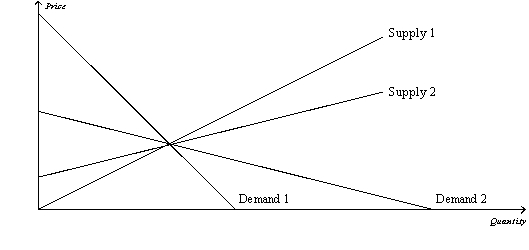 -Refer to Figure 8-12. Which of the following combinations will minimize the deadweight loss from a tax?
 (Multiple Choice)
4.9/5 (82)
(82) When a tax is imposed, the loss of consumer surplus and producer surplus as a result of the tax exceeds the tax revenue collected by the government.
(True/False)
5.0/5 (82)
(82) The graph that represents the amount of deadweight loss (measured on the vertical axis) as a function of the size of the tax (measured on the horizontal axis) looks like
(Multiple Choice)
4.9/5 (86)
(86) As more people become self-employed, which allows them to determine how many hours they work per week, we would expect the deadweight loss from the Social Security tax to
(Multiple Choice)
4.8/5 (83)
(83) Figure 8-5
Suppose that the government imposes a tax of P3 - P1.
-Refer to Figure 8-5. The total surplus with the tax is represented by area
-Refer to Figure 8-5. The total surplus with the tax is represented by area (Multiple Choice)
4.8/5 (84)
(84) Illustrate on three demand-and-supply graphs how the size of a tax (small, medium and large) can alter total revenue and deadweight loss.
(Essay)
4.9/5 (82)
(82) Scenario 8-2
Tom mows Stephanie's lawn for $25. Tom's opportunity cost of mowing Stephanie's lawn is $20, and Stephanie's willingness to pay Tom to mow her lawn is $28.
-Refer to Scenario 8-2. Assume Tom is required to pay a tax of $10 each time he mows a lawn. Which of the following results is most likely?
(Multiple Choice)
4.8/5 (86)
(86) Figure 8-19. The figure represents the relationship between the size of a tax and the tax revenue raised by that tax. 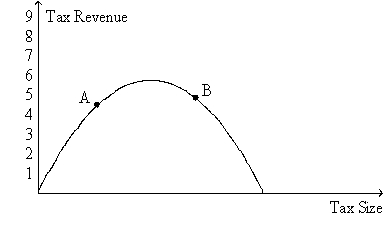 -Refer to Figure 8-19. If the economy is at point A on the curve, then a decrease in the tax rate will
 (Multiple Choice)
4.9/5 (74)
(74) The larger the deadweight loss from taxation, the larger the cost of government programs.
(True/False)
4.8/5 (86)
(86) Taxes on labor tend to encourage second earners to stay at home rather than work in the labor force.
(True/False)
4.8/5 (85)
(85) Figure 8-1 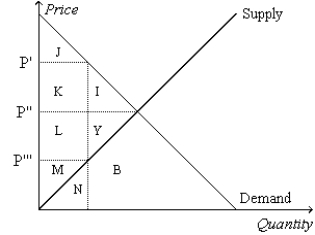 -Refer to Figure 8-1. Suppose the government imposes a tax of P' - P'''. The area measured by K+L represents
 (Multiple Choice)
4.8/5 (78)
(78) When a tax is imposed on sellers, producer surplus decreases but consumer surplus increases.
(True/False)
4.8/5 (63)
(63) Andre walks Julia's dog once a day for $50 per week. Julia values this service at $60 per week, while the opportunity cost of Andre's time is $30 per week. The government places a tax of $35 per week on dog walkers. After the tax, what is the total surplus?
(Multiple Choice)
4.8/5 (77)
(77) Figure 8-1
-Refer to Figure 8-1. Suppose the government imposes a tax of P' - P'''. The area measured by L+M+Y represents
-Refer to Figure 8-1. Suppose the government imposes a tax of P' - P'''. The area measured by L+M+Y represents (Multiple Choice)
4.7/5 (82)
(82) 
Filters
- Essay(0)
- Multiple Choice(0)
- Short Answer(0)
- True False(0)
- Matching(0)