



 Chat with AI
Exam 8: Application: The Costs of Taxation

Exam 1: Ten Principles of Economics347 Questions
Exam 2: Thinking Like an Economist535 Questions
Exam 3: Interdependence and the Gains From Trade442 Questions
Exam 4: The Market Forces of Supply and Demand569 Questions
Exam 5: Elasticity and Its Application503 Questions
Exam 6: Supply, Demand, and Government Policies556 Questions
Exam 7: Consumers, Producers, and the Efficiency of Markets460 Questions
Exam 8: Application: The Costs of Taxation422 Questions
Exam 9: Application: International Trade409 Questions
Exam 10: Measuring a Nations Income428 Questions
Exam 11: Measuring the Cost of Living436 Questions
Exam 12: Production and Growth417 Questions
Exam 13: Saving, Investment, and the Financial System473 Questions
Exam 14: The Basic Tools of Finance419 Questions
Exam 15: Unemployment571 Questions
Exam 16: The Monetary System423 Questions
Exam 17: Money Growth and Inflation388 Questions
Exam 18: Open-Economy Macroeconomic Models448 Questions
Exam 19: A Macroeconomic Theory of the Open Economy374 Questions
Exam 20: Aggregate Demand and Aggregate Supply471 Questions
Exam 21: The Influence of Monetary and Fiscal Policy on Aggregate Demand416 Questions
Exam 22: The Short-Run Trade-Off Between Inflation and Unemployment400 Questions
Exam 23: Six Debates Over Macroeconomic Policy235 Questions
Select questions type


Figure 8-1 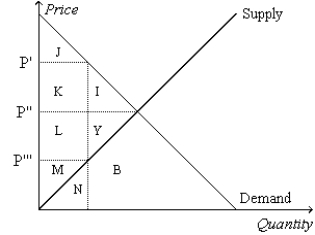 -Refer to Figure 8-1. Suppose the government imposes a tax of P' - P'''. The producer surplus after the tax is measured by the area
 (Multiple Choice)
4.9/5  (74)
(74) It does not matter whether a tax is levied on the buyers or the sellers of a good because
(Multiple Choice)
4.8/5 (76)
(76) Figure 8-5
Suppose that the government imposes a tax of P3 - P1. 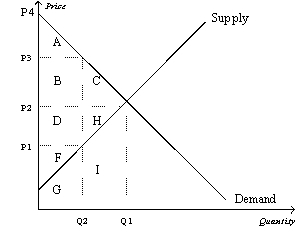 -Refer to Figure 8-5. The tax causes a reduction in producer surplus that is represented by area
 (Multiple Choice)
4.9/5 (73)
(73) Consider a good to which a per-unit tax applies. The size of the deadweight that results from the tax is smaller, the
(Multiple Choice)
4.7/5 (75)
(75) When a tax is imposed on a good for which both demand and supply are very elastic,
(Multiple Choice)
4.9/5 (76)
(76) Figure 8-5
Suppose that the government imposes a tax of P3 - P1.
-Refer to Figure 8-5. Consumer surplus before the tax was levied is represented by area
-Refer to Figure 8-5. Consumer surplus before the tax was levied is represented by area (Multiple Choice)
4.8/5 (77)
(77) Scenario 8-2
Tom mows Stephanie's lawn for $25. Tom's opportunity cost of mowing Stephanie's lawn is $20, and Stephanie's willingness to pay Tom to mow her lawn is $28.
-Refer to Scenario 8-2. Assume Tom is required to pay a tax of $3 each time he mows a lawn. Which of the following results is most likely?
(Multiple Choice)
4.9/5 (78)
(78) Concerning the labor market and taxes on labor, economists disagree about
(Multiple Choice)
4.9/5 (72)
(72) Figure 8-2
The vertical distance between points A and B represents a tax in the market. 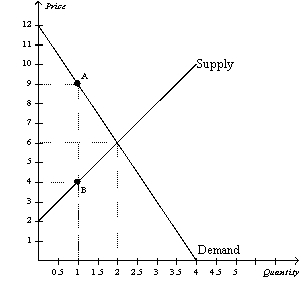 -Refer to Figure 8-2. The per-unit burden of the tax on buyers is
 (Multiple Choice)
4.9/5 (80)
(80) Who once said that taxes are the price we pay for a civilized society?
(Multiple Choice)
4.7/5 (84)
(84) Figure 8-1
-Refer to Figure 8-1. Suppose the government imposes a tax of P' - P'''. The deadweight loss due to the tax is measured by the area
-Refer to Figure 8-1. Suppose the government imposes a tax of P' - P'''. The deadweight loss due to the tax is measured by the area (Multiple Choice)
4.9/5 (80)
(80) Figure 8-2
The vertical distance between points A and B represents a tax in the market.
-Refer to Figure 8-2. The imposition of the tax causes the price received by sellers to
-Refer to Figure 8-2. The imposition of the tax causes the price received by sellers to (Multiple Choice)
4.8/5 (75)
(75) When a good is taxed, the deadweight loss is larger the more elastic are demand and supply.
(True/False)
4.8/5 (80)
(80) Which of the following statements correctly describes the relationship between the size of the deadweight loss and the amount of tax revenue as the size of a tax increases from a small tax to a medium tax and finally to a large tax?
(Multiple Choice)
4.9/5 (68)
(68) When a country is on the downward-sloping side of the Laffer curves, a cut in the tax rate will
(Multiple Choice)
4.8/5 (77)
(77) When a tax is imposed on a good, the resulting decrease in consumer surplus is always larger than the resulting decrease in producer surplus.
(True/False)
4.8/5 (74)
(74) When a tax is imposed on a good, consumer surplus decreases and producer surplus remains unchanged.
(True/False)
4.9/5 (73)
(73) Economists disagree on whether labor taxes cause small or large deadweight losses. This disagreement arises primarily because economists hold different views about
(Multiple Choice)
5.0/5 (82)
(82) 
Filters
- Essay(0)
- Multiple Choice(0)
- Short Answer(0)
- True False(0)
- Matching(0)