



 Chat with AI
Exam 8: Application: The Costs of Taxation

Exam 1: Ten Principles of Economics347 Questions
Exam 2: Thinking Like an Economist535 Questions
Exam 3: Interdependence and the Gains From Trade442 Questions
Exam 4: The Market Forces of Supply and Demand569 Questions
Exam 5: Elasticity and Its Application503 Questions
Exam 6: Supply, Demand, and Government Policies556 Questions
Exam 7: Consumers, Producers, and the Efficiency of Markets460 Questions
Exam 8: Application: The Costs of Taxation422 Questions
Exam 9: Application: International Trade409 Questions
Exam 10: Measuring a Nations Income428 Questions
Exam 11: Measuring the Cost of Living436 Questions
Exam 12: Production and Growth417 Questions
Exam 13: Saving, Investment, and the Financial System473 Questions
Exam 14: The Basic Tools of Finance419 Questions
Exam 15: Unemployment571 Questions
Exam 16: The Monetary System423 Questions
Exam 17: Money Growth and Inflation388 Questions
Exam 18: Open-Economy Macroeconomic Models448 Questions
Exam 19: A Macroeconomic Theory of the Open Economy374 Questions
Exam 20: Aggregate Demand and Aggregate Supply471 Questions
Exam 21: The Influence of Monetary and Fiscal Policy on Aggregate Demand416 Questions
Exam 22: The Short-Run Trade-Off Between Inflation and Unemployment400 Questions
Exam 23: Six Debates Over Macroeconomic Policy235 Questions
Select questions type


The deadweight loss from a tax of $8 per unit will be smallest in a market with
(Multiple Choice)
4.8/5  (79)
(79) In the early 1980s, which of the following countries had a marginal tax rate of about 80 percent?
(Multiple Choice)
4.9/5 (86)
(86) Figure 8-4
The vertical distance between points A and B represents a tax in the market.  -Refer to Figure 8-4. The amount of the tax on each unit of the good is
 (Multiple Choice)
4.8/5 (79)
(79) Figure 8-7
The vertical distance between points A and B represents a tax in the market.  -Refer to Figure 8-7. Before the tax is imposed, the equilibrium price is
 (Multiple Choice)
4.9/5 (78)
(78) Figure 8-7
The vertical distance between points A and B represents a tax in the market.
-Refer to Figure 8-7. The deadweight loss associated with this tax amounts to
-Refer to Figure 8-7. The deadweight loss associated with this tax amounts to (Multiple Choice)
4.8/5 (84)
(84) As the tax on a good increases from $1 per unit to $2 per unit to $3 per unit and so on, the
(Multiple Choice)
4.8/5 (84)
(84) The view held by Arthur Laffer and Ronald Reagan that cuts in tax rates would encourage people to increase the quantity of labor they supplied became known as
(Multiple Choice)
4.7/5 (85)
(85) Consider a good to which a per-unit tax applies. The greater the price elasticities of demand and supply for the good, the
(Multiple Choice)
4.9/5 (89)
(89) Figure 8-7
The vertical distance between points A and B represents a tax in the market.
-Refer to Figure 8-7. Suppose a 22nd unit of the good were sold by a seller to a buyer. Which of the following statements is correct?
-Refer to Figure 8-7. Suppose a 22nd unit of the good were sold by a seller to a buyer. Which of the following statements is correct? (Multiple Choice)
4.7/5 (82)
(82) Suppose Ashley needs a dog sitter so that she can travel to her sister's wedding. Ashley values dog sitting for the weekend at $200. Cami is willing to dog sit for Ashley so long as she receives at least $175. Ashley and Cami agree on a price of $185. Suppose the government imposes a tax of $30 on dog sitting. The tax has made Ashley and Cami worse off by a total of
(Multiple Choice)
4.8/5 (71)
(71) Figure 8-19. The figure represents the relationship between the size of a tax and the tax revenue raised by that tax. 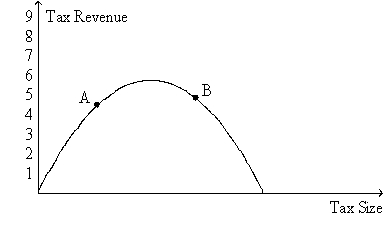 -Refer to Figure 8-19. According to a recent research paper published by the European Central Bank, which two countries are at a point such as point B if the tax in question is the tax on capital income?
 (Multiple Choice)
5.0/5 (86)
(86) Figure 8-13 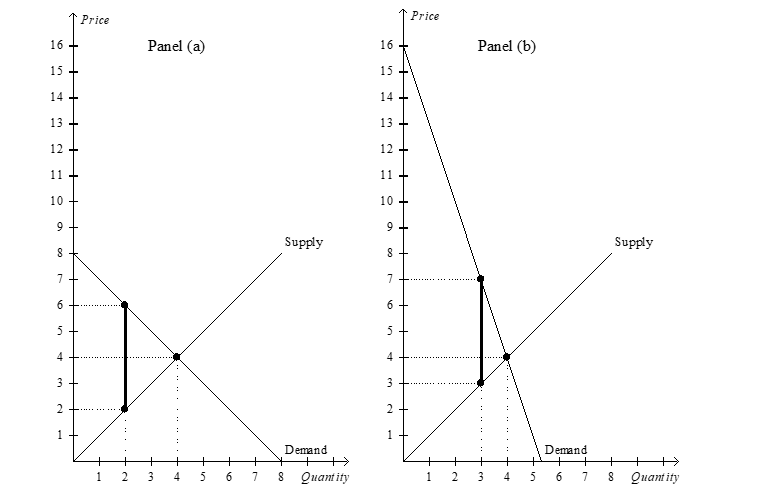 -Refer to Figure 8-13. Panel (a) and Panel (b) each illustrate a $4 tax placed on a market. In comparison to Panel (b), Panel (a) illustrates which of the following statements?
 (Multiple Choice)
4.9/5 (72)
(72) Figure 8-2
The vertical distance between points A and B represents a tax in the market. 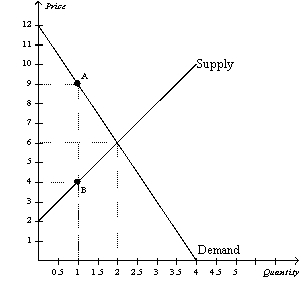 -Refer to Figure 8-2. The amount of tax revenue received by the government is
 (Multiple Choice)
4.9/5 (73)
(73) Supply-side economics is a term associated with the views of
(Multiple Choice)
4.8/5 (81)
(81) If the government imposes a $3 tax in a market, the buyers and sellers will share an equal burden of the tax.
(True/False)
5.0/5 (91)
(91) Diana is a personal trainer whose client Charles pays $80 per hour-long session. Charles values this service at $100 per hour, while the opportunity cost of Diana's time is $75 per hour. The government places a tax of $10 per hour on personal trainers. Before the tax, what is the total surplus?
(Multiple Choice)
4.8/5 (82)
(82) Diana is a personal trainer whose client Charles pays $80 per hour-long session. Charles values this service at $100 per hour, while the opportunity cost of Diana's time is $75 per hour. The government places a tax of $10 per hour on personal trainers. After the tax, what is likely to happen in the market for personal training?
(Multiple Choice)
4.9/5 (81)
(81) The benefit that government receives from a tax is measured by
(Multiple Choice)
4.7/5 (64)
(64) 
Filters
- Essay(0)
- Multiple Choice(0)
- Short Answer(0)
- True False(0)
- Matching(0)