



 Chat with AI
Exam 6: Supply, Demand, and Government Policies

Exam 1: Ten Principles of Economics347 Questions
Exam 2: Thinking Like an Economist535 Questions
Exam 3: Interdependence and the Gains From Trade442 Questions
Exam 4: The Market Forces of Supply and Demand569 Questions
Exam 5: Elasticity and Its Application503 Questions
Exam 6: Supply, Demand, and Government Policies556 Questions
Exam 7: Consumers, Producers, and the Efficiency of Markets460 Questions
Exam 8: Application: The Costs of Taxation422 Questions
Exam 9: Application: International Trade409 Questions
Exam 10: Measuring a Nations Income428 Questions
Exam 11: Measuring the Cost of Living436 Questions
Exam 12: Production and Growth417 Questions
Exam 13: Saving, Investment, and the Financial System473 Questions
Exam 14: The Basic Tools of Finance419 Questions
Exam 15: Unemployment571 Questions
Exam 16: The Monetary System423 Questions
Exam 17: Money Growth and Inflation388 Questions
Exam 18: Open-Economy Macroeconomic Models448 Questions
Exam 19: A Macroeconomic Theory of the Open Economy374 Questions
Exam 20: Aggregate Demand and Aggregate Supply471 Questions
Exam 21: The Influence of Monetary and Fiscal Policy on Aggregate Demand416 Questions
Exam 22: The Short-Run Trade-Off Between Inflation and Unemployment400 Questions
Exam 23: Six Debates Over Macroeconomic Policy235 Questions
Select questions type


Lawmakers designed the burden of the FICA payroll tax to be split evenly between workers and firms. Labor economists believe that
(Multiple Choice)
4.9/5  (83)
(83) A tax on sellers shifts the supply curve but not the demand curve.
(True/False)
4.9/5 (80)
(80) A tax on the buyers of personal computer external hard drives encourages
(Multiple Choice)
4.8/5 (82)
(82) A binding minimum wage raises the incomes of some workers, but it lowers the incomes of workers who cannot find jobs.
(True/False)
4.9/5 (84)
(84) Suppose the equilibrium price of a tube of toothpaste is $2, and the government imposes a price floor of $3 per tube. As a result of the price floor, the
(Multiple Choice)
4.9/5 (85)
(85) Table 6-2
Price Quantity Denanded Quantity Sugplied \ 10 250 0 \ 5 200 75 \ 10 150 150 \ 15 100 225 \ 20 50 300 \ 25 0 375
-Refer to Table 6-2. A price floor set at $20 will
(Multiple Choice)
4.9/5 (74)
(74) Suppose the government imposes a 50-cent tax on the sellers of packets of chewing gum. The tax would
(Multiple Choice)
4.8/5 (82)
(82) Figure 6-6  -Refer to Figure 6-6. If the government imposes a price floor of $6 on this market, then there will be
 (Multiple Choice)
4.9/5 (74)
(74) A tax of $1 on sellers shifts the supply curve upward by exactly $1.
(True/False)
4.9/5 (78)
(78) The impact of the minimum wage depends on the skill and experience of the worker.
(True/False)
4.8/5 (75)
(75) Figure 6-7  -Refer to Figure 6-7. Suppose a price ceiling of $5 is imposed on this market. As a result,
 (Multiple Choice)
4.9/5 (84)
(84) If a tax is levied on the buyers of a product, then there will be a(n)
(Multiple Choice)
4.9/5 (83)
(83) Figure 6-15  -Refer to Figure 6-15. Suppose a tax of $2 per unit is imposed on this market. How much will sellers receive per unit after the tax is imposed?
 (Multiple Choice)
4.8/5 (91)
(91) You receive a paycheck from your employer, and your pay stub indicates that $300 was deducted to pay the FICA (Social Security/Medicare) tax. Which of the following statements is correct?
(Multiple Choice)
5.0/5 (80)
(80) Workers, rather than firms, bear most of the burden of the payroll tax.
(True/False)
4.9/5 (80)
(80) Figure 6-18 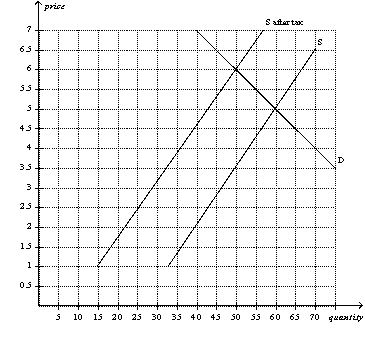 -Refer to Figure 6-18. Sellers pay how much of the tax per unit?
 (Multiple Choice)
4.8/5 (83)
(83) Minimum-wage laws are precise policy instruments that can specifically target workers whose family incomes are low.
(True/False)
4.9/5 (80)
(80) 
Filters
- Essay(0)
- Multiple Choice(0)
- Short Answer(0)
- True False(0)
- Matching(0)