



 Chat with AI
Exam 6: Supply, Demand, and Government Policies

Exam 1: Ten Principles of Economics347 Questions
Exam 2: Thinking Like an Economist535 Questions
Exam 3: Interdependence and the Gains From Trade442 Questions
Exam 4: The Market Forces of Supply and Demand569 Questions
Exam 5: Elasticity and Its Application503 Questions
Exam 6: Supply, Demand, and Government Policies556 Questions
Exam 7: Consumers, Producers, and the Efficiency of Markets460 Questions
Exam 8: Application: The Costs of Taxation422 Questions
Exam 9: Application: International Trade409 Questions
Exam 10: Measuring a Nations Income428 Questions
Exam 11: Measuring the Cost of Living436 Questions
Exam 12: Production and Growth417 Questions
Exam 13: Saving, Investment, and the Financial System473 Questions
Exam 14: The Basic Tools of Finance419 Questions
Exam 15: Unemployment571 Questions
Exam 16: The Monetary System423 Questions
Exam 17: Money Growth and Inflation388 Questions
Exam 18: Open-Economy Macroeconomic Models448 Questions
Exam 19: A Macroeconomic Theory of the Open Economy374 Questions
Exam 20: Aggregate Demand and Aggregate Supply471 Questions
Exam 21: The Influence of Monetary and Fiscal Policy on Aggregate Demand416 Questions
Exam 22: The Short-Run Trade-Off Between Inflation and Unemployment400 Questions
Exam 23: Six Debates Over Macroeconomic Policy235 Questions
Select questions type


Figure 6-1
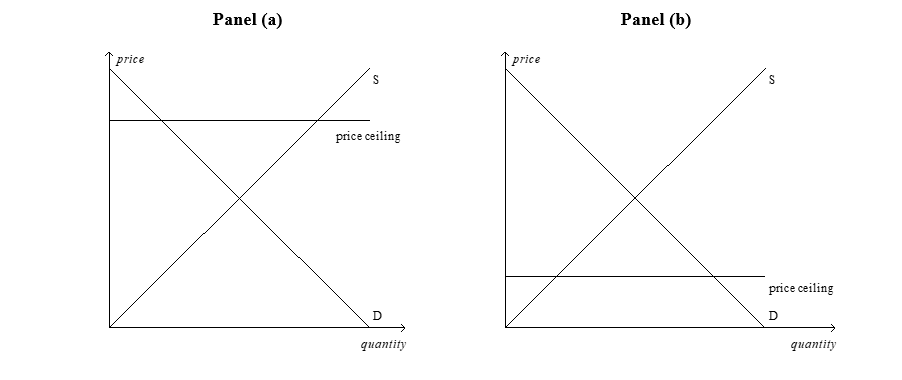 -Refer to Figure 6-1. The price ceiling shown in panel (b)
 (Multiple Choice)
4.8/5  (86)
(86) Suppose that the demand for lava lamps is elastic, and the supply of lava lamps is inelastic. A tax of $2 per lamp levied on lava lamps will increase the price paid by buyers of lava lamps by
(Multiple Choice)
4.8/5 (66)
(66) Figure 6-1
-Refer to Figure 6-1. A binding price ceiling is shown in
-Refer to Figure 6-1. A binding price ceiling is shown in (Multiple Choice)
4.9/5 (74)
(74) 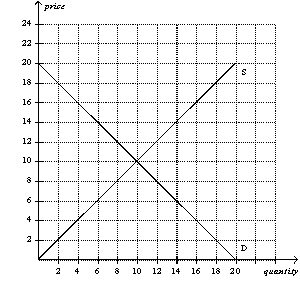 -Refer to Figure 6-10. A price floor set at
Figure 6-4  -Refer to Figure 6-4. Which of the following statements is not correct?
 (Multiple Choice)
4.9/5 (74)
(74) When a free market for a good reaches equilibrium, anyone who is willing and able to sell at the market price can sell the good.
(True/False)
4.9/5 (84)
(84) Figure 6-5 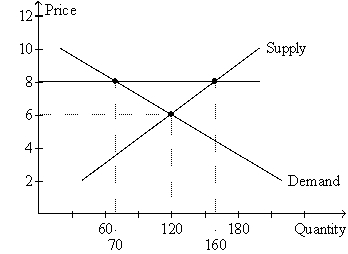 -Refer to Figure 6-5. If the horizontal line on the graph represents a price ceiling, then the price ceiling is
 (Multiple Choice)
4.8/5 (83)
(83) A price floor set below the equilibrium price causes quantity supplied to exceed quantity demanded.
(True/False)
4.9/5 (87)
(87) Suppose there is currently a tax of $50 per ticket on airline tickets. Sellers of airline tickets are required to pay the tax to the government. If the tax is reduced from $50 per ticket to $30 per ticket, then the
(Multiple Choice)
4.9/5 (85)
(85) When OPEC raised the price of crude oil in the 1970s, it caused the United States'
(Multiple Choice)
4.9/5 (87)
(87) Figure 6-21  -Refer to Figure 6-21. The effective price that sellers receive after the tax is imposed is
 (Multiple Choice)
5.0/5 (81)
(81) Figure 6-19  -Refer to Figure 6-19. For every unit of the good that is sold, sellers are required to send
 (Multiple Choice)
4.9/5 (68)
(68) Table 6-2
Price Quantity Denanded Quantity Sugplied \ 10 250 0 \ 5 200 75 \ 10 150 150 \ 15 100 225 \ 20 50 300 \ 25 0 375
-Refer to Table 6-2. A price ceiling set at $5 will
(Multiple Choice)
4.9/5 (82)
(82) Figure 6-8  -Refer to Figure 6-8. The price of the good would continue to serve as the rationing mechanism if
 (Multiple Choice)
4.9/5 (82)
(82) Figure 6-23  -Refer to Figure 6-23. The amount of the tax per unit is
 (Multiple Choice)
4.9/5 (71)
(71) Figure 6-27  -Refer to Figure 6-27. If the government places a $2 tax in the market, the seller receives $4.
 (True/False)
4.9/5 (72)
(72) If the government levies a $500 tax per car on sellers of cars, then the price received by sellers of cars would
(Multiple Choice)
4.7/5 (67)
(67) 
Filters
- Essay(0)
- Multiple Choice(0)
- Short Answer(0)
- True False(0)
- Matching(0)