



 Chat with AI
Exam 6: Supply, Demand, and Government Policies

Exam 1: Ten Principles of Economics347 Questions
Exam 2: Thinking Like an Economist535 Questions
Exam 3: Interdependence and the Gains From Trade442 Questions
Exam 4: The Market Forces of Supply and Demand569 Questions
Exam 5: Elasticity and Its Application503 Questions
Exam 6: Supply, Demand, and Government Policies556 Questions
Exam 7: Consumers, Producers, and the Efficiency of Markets460 Questions
Exam 8: Application: The Costs of Taxation422 Questions
Exam 9: Application: International Trade409 Questions
Exam 10: Measuring a Nations Income428 Questions
Exam 11: Measuring the Cost of Living436 Questions
Exam 12: Production and Growth417 Questions
Exam 13: Saving, Investment, and the Financial System473 Questions
Exam 14: The Basic Tools of Finance419 Questions
Exam 15: Unemployment571 Questions
Exam 16: The Monetary System423 Questions
Exam 17: Money Growth and Inflation388 Questions
Exam 18: Open-Economy Macroeconomic Models448 Questions
Exam 19: A Macroeconomic Theory of the Open Economy374 Questions
Exam 20: Aggregate Demand and Aggregate Supply471 Questions
Exam 21: The Influence of Monetary and Fiscal Policy on Aggregate Demand416 Questions
Exam 22: The Short-Run Trade-Off Between Inflation and Unemployment400 Questions
Exam 23: Six Debates Over Macroeconomic Policy235 Questions
Select questions type


Which of the following is the most likely explanation for the imposition of a price floor on the market for corn?
(Multiple Choice)
4.8/5  (91)
(91) If the government levies a $5 tax per ticket on buyers of NFL game tickets, then the price paid by buyers of NFL game tickets would
(Multiple Choice)
4.9/5 (87)
(87) Binding price floors benefit sellers because they allow sellers to sell all the goods they want at a higher price.
(True/False)
5.0/5 (81)
(81) When a payroll tax is enacted, the wage received by workers
(Multiple Choice)
4.9/5 (97)
(97) Table 6-4
The following table contains the demand schedule and supply schedule for a market for a particular good. Suppose sellers of the good successfully lobby Congress to impose a price floor $3 above the equilibrium price in this market. price Quantity Denanded Quantity Suppplied \ 0 15 0 \ 1 13 3 \ 2 11 6 \ 3 9 9 \ 4 7 12 \ 5 5 15 \ 6 3 18
-Refer to Table 6-4. Following the imposition of a price floor $3 above the equilibrium price, irate buyers convince Congress to repeal the price floor and to impose a price ceiling $1 below the former price floor. The resulting shortage is
(Multiple Choice)
5.0/5 (75)
(75) Which of the following causes the price paid by buyers to be different than the price received by sellers?
(Multiple Choice)
4.9/5 (90)
(90) Economists blame the long lines at gasoline stations in the U.S. in the 1970s on
(Multiple Choice)
4.7/5 (69)
(69) If the government levies a $2 tax per DVD on buyers of DVDs, then the price received by sellers of DVDs would
(Multiple Choice)
4.7/5 (88)
(88) Figure 6-21  -Refer to Figure 6-21. The burden of the tax on sellers is
 (Multiple Choice)
4.9/5 (78)
(78) Figure 6-4  -Refer to Figure 6-4. A government-imposed price of $12 in this market is an example of a
 (Multiple Choice)
4.7/5 (90)
(90) Figure 6-19  -Refer to Figure 6-19. How much tax revenue does this tax produce for the government?
 (Multiple Choice)
4.9/5 (81)
(81) At the equilibrium price, the quantity that buyers want to buy exactly equals the quantity that sellers want to sell.
(True/False)
4.7/5 (79)
(79) A tax on sellers increases the quantity of the good sold in the market.
(True/False)
4.9/5 (89)
(89) A price ceiling set below the equilibrium price causes quantity demanded to exceed quantity supplied.
(True/False)
4.8/5 (68)
(68) Figure 6-11 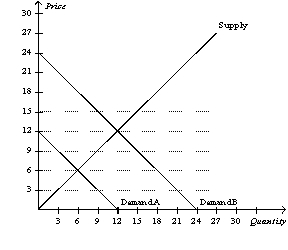 -Refer to Figure 6-11. If the government imposes a price floor at $9, it would be
 (Multiple Choice)
4.8/5 (86)
(86) 
Filters
- Essay(0)
- Multiple Choice(0)
- Short Answer(0)
- True False(0)
- Matching(0)