



 Chat with AI
Exam 6: Supply, Demand, and Government Policies

Exam 1: Ten Principles of Economics347 Questions
Exam 2: Thinking Like an Economist535 Questions
Exam 3: Interdependence and the Gains From Trade442 Questions
Exam 4: The Market Forces of Supply and Demand569 Questions
Exam 5: Elasticity and Its Application503 Questions
Exam 6: Supply, Demand, and Government Policies556 Questions
Exam 7: Consumers, Producers, and the Efficiency of Markets460 Questions
Exam 8: Application: The Costs of Taxation422 Questions
Exam 9: Application: International Trade409 Questions
Exam 10: Measuring a Nations Income428 Questions
Exam 11: Measuring the Cost of Living436 Questions
Exam 12: Production and Growth417 Questions
Exam 13: Saving, Investment, and the Financial System473 Questions
Exam 14: The Basic Tools of Finance419 Questions
Exam 15: Unemployment571 Questions
Exam 16: The Monetary System423 Questions
Exam 17: Money Growth and Inflation388 Questions
Exam 18: Open-Economy Macroeconomic Models448 Questions
Exam 19: A Macroeconomic Theory of the Open Economy374 Questions
Exam 20: Aggregate Demand and Aggregate Supply471 Questions
Exam 21: The Influence of Monetary and Fiscal Policy on Aggregate Demand416 Questions
Exam 22: The Short-Run Trade-Off Between Inflation and Unemployment400 Questions
Exam 23: Six Debates Over Macroeconomic Policy235 Questions
Select questions type


Figure 6-16  -Refer to Figure 6-16. Suppose a tax of $5 per unit is imposed on this market. How much will buyers pay per unit after the tax is imposed?
 (Multiple Choice)
4.8/5  (77)
(77) Using the graph shown, in which the vertical distance between points A and B represents the tax in the market, answer the following questions.
a. What was the equilibrium price and quantity in this market before the tax?
b. What is the amount of the tax?
c. How much of the tax will the buyers pay?
d. How much of the tax will the sellers pay?
e. How much will the buyer pay for the product after the tax is imposed?
f. How much will the seller receive after the tax is imposed?
g. As a result of the tax, what has happened to the level of market activity?
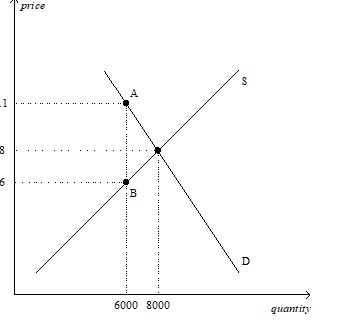 a.What was the equilibrium price and quantity in this market before the tax?
b.What is the amount of the tax?
c.How much of the tax will the buyers pay?
d.How much of the tax will the sellers pay?
e.How much will the buyer pay for the product after the tax is imposed?
a.What was the equilibrium price and quantity in this market before the tax?
b.What is the amount of the tax?
c.How much of the tax will the buyers pay?
d.How much of the tax will the sellers pay?
e.How much will the buyer pay for the product after the tax is imposed? (Essay)
4.8/5 (89)
(89) The price paid by buyers in a market will increase if the government
(Multiple Choice)
4.9/5 (75)
(75) Figure 6-26  -Refer to Figure 6-26. A price floor set at $60 would create a surplus of 20 units.
 (True/False)
4.8/5 (89)
(89) A price floor is a legal minimum on the price at which a good or service can be sold.
(True/False)
4.7/5 (78)
(78) Figure 6-6  -Refer to Figure 6-6. If the government imposes a price floor of $14 on this market, then there will be
 (Multiple Choice)
4.9/5 (68)
(68) Long lines and discrimination are examples of rationing methods that may naturally develop in response to a binding price ceiling.
(True/False)
4.7/5 (90)
(90) Figure 6-27  -Refer to Figure 6-27. If the government places a $2 tax in the market, the buyer bears $2 of the tax burden.
 (True/False)
4.8/5 (87)
(87) Figure 6-9  -Refer to Figure 6-9. At which price would a price ceiling be binding?
 (Multiple Choice)
4.8/5 (66)
(66) Figure 6-17  -Refer to Figure 6-17. In the after-tax equilibrium, how much revenue does the government collect from the tax on this good?
 (Multiple Choice)
4.8/5 (78)
(78) A binding price ceiling (i)
Causes a surplus.(ii)
Causes a shortage.(iii)
Is set at a price above the equilibrium price.(iv)
Is set at a price below the equilibrium price.
(Multiple Choice)
4.8/5 (90)
(90) 
Filters
- Essay(0)
- Multiple Choice(0)
- Short Answer(0)
- True False(0)
- Matching(0)