



 Chat with AI
Exam 21: International Trade Restrictions

Exam 1: Economics: The World Around You90 Questions
Exam 2: Choice, opportunity Costs, and Specialization95 Questions
Exam 3: Markets, Demand and Supply, and the Price System98 Questions
Exam 4: The Market System and the Private and Public Sector100 Questions
Exam 5: Elasticity: Demand and Supply132 Questions
Exam 6: Consumer Choice142 Questions
Exam 7: Supply: The Costs of Doing Business106 Questions
Exam 8: Profit Maximization122 Questions
Exam 9: Perfect Competition135 Questions
Exam 10: Monopoly118 Questions
Exam 11: Monopolistic Competition and Oligopoly114 Questions
Exam 12: Antitrust and Regulation100 Questions
Exam 13: Market Failures, Government Failures, and Rent Seeking121 Questions
Exam 14: Resource Markets112 Questions
Exam 15: The Labor Market117 Questions
Exam 16: Capital Markets100 Questions
Exam 17: The Land Market and Natural Resources55 Questions
Exam 18: Aging, Social Security and Health Care88 Questions
Exam 19: Income Distribution,Poverty and Government Policy115 Questions
Exam 20: World Trade Equilibrium112 Questions
Exam 21: International Trade Restrictions109 Questions
Exam 22: Exchange Rates and Financial Links Between Countries132 Questions
Select questions type


Which of the following probably best explains why trade restrictions are imposed even if the costs to consumers are greater than the benefits to protected industries?
(Multiple Choice)
4.8/5  (89)
(89) When dealing with strategic trade policy,one practical problem for government is the likelihood of retaliation by the foreign government.
(True/False)
4.9/5 (82)
(82) When barriers to trade are imposed,we should expect some groups to be harmed at the expense of other groups.
(True/False)
4.9/5 (82)
(82) The world output is higher if the countries follow restrictive trade policies rather than free trade.
(True/False)
4.9/5 (74)
(74) Protection is rarely withdrawn from infant industries because such firms are necessary to ensure creation of domestic jobs.
(True/False)
4.9/5 (84)
(84) Typically,restrictions to "save domestic jobs" simply redistribute jobs by creating:
(Multiple Choice)
4.8/5 (68)
(68) Employers and workers in the protected industry know that the consequences of protection are principally:
(Multiple Choice)
5.0/5 (86)
(86) In the United States,a "buy American" act was passed in 1933 to create larger markets for domestic goods.
(True/False)
4.9/5 (77)
(77) The most successful free trade agreements achieve all of the following goals,except:
(Multiple Choice)
4.9/5 (71)
(71) It is often argued that if foreign goods are kept out of the domestic economy:
(Multiple Choice)
4.8/5 (75)
(75) The figure given below depicts the negatively sloped demand and positively sloped supply curves of wheat in a country. Figure 21.2 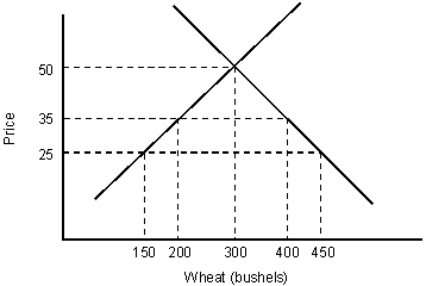 - In Figure 21.2,if the world price of wheat is $35 and a $15 tariff is imposed:
 (Multiple Choice)
4.8/5 (84)
(84) Tariff accounts for 32% of the total government revenue in the U.K.and only 1.2% in India.
(True/False)
4.9/5 (94)
(94) Developing countries often justify imposition of tariffs because:
(Multiple Choice)
4.9/5 (68)
(68) The figure given below depicts the negatively sloped demand and positively sloped supply curves of wheat in a country. Figure 21.2 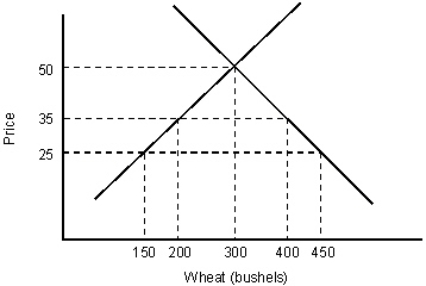 - In Figure 21.2,if the world price per bushel of wheat is $25,and a tariff of $10 is imposed,what is the domestic production?
 (Multiple Choice)
4.7/5 (73)
(73) In order to protect key industries,some countries impose taxes on their exports instead of imports,mainly because it is easier to collect taxes from the export industry.
(True/False)
4.7/5 (78)
(78) As a result of the government procurement policy in the U.S.:
(Multiple Choice)
4.8/5 (80)
(80) The figure below shows the demand (D) and supply (S) curves of a good produced domestically in an economy as well as traded in the international market. Figure 21.1 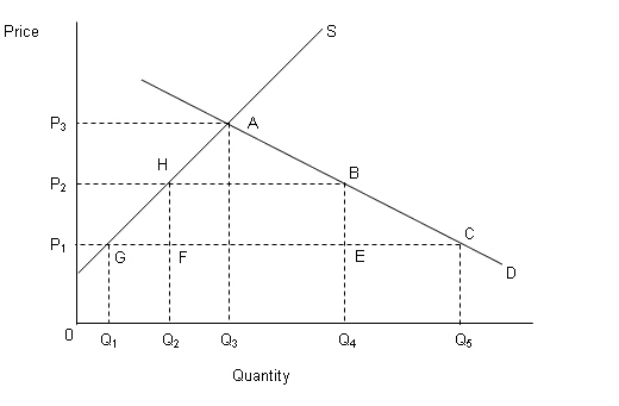 In the figure,
P1: Price of the good in the international market.
P2: Price of the good in the domestic market after the imposition of tariff by the government.
P3: No-trade price of the good in the domestic market.
-According to Figure 21.1,the tariff revenue earned by the domestic government is equal to the:
In the figure,
P1: Price of the good in the international market.
P2: Price of the good in the domestic market after the imposition of tariff by the government.
P3: No-trade price of the good in the domestic market.
-According to Figure 21.1,the tariff revenue earned by the domestic government is equal to the: (Multiple Choice)
4.9/5 (90)
(90) After the U.S.government had approved the feeding of hormones to U.S.beef cattle,several western European nations restricted the import of beef from the U.S.Which of the following tools of commercial policy had been put to use in this situation?
(Multiple Choice)
4.9/5 (78)
(78) The figure below shows the demand (D) and supply (S) curves of a good produced domestically in an economy as well as traded in the international market. Figure 21.1 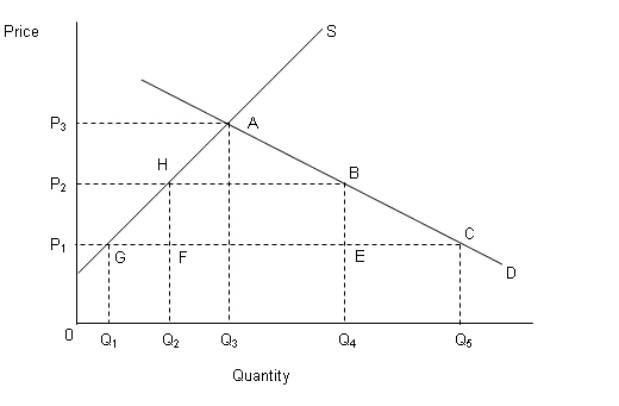 In the figure,
P1: Price of the good in the international market.
P2: Price of the good in the domestic market after the imposition of tariff by the government.
P3: No-trade price of the good in the domestic market.
-According to Figure 21.1,the domestic equilibrium quantity of the good is:
In the figure,
P1: Price of the good in the international market.
P2: Price of the good in the domestic market after the imposition of tariff by the government.
P3: No-trade price of the good in the domestic market.
-According to Figure 21.1,the domestic equilibrium quantity of the good is: (Multiple Choice)
4.7/5 (75)
(75) 
Filters
- Essay(0)
- Multiple Choice(0)
- Short Answer(0)
- True False(0)
- Matching(0)