



 Chat with AI
Exam 21: International Trade Restrictions

Exam 1: Economics: The World Around You90 Questions
Exam 2: Choice, opportunity Costs, and Specialization95 Questions
Exam 3: Markets, Demand and Supply, and the Price System98 Questions
Exam 4: The Market System and the Private and Public Sector100 Questions
Exam 5: Elasticity: Demand and Supply132 Questions
Exam 6: Consumer Choice142 Questions
Exam 7: Supply: The Costs of Doing Business106 Questions
Exam 8: Profit Maximization122 Questions
Exam 9: Perfect Competition135 Questions
Exam 10: Monopoly118 Questions
Exam 11: Monopolistic Competition and Oligopoly114 Questions
Exam 12: Antitrust and Regulation100 Questions
Exam 13: Market Failures, Government Failures, and Rent Seeking121 Questions
Exam 14: Resource Markets112 Questions
Exam 15: The Labor Market117 Questions
Exam 16: Capital Markets100 Questions
Exam 17: The Land Market and Natural Resources55 Questions
Exam 18: Aging, Social Security and Health Care88 Questions
Exam 19: Income Distribution,Poverty and Government Policy115 Questions
Exam 20: World Trade Equilibrium112 Questions
Exam 21: International Trade Restrictions109 Questions
Exam 22: Exchange Rates and Financial Links Between Countries132 Questions
Select questions type


Suppose that the world price of kiwi fruit ($10 per box) is below the domestic price ($12 per box).A tariff of $1 per box would:
(Multiple Choice)
4.8/5  (84)
(84) If average costs of production decline with increases in output for a particular firm:
(Multiple Choice)
4.9/5 (70)
(70) The figure below shows the demand (D) and supply (S) curves of corn syrups. Figure 21.3 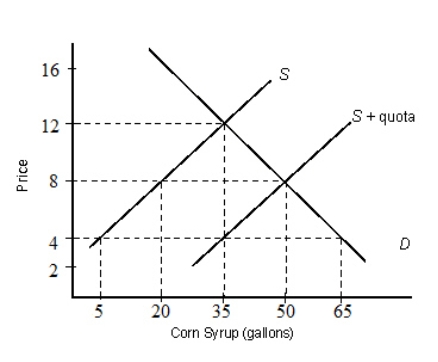 - In Figure 21.3,suppose an import quota of 30 gallons of corn syrup is imposed.If the world price per gallon is $4:
 (Multiple Choice)
4.9/5 (79)
(79) The figure below shows the demand (D) and supply (S) curves of a good produced domestically in an economy as well as traded in the international market. Figure 21.1 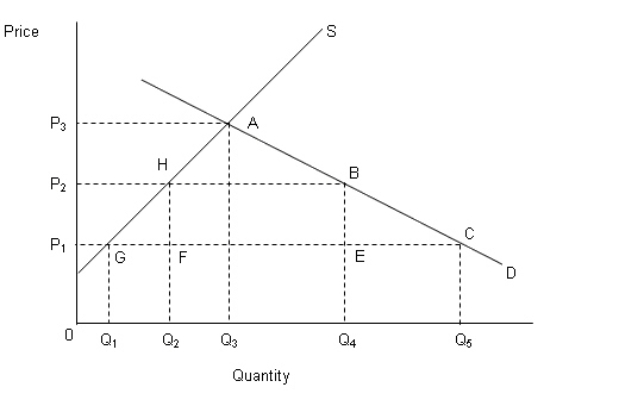 In the figure,
P1: Price of the good in the international market.
P2: Price of the good in the domestic market after the imposition of tariff by the government.
P3: No-trade price of the good in the domestic market.
-Refer to Figure 21.1.If the government imposes a tariff such that the price of the good in the domestic market is P2 while the international price is P1,the dollar value of the tariff is equal to:
In the figure,
P1: Price of the good in the international market.
P2: Price of the good in the domestic market after the imposition of tariff by the government.
P3: No-trade price of the good in the domestic market.
-Refer to Figure 21.1.If the government imposes a tariff such that the price of the good in the domestic market is P2 while the international price is P1,the dollar value of the tariff is equal to: (Multiple Choice)
4.8/5 (82)
(82) The figure below shows the demand (D) and supply (S) curves of corn syrups. Figure 21.3 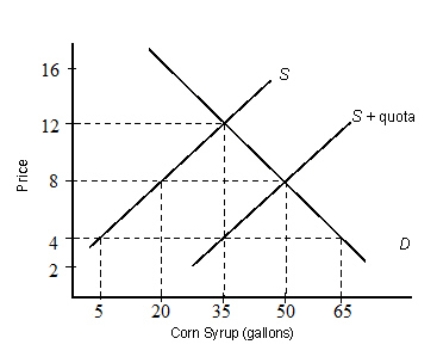 -In Figure 21.3,with an import quota of 30 gallons of corn syrup,what is the new equilibrium quantity demanded?
 (Multiple Choice)
4.8/5 (67)
(67) Which of the following statements about an increasing-returns-to-scale industry is not true?
(Multiple Choice)
4.8/5 (82)
(82) Steel producers in the United States observe that foreign sales of U.S.steel has drastically declined due to stringent trade policies adopted by the foreign governments and unfair treatment of U.S.steel exports in foreign countries.The lobbying efforts of such loss making U.S.steel manufacturers induces the domestic government to restrict the entry of imported steel and help stimulate the sales of domestically produced steel.Which of the following is most similar to the example mentioned above?
(Multiple Choice)
4.7/5 (94)
(94) The figure given below depicts the negatively sloped demand and positively sloped supply curves of wheat in a country. Figure 21.2 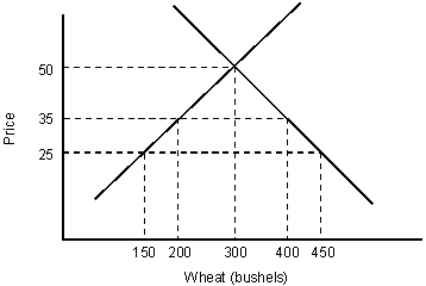 - In Figure 21.2,if the world price of wheat is $25 and a $10 tariff is imposed:
 (Multiple Choice)
5.0/5 (84)
(84) The figure below shows the demand (D) and supply (S) curves of cocoa in the U.S. Figure 21.4 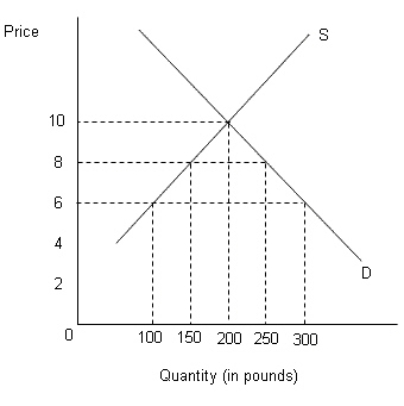 - Refer to Figure 21.4.Assume that Ghana is the only cocoa exporter supplying cocoa in the world market at $6 per pound.If the U.S.enters into a free trade agreement (FTA) with Ghana,what would be its total cocoa imports?
 (Multiple Choice)
4.9/5 (65)
(65) Tariffs are considered to be a popular tax in the first world countries,who justify them on the basis of the revenue they generate for government spending.
(True/False)
4.9/5 (79)
(79) Protecting infant industries from foreign competition may make sense,but only until the industry matures.
(True/False)
4.9/5 (84)
(84) When restrictions alter the pattern of international trade,the _____ benefit and the _____ suffer(s).
(Multiple Choice)
4.8/5 (83)
(83) In the light of the infant industry argument,identify the industry which is likely to have substantially high initial costs.
(Multiple Choice)
4.8/5 (84)
(84) Protection of an infant industry should be withdrawn once that industry:
(Multiple Choice)
4.8/5 (78)
(78) Which of the following statements is true of the impact of trade restrictions on domestic employment?
(Multiple Choice)
4.7/5 (83)
(83) The figure below shows the demand (D) and supply (S) curves of cocoa in the U.S. Figure 21.4 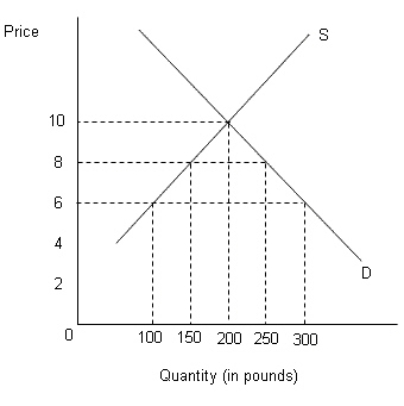 - Refer to Figure 21.4.If cocoa sells for $6 per pound in the world market,determine the volume of U.S.cocoa imports.
 (Multiple Choice)
5.0/5 (88)
(88) Suppose the production of helicopters is an industry characterized by increasing returns to scale and an Argentine firm,Cicare,is the only player in this market.The firm caters to the global market and earns a profit of $10 million.Flettner,a German firm has been considering entering this market for a while,but it is aware that its entry will cause each firm to lose about $4 million.However,a government subsidy allows Flettner to enter the helicopter market and Cicare incurs a loss of $4 million due to its entry.Eventually,Flettner evolves as the monopoly supplier of helicopters while Cicare is forced to shut down.This conclusion rests on which of the following assumptions?
(Multiple Choice)
4.8/5 (92)
(92) Nascent industries require adequate protection from foreign competition because:
(Multiple Choice)
4.9/5 (71)
(71) 
Filters
- Essay(0)
- Multiple Choice(0)
- Short Answer(0)
- True False(0)
- Matching(0)