



 Chat with AI
Exam 19: Income Distribution,Poverty and Government Policy

Exam 1: Economics: The World Around You90 Questions
Exam 2: Choice, opportunity Costs, and Specialization95 Questions
Exam 3: Markets, Demand and Supply, and the Price System98 Questions
Exam 4: The Market System and the Private and Public Sector100 Questions
Exam 5: Elasticity: Demand and Supply132 Questions
Exam 6: Consumer Choice142 Questions
Exam 7: Supply: The Costs of Doing Business106 Questions
Exam 8: Profit Maximization122 Questions
Exam 9: Perfect Competition135 Questions
Exam 10: Monopoly118 Questions
Exam 11: Monopolistic Competition and Oligopoly114 Questions
Exam 12: Antitrust and Regulation100 Questions
Exam 13: Market Failures, Government Failures, and Rent Seeking121 Questions
Exam 14: Resource Markets112 Questions
Exam 15: The Labor Market117 Questions
Exam 16: Capital Markets100 Questions
Exam 17: The Land Market and Natural Resources55 Questions
Exam 18: Aging, Social Security and Health Care88 Questions
Exam 19: Income Distribution,Poverty and Government Policy115 Questions
Exam 20: World Trade Equilibrium112 Questions
Exam 21: International Trade Restrictions109 Questions
Exam 22: Exchange Rates and Financial Links Between Countries132 Questions
Select questions type


The income tax structure in the United States is regressive in nature.

Free
(True/False)
4.8/5  (69)
(69) Correct Answer: Verified
False
When a low-income individual receives a transfer payment,that individual has less of an incentive to forgo leisure time for work time.
Free
(True/False)
4.7/5 (77)
(77) Correct Answer:Verified
VerifiedTrue
The table below shows the distribution of income in the U.S.in the year 1978. Table 19.1
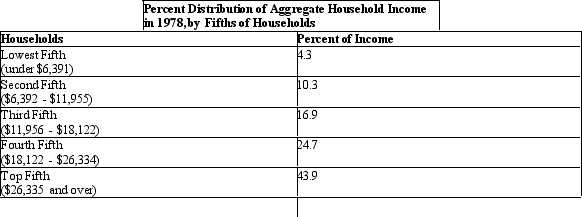 - Refer to Table 19.1.What percentage of income is received by the bottom 20% of the households?
Free
(Multiple Choice)
4.9/5 (73)
(73) Correct Answer:Verified
VerifiedD
Which of the following statements in the context of poverty in the U.S.is true?
(Multiple Choice)
4.7/5 (83)
(83) The rule which is used to compare economic growth among the nations is:
(Multiple Choice)
4.8/5 (79)
(79) The welfare programs undertaken by the U.S.government has been universally successful in reducing poverty and fostering economic growth.
(True/False)
4.8/5 (58)
(58) If those who are poor at any one time are poor only temporarily,then their plight is only temporary.This statement is based on which of the following assumptions?
(Multiple Choice)
4.8/5 (90)
(90) _____ are the primary population group with poverty-level incomes in the USA.
(Multiple Choice)
4.8/5 (81)
(81) For people who are too well off to receive welfare benefits but who would become eligible for negative income tax payments,the negative income tax might create work disincentives.
(True/False)
4.9/5 (82)
(82) If 50 percent of the population receives 20 percent of the total income it can be represented by:
(Multiple Choice)
4.9/5 (84)
(84) If the negative income tax rate is less than 100 percent,the break-even income level will be lower than the poverty level,and families who are officially considered poor will not receive the benefits.
(True/False)
4.9/5 (92)
(92) If the guaranteed income floor for a family of four is $14,000 and the tax rate is 50 percent,then the break-even income for this family will be $28,000.
(True/False)
4.8/5 (80)
(80) Government policies designed to change the distribution of income to one that is more equal involve taking from the rich and giving to the poor.
(True/False)
4.9/5 (87)
(87) The extent to which people move from one income quintile to another over time is called _____.
(Multiple Choice)
4.8/5 (89)
(89) Under the negative income tax program,a family will always receive some amount of transfer from the government,irrespective of its income level.
(True/False)
4.9/5 (66)
(66) Unemployment insurance provided by the U.S.government is usually funded by:
(Multiple Choice)
4.8/5 (85)
(85) The figure given below shows the Lorenz curves of two countries (Country A and Country B). Figure 19.2
Total income (cumulative percentage) 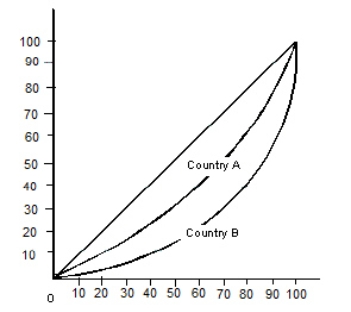 Total population (cumuative percentage)
-Refer to Figure 19.2.The richest 20 percent of the population in Country A receive:
Total population (cumuative percentage)
-Refer to Figure 19.2.The richest 20 percent of the population in Country A receive: (Multiple Choice)
4.8/5 (90)
(90) 
Filters
- Essay(0)
- Multiple Choice(0)
- Short Answer(0)
- True False(0)
- Matching(0)