



 Chat with AI
Exam 16: Capital Markets

Exam 1: Economics: The World Around You90 Questions
Exam 2: Choice, opportunity Costs, and Specialization95 Questions
Exam 3: Markets, Demand and Supply, and the Price System98 Questions
Exam 4: The Market System and the Private and Public Sector100 Questions
Exam 5: Elasticity: Demand and Supply132 Questions
Exam 6: Consumer Choice142 Questions
Exam 7: Supply: The Costs of Doing Business106 Questions
Exam 8: Profit Maximization122 Questions
Exam 9: Perfect Competition135 Questions
Exam 10: Monopoly118 Questions
Exam 11: Monopolistic Competition and Oligopoly114 Questions
Exam 12: Antitrust and Regulation100 Questions
Exam 13: Market Failures, Government Failures, and Rent Seeking121 Questions
Exam 14: Resource Markets112 Questions
Exam 15: The Labor Market117 Questions
Exam 16: Capital Markets100 Questions
Exam 17: The Land Market and Natural Resources55 Questions
Exam 18: Aging, Social Security and Health Care88 Questions
Exam 19: Income Distribution,Poverty and Government Policy115 Questions
Exam 20: World Trade Equilibrium112 Questions
Exam 21: International Trade Restrictions109 Questions
Exam 22: Exchange Rates and Financial Links Between Countries132 Questions
Select questions type


A bubble or panic generally occurs in the stock market because of:

Free
(Multiple Choice)
4.8/5  (79)
(79) Correct Answer: Verified
C
Buying a newly issued bond implies:
Free
(Multiple Choice)
4.9/5 (73)
(73) Correct Answer:Verified
VerifiedC
Mutual funds that are composed of corporate and government bonds are known as:
Free
(Multiple Choice)
4.7/5 (74)
(74) Correct Answer:Verified
VerifiedD
Shane holds wealth worth $10,000.He considers investing it equally in two gambles one of which has a probability of 0.6 to yield a return of 10% and the other has a probability of 0.4 to yield a return of 20%.What will be Shane's total expected return from the two gambles?
(Multiple Choice)
4.7/5 (82)
(82) If the number of people who want to sell of stocks are higher than those who want to buy it,the stock prices move up.
(True/False)
4.8/5 (75)
(75) The figure given below shows the demand curves [D1 and D2] and the supply curve [S1] of capital. Figure 16.1 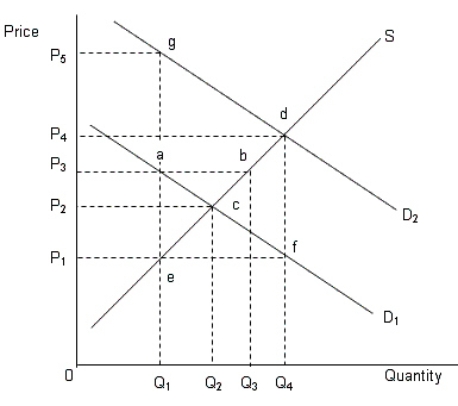 - In Figure 16.1,if the price set in the market is P3 when the demand curve is D1,then:
 (Multiple Choice)
4.7/5 (84)
(84) A bond with a par value of $1,000 is traded at $1,500.The coupon rate offered on the bond is 10 percent.The bond matures after a period of 5 years .The coupon paid to the bond holder after the end of the first year is:
(Multiple Choice)
4.8/5 (75)
(75) Most stock indexes use which of the following measures to weight the companies that participate in the index?
(Multiple Choice)
4.9/5 (93)
(93) Which of the following names is given to the corporate bonds that carry the maximum risk?
(Multiple Choice)
4.8/5 (85)
(85) When the interest rate on the alternative investments rise,it becomes costly for the bondholders to retain their bonds with them.
(True/False)
4.9/5 (82)
(82) The amount that a risk averse person requires to take on risk is called:
(Multiple Choice)
4.9/5 (83)
(83) As the price of capital falls,the quantity of capital that producers are willing and able to offer falls.
(True/False)
4.9/5 (70)
(70) The fixed amount that the issuer of a bond agrees to pay the bondholder each year until the bond matures is called:
(Multiple Choice)
4.9/5 (81)
(81) What is the main difference between common and preferred stocks?
(Multiple Choice)
4.9/5 (85)
(85) A mutual fund for which a fee is paid at the time of purchase is a:
(Multiple Choice)
4.8/5 (61)
(61) 
Filters
- Essay(0)
- Multiple Choice(0)
- Short Answer(0)
- True False(0)
- Matching(0)