



 Chat with AI
Exam 21: International Trade Restrictions

Exam 1: Economics: The World Around You90 Questions
Exam 2: Choice, opportunity Costs, and Specialization95 Questions
Exam 3: Markets, Demand and Supply, and the Price System98 Questions
Exam 4: The Market System and the Private and Public Sector100 Questions
Exam 5: Elasticity: Demand and Supply132 Questions
Exam 6: Consumer Choice142 Questions
Exam 7: Supply: The Costs of Doing Business106 Questions
Exam 8: Profit Maximization122 Questions
Exam 9: Perfect Competition135 Questions
Exam 10: Monopoly118 Questions
Exam 11: Monopolistic Competition and Oligopoly114 Questions
Exam 12: Antitrust and Regulation100 Questions
Exam 13: Market Failures, Government Failures, and Rent Seeking121 Questions
Exam 14: Resource Markets112 Questions
Exam 15: The Labor Market117 Questions
Exam 16: Capital Markets100 Questions
Exam 17: The Land Market and Natural Resources55 Questions
Exam 18: Aging, Social Security and Health Care88 Questions
Exam 19: Income Distribution,Poverty and Government Policy115 Questions
Exam 20: World Trade Equilibrium112 Questions
Exam 21: International Trade Restrictions109 Questions
Exam 22: Exchange Rates and Financial Links Between Countries132 Questions
Select questions type


If the world price of a good is lower than its domestic equilibrium price,the country will:
(Multiple Choice)
5.0/5  (69)
(69) The United States has no comparative advantage in shipping,so a domestic shipping industry has no reason to exist.
(True/False)
4.9/5 (78)
(78) International trade on the basis of comparative advantage maximizes world output and allows consumers to access better-quality products at lower prices than would be available in the domestic market alone.
(True/False)
4.9/5 (81)
(81) The figure given below depicts the negatively sloped demand and positively sloped supply curves of wheat in a country. Figure 21.2 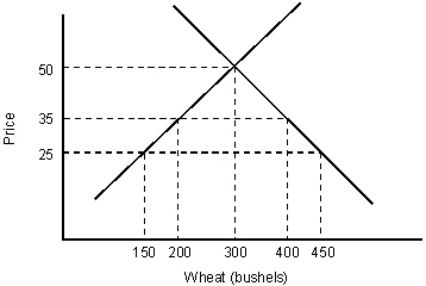 - According to Figure 21.2,if the world price per bushel of wheat is $25,what is the domestic production?
 (Multiple Choice)
4.8/5 (82)
(82) The figure below shows the demand (D) and supply (S) curves of corn syrups. Figure 21.3 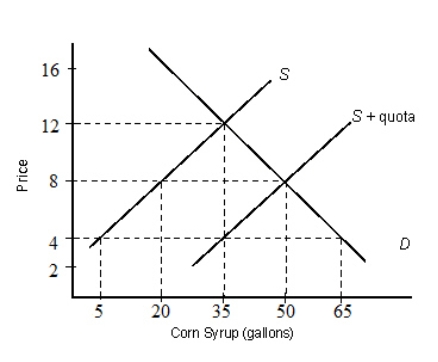 - In Figure 21.3,with an import quota of 30 gallons of corn syrup,what is the new equilibrium price?
 (Multiple Choice)
4.8/5 (80)
(80) Which of the following statements about international trade restrictions is true?
(Multiple Choice)
4.8/5 (74)
(74) The notion of reciprocity means that one nation will impose import restrictions on another in order to:
(Multiple Choice)
4.8/5 (78)
(78) Agreements to abolish most barriers to trade among nations are known as:
(Multiple Choice)
4.9/5 (98)
(98) One important unintended consequence of the Smoot-Hawley Tariff Act was to:
(Multiple Choice)
4.7/5 (72)
(72) If the average costs of production decline with increases in output,then the larger a firm is,the lower its per unit costs will be.
(True/False)
4.8/5 (92)
(92) Domestic firms often claim that foreign firms have an unfair advantage because foreign workers are willing to work for very low wages.
(True/False)
5.0/5 (71)
(71) Which of the following can be considered as a cultural barrier to trade?
(Multiple Choice)
4.8/5 (89)
(89) Many economists believe that the collapse of world trade and the depression in the 1930s were linked by a decrease in real income caused by producing on the basis of comparative advantage.
(True/False)
4.7/5 (56)
(56) Industries that are truly critical to the national defense should be protected from foreign competition if that is the only way to ensure their existence.
(True/False)
4.9/5 (74)
(74) In a free trade area,member nations have no trade barriers among themselves but are free to set their own trade policies toward nonmembers.
(True/False)
4.9/5 (77)
(77) The figure given below depicts the negatively sloped demand and positively sloped supply curves of wheat in a country. Figure 21.2 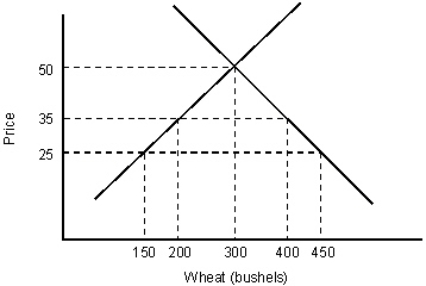 - According to Figure 21.2,if the world price of wheat is $25 and a tariff of $25 is imposed by the domestic government,the total tariff revenue collected by the government is:
 (Multiple Choice)
4.9/5 (80)
(80) 
Filters
- Essay(0)
- Multiple Choice(0)
- Short Answer(0)
- True False(0)
- Matching(0)