



 Chat with AI
Exam 21: International Trade Restrictions

Exam 1: Economics: The World Around You90 Questions
Exam 2: Choice, opportunity Costs, and Specialization95 Questions
Exam 3: Markets, Demand and Supply, and the Price System98 Questions
Exam 4: The Market System and the Private and Public Sector100 Questions
Exam 5: Elasticity: Demand and Supply132 Questions
Exam 6: Consumer Choice142 Questions
Exam 7: Supply: The Costs of Doing Business106 Questions
Exam 8: Profit Maximization122 Questions
Exam 9: Perfect Competition135 Questions
Exam 10: Monopoly118 Questions
Exam 11: Monopolistic Competition and Oligopoly114 Questions
Exam 12: Antitrust and Regulation100 Questions
Exam 13: Market Failures, Government Failures, and Rent Seeking121 Questions
Exam 14: Resource Markets112 Questions
Exam 15: The Labor Market117 Questions
Exam 16: Capital Markets100 Questions
Exam 17: The Land Market and Natural Resources55 Questions
Exam 18: Aging, Social Security and Health Care88 Questions
Exam 19: Income Distribution,Poverty and Government Policy115 Questions
Exam 20: World Trade Equilibrium112 Questions
Exam 21: International Trade Restrictions109 Questions
Exam 22: Exchange Rates and Financial Links Between Countries132 Questions
Select questions type


Protection provided to the infant industries is rarely withdrawn because:
(Multiple Choice)
4.9/5  (78)
(78) Which of the following tools of commercial policy acts as a quantitative restriction on imports?
(Multiple Choice)
4.9/5 (77)
(77) Preferential trade agreements have a beneficial trade-diversion effect when they reduce prices for traded goods and stimulate the volume of international trade.
(True/False)
4.9/5 (93)
(93) While it is possible to erect barriers to foreign competition and save domestic jobs,restricting international trade may impose large costs on an economy.
(True/False)
4.8/5 (73)
(73) The effect of an import quota on the domestic market is to shift the:
(Multiple Choice)
4.8/5 (78)
(78) When production does not proceed on the basis of comparative advantage,resources are expended on their most efficient uses.
(True/False)
4.8/5 (94)
(94) When the world price of the traded good is lower than the domestic no-trade equilibrium price,free trade causes domestic production to fall and domestic consumption to rise.
(True/False)
4.9/5 (71)
(71) In reality international trade is determined solely by comparative advantage and the free market forces of supply and demand.
(True/False)
4.7/5 (72)
(72) The figure given below depicts the negatively sloped demand and positively sloped supply curves of wheat in a country. Figure 21.2 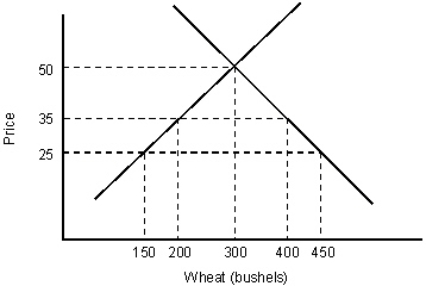 - According to Figure 21.2,if the world price of wheat is $25 and a tariff of $10 is imposed by the domestic government,the total tariff revenue collected by the government is:
 (Multiple Choice)
4.9/5 (74)
(74) The figure given below depicts the negatively sloped demand and positively sloped supply curves of wheat in a country. Figure 21.2 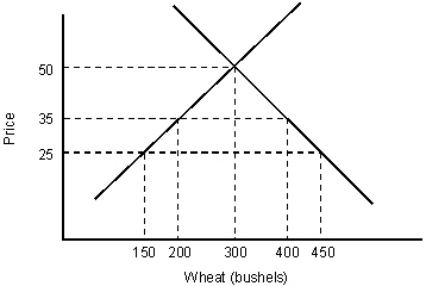 - In Figure 21.2,if the world price per bushel of wheat is $25 and a tariff of $10 is imposed by the domestic government,what is the domestic demand?
 (Multiple Choice)
5.0/5 (77)
(77) The figure below shows the demand (D) and supply (S) curves of cocoa in the U.S. Figure 21.4 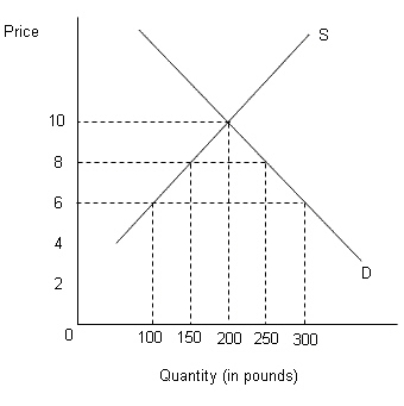 -According to Figure 21.4,the no-trade equilibrium price and quantity of cocoa in the U.S.market are:
 (Multiple Choice)
5.0/5 (86)
(86) Subsidies are payments made by the government of a country to:
(Multiple Choice)
4.9/5 (79)
(79) According to strategic trade policy,international trade largely involves firms which:
(Multiple Choice)
4.8/5 (71)
(71) Creating conditions for fair trade by limiting imports will make the domestic consumers better off,as they will be required to pay low prices for the products.
(True/False)
4.8/5 (77)
(77) According to empirical observations,the cost of restricting international trade in the U.S.is much greater than the benefits generated from restriction.In the light of the above observation,which of the following statements is true?
(Multiple Choice)
4.8/5 (82)
(82) In 1992 the EEC was replaced by the EU with an agreement to:
(Multiple Choice)
4.8/5 (92)
(92) The figure below shows the demand (D) and supply (S) curves of cocoa in the U.S. Figure 21.4 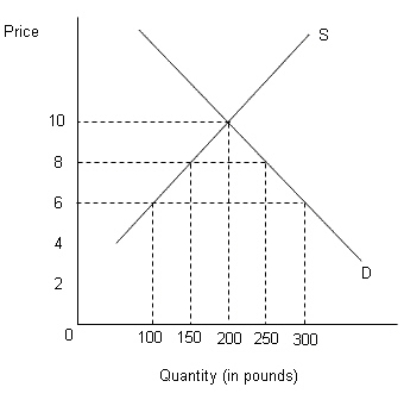 - From Figure 21.4,determine the total volume of U.S.cocoa imports if its government imposes tariff at the rate of $2 per pound on cocoa.
 (Multiple Choice)
4.8/5 (93)
(93) 
Filters
- Essay(0)
- Multiple Choice(0)
- Short Answer(0)
- True False(0)
- Matching(0)