



 Chat with AI
Exam 3: Air Temperature

Exam 1: Discovering the Earths Dimensions104 Questions
Exam 2: The Earths Global Energy Balance129 Questions
Exam 3: Air Temperature157 Questions
Exam 4: Atmospheric Moisture and Precipitation132 Questions
Exam 5: Global Atmospheric and Oceanic Circulation138 Questions
Exam 6: Weather Systems130 Questions
Exam 7: Global Climates and Climate Change148 Questions
Exam 8: Earth From the Inside Out79 Questions
Exam 9: Plate Tectonics, Earthquakes, and Volcanoes79 Questions
Exam 10: Weathering and Mass Wasting56 Questions
Exam 11: Fresh Water of the Continents67 Questions
Exam 12: Land-Forms Made by Running Water59 Questions
Exam 13: Landforms Made by Wind and Waves65 Questions
Exam 14: Glacial and Periglacial Landforms105 Questions
Exam 15: Global Soils137 Questions
Exam 16: Biogeographic Processes105 Questions
Exam 17: Global Biogeography142 Questions
Select questions type


Which of the following does not contribute to global warming?
(Multiple Choice)
4.9/5  (83)
(83) According to the IPCC report of 2007, the possibility that global warming is occurring is considered to be:
(Multiple Choice)
4.8/5 (87)
(87) During the day, air near the ground surface is primarily warmed by:
(Multiple Choice)
4.8/5 (84)
(84) In the northern hemisphere, isotherms tend to shift farther _______ over continents than over oceans during the winter.
(Multiple Choice)
4.8/5 (57)
(57) The curves on this figure show diurnal insolation for a mid-latitude location in the southern hemisphere. The curves for the June solstice, December solstice, and equinoxes are labeled as _________, respectively. 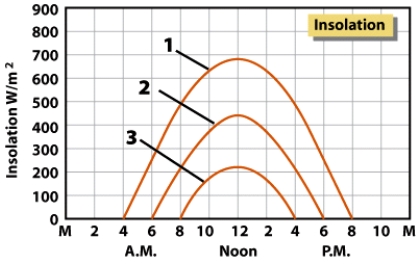
(Multiple Choice)
4.9/5 (72)
(72) Sensible heat refers to the kinetic energy level of the molecules of a substance.
(True/False)
4.9/5 (78)
(78) Water surfaces tend to lose more energy though evaporation than land surfaces.
(True/False)
4.8/5 (81)
(81) _______ is an indication of the intensity of kinetic energy of molecular motion within a substance.
(Multiple Choice)
4.9/5 (70)
(70) __________ can be transferred to or from a surface by radiation, convection, and latent or sensible heat exchanges.
(Short Answer)
4.8/5 (87)
(87) In the northern hemisphere, isotherms tend to shift farther _______ over continents than over oceans during the summer.
(Multiple Choice)
5.0/5 (75)
(75) Coastal cities tend to have more moderate, uniform temperatures and inland cities tend to experience more extreme temperatures.
(True/False)
5.0/5 (71)
(71) ___________ is released when water vapor turns back into a liquid or solid state.
(Multiple Choice)
4.8/5 (84)
(84) For mid-latitude locations, daily net radiation tends to largest on the:
(Multiple Choice)
4.9/5 (86)
(86) During the night, net radiation at the ground surface tends to be positive resulting in the ground surface cooling off.
(True/False)
4.8/5 (74)
(74) For mid-latitude locations, daily net radiation tends to smallest on the:
(Multiple Choice)
4.9/5 (85)
(85) The rate at which air temperature changes with elevation is known as the environmental lapse rate.
(True/False)
4.9/5 (65)
(65) Which of the temperature profiles on this figure most closely resembles the situation you would expect around 3:00 p.m.? 
(Multiple Choice)
4.9/5 (87)
(87) 
Filters
- Essay(0)
- Multiple Choice(0)
- Short Answer(0)
- True False(0)
- Matching(0)