



 Chat with AI
Exam 3: Air Temperature

Exam 1: Discovering the Earths Dimensions104 Questions
Exam 2: The Earths Global Energy Balance129 Questions
Exam 3: Air Temperature157 Questions
Exam 4: Atmospheric Moisture and Precipitation132 Questions
Exam 5: Global Atmospheric and Oceanic Circulation138 Questions
Exam 6: Weather Systems130 Questions
Exam 7: Global Climates and Climate Change148 Questions
Exam 8: Earth From the Inside Out79 Questions
Exam 9: Plate Tectonics, Earthquakes, and Volcanoes79 Questions
Exam 10: Weathering and Mass Wasting56 Questions
Exam 11: Fresh Water of the Continents67 Questions
Exam 12: Land-Forms Made by Running Water59 Questions
Exam 13: Landforms Made by Wind and Waves65 Questions
Exam 14: Glacial and Periglacial Landforms105 Questions
Exam 15: Global Soils137 Questions
Exam 16: Biogeographic Processes105 Questions
Exam 17: Global Biogeography142 Questions
Select questions type


Minimum daily temperatures usually occur about a half hour after _______.
(Short Answer)
4.9/5  (76)
(76) Temperature decreases with elevation in the troposphere because of:
(Multiple Choice)
4.8/5 (68)
(68) Examine the annual net radiation patterns shown in this figure. The curve for the city of Aswan at 24ᵒ N latitude is labeled: 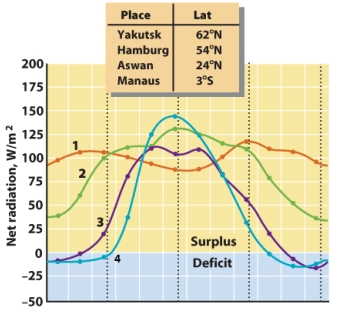
(Multiple Choice)
4.8/5 (84)
(84) Examine the annual net radiation patterns shown in this figure. The curve for the city of Hamburg at 54ᵒ N latitude is labeled: 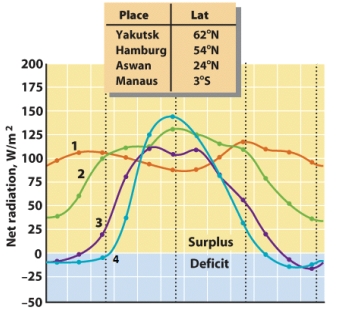
(Multiple Choice)
4.8/5 (84)
(84) Adjacent water and land locations have quite different temperature ranges due to differences in:
(Multiple Choice)
4.8/5 (76)
(76) Urban areas generally absorb more insolation than nearby rural areas because surfaces like asphalt have higher albedos than surfaces like meadow or forest.
(True/False)
4.8/5 (80)
(80) An isotherm is a line that connects points of equal temperature on a map.
(True/False)
4.9/5 (72)
(72) Annual temperature ranges tend to _______ increasing latitude.
(Multiple Choice)
4.8/5 (84)
(84) The situation in which air temperatures increase with elevation is known as a temperature ________.
(Short Answer)
4.8/5 (75)
(75) Insolation tends to be more intense at higher elevations, because there are fewer air molecules to absorb or scatter the sun's light.
(True/False)
4.9/5 (85)
(85) On high mountains, insolation levels will be _______ the adjacent lowlands.
(Multiple Choice)
4.8/5 (77)
(77) Temperature tends to ______ with elevation in the mesosphere, and ________ with elevation in the thermosphere.
(Multiple Choice)
4.9/5 (83)
(83) Outline the factors that cause temperature differences between land and water bodies.
(Essay)
4.9/5 (83)
(83) The process by which plants lose water to the atmosphere by evaporation through leaf pores is called evapotranspiration.
(True/False)
4.8/5 (79)
(79) If you touch a hot oven with your hands and get burned, which transfer of heat process is being observed?
(Multiple Choice)
4.7/5 (87)
(87) Which of the following areas would tend to have the coolest air temperatures on a given day, assuming all receive the same insolation?
(Multiple Choice)
4.8/5 (75)
(75) For mid-latitude locations, total daily insolation tends to smallest on the:
(Multiple Choice)
4.9/5 (81)
(81) 
Filters
- Essay(0)
- Multiple Choice(0)
- Short Answer(0)
- True False(0)
- Matching(0)