



 Chat with AI
Exam 3: Air Temperature

Exam 1: Discovering the Earths Dimensions104 Questions
Exam 2: The Earths Global Energy Balance129 Questions
Exam 3: Air Temperature157 Questions
Exam 4: Atmospheric Moisture and Precipitation132 Questions
Exam 5: Global Atmospheric and Oceanic Circulation138 Questions
Exam 6: Weather Systems130 Questions
Exam 7: Global Climates and Climate Change148 Questions
Exam 8: Earth From the Inside Out79 Questions
Exam 9: Plate Tectonics, Earthquakes, and Volcanoes79 Questions
Exam 10: Weathering and Mass Wasting56 Questions
Exam 11: Fresh Water of the Continents67 Questions
Exam 12: Land-Forms Made by Running Water59 Questions
Exam 13: Landforms Made by Wind and Waves65 Questions
Exam 14: Glacial and Periglacial Landforms105 Questions
Exam 15: Global Soils137 Questions
Exam 16: Biogeographic Processes105 Questions
Exam 17: Global Biogeography142 Questions
Select questions type


During the daytime, net radiation at the ground surface tends to be positive resulting in the ground surface warming up.
(True/False)
4.7/5  (89)
(89) The temperature change in equatorial regions from January to July is __________ the change in mid-latitude regions.
(Multiple Choice)
4.8/5 (89)
(89) For mid-latitude locations, air temperatures tend to be highest on the:
(Multiple Choice)
4.8/5 (66)
(66) Temperature inversions can cause problems for agriculture because they may contribute to:
(Multiple Choice)
4.7/5 (78)
(78) Which of the following surfaces would tend to heat up most, given the same amount of insolation?
(Multiple Choice)
4.8/5 (88)
(88) Average January temperatures are much colder in parts of Siberia than in Antarctica.
(True/False)
4.8/5 (70)
(70) Which of the temperature profiles on this figure most closely resembles the situation you would expect shortly after dawn? 
(Multiple Choice)
5.0/5 (87)
(87) Examine the annual net radiation patterns shown in this figure. The curve for the city of Yakutsk at 62ᵒ N latitude is labeled: 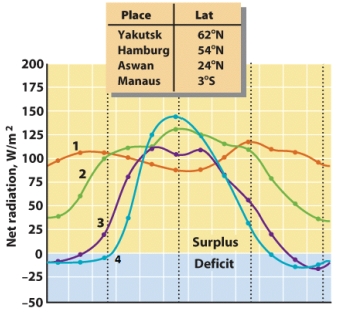
(Multiple Choice)
4.9/5 (64)
(64) Because of their lower ________, urban surfaces like asphalt tend to absorb more insolation than rural surfaces like forest.
(Short Answer)
4.7/5 (87)
(87) Latent heat is the energy that is absorbed by a substance when it changes state.
(True/False)
4.8/5 (82)
(82) Ground surface temperatures tend to be ______ than the temperature of the overlying air.
(Multiple Choice)
4.7/5 (80)
(80) During the daytime, air temperature tends to ______ closer to the ground, and during the night it tends to _______ closer to the ground.
(Multiple Choice)
4.8/5 (82)
(82) Changes in tropospheric aerosols, cloud cover, and land cover associated with human activities all tend to _______ global temperatures.
(Short Answer)
4.8/5 (72)
(72) According to the IPCC report of 2007, the possibility that recent global warming is a result of human activity is considered:
(Multiple Choice)
4.9/5 (77)
(77) On high mountains, air pressure will be _______ the adjacent lowlands.
(Multiple Choice)
4.9/5 (68)
(68) Examine the monthly mean air temperature patterns shown in this figure. The curve for the city of Manaus at 3ᵒ S latitude is labeled: 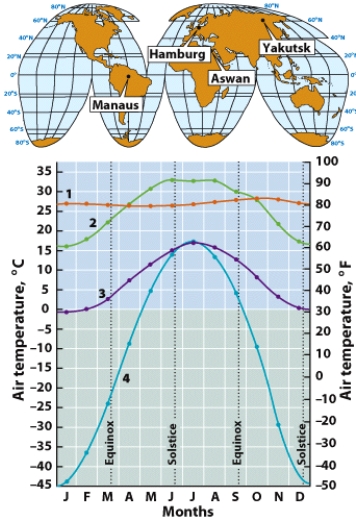
(Multiple Choice)
4.9/5 (81)
(81) Which of these locations would be likely to experience the smallest annual temperature range?
(Multiple Choice)
5.0/5 (72)
(72) 
Filters
- Essay(0)
- Multiple Choice(0)
- Short Answer(0)
- True False(0)
- Matching(0)