



 Chat with AI
Exam 3: Air Temperature

Exam 1: Discovering the Earths Dimensions104 Questions
Exam 2: The Earths Global Energy Balance129 Questions
Exam 3: Air Temperature157 Questions
Exam 4: Atmospheric Moisture and Precipitation132 Questions
Exam 5: Global Atmospheric and Oceanic Circulation138 Questions
Exam 6: Weather Systems130 Questions
Exam 7: Global Climates and Climate Change148 Questions
Exam 8: Earth From the Inside Out79 Questions
Exam 9: Plate Tectonics, Earthquakes, and Volcanoes79 Questions
Exam 10: Weathering and Mass Wasting56 Questions
Exam 11: Fresh Water of the Continents67 Questions
Exam 12: Land-Forms Made by Running Water59 Questions
Exam 13: Landforms Made by Wind and Waves65 Questions
Exam 14: Glacial and Periglacial Landforms105 Questions
Exam 15: Global Soils137 Questions
Exam 16: Biogeographic Processes105 Questions
Exam 17: Global Biogeography142 Questions
Select questions type


The diurnal insolation patterns illustrated on this figure most closely resemble those from: 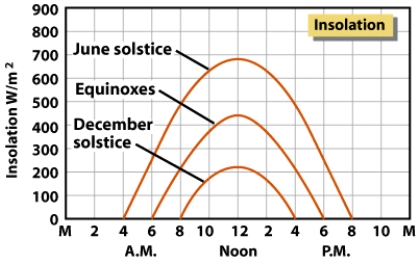
(Multiple Choice)
4.9/5  (74)
(74) Examine the monthly mean air temperature patterns shown in this figure. The curve for the city of Hamburg at 54ᵒ N latitude is labeled: 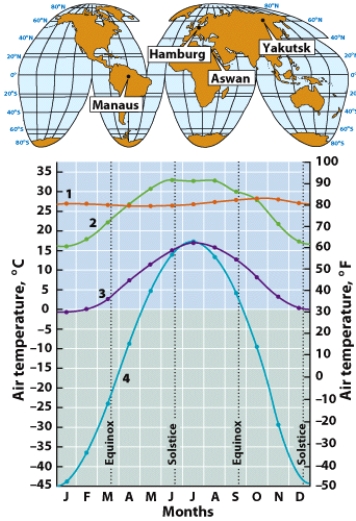
(Multiple Choice)
5.0/5 (88)
(88) Which of the following areas would tend to have the warmest air temperatures on a given day, assuming all receive the same insolation?
(Multiple Choice)
4.9/5 (79)
(79) During the daytime, net radiation at the ground surface tends to be positive.
(True/False)
4.8/5 (86)
(86) Average temperatures tend to increase with elevation in the troposphere , at a given latitude.
(True/False)
4.8/5 (78)
(78) The temperature change in coastal regions from January to July is __________ the change in continental regions.
(Multiple Choice)
4.9/5 (79)
(79) Temperature tends to ______ with elevation in the mesosphere, and ________ with elevation in the stratosphere.
(Multiple Choice)
4.8/5 (74)
(74) The average environmental lapse rate in the troposphere is about:
(Multiple Choice)
4.8/5 (70)
(70) Locations near the equator experience two peaks in annual insolation that coincide with the equinoxes.
(True/False)
4.9/5 (85)
(85) For mid-latitude locations, total daily insolation tends to highest on the:
(Multiple Choice)
5.0/5 (79)
(79) The two lowest layers of the atmosphere are separated by the:
(Multiple Choice)
4.9/5 (80)
(80) Heat energy transferring from a warm object to a cold object when placed in direct contact is a form of conduction.
(True/False)
4.9/5 (91)
(91) Heat that is absorbed and stored in a gas or liquid during the processes of evaporation, melting, or sublimation is:
(Multiple Choice)
4.9/5 (97)
(97) The temperature of the ground surface and the near surface layer of air tends to reach a maximum at the local solar noon, when insolation levels are at their highest.
(True/False)
4.9/5 (80)
(80) Which of the following does not contribute to global warming?
(Multiple Choice)
4.9/5 (80)
(80) Temperature inversions often occur at night, as the ground surface radiatively cools and in turn cools the layer of air immediately above it.
(True/False)
4.7/5 (79)
(79) 
Filters
- Essay(0)
- Multiple Choice(0)
- Short Answer(0)
- True False(0)
- Matching(0)