



 Chat with AI
Exam 3: Air Temperature

Exam 1: Discovering the Earths Dimensions104 Questions
Exam 2: The Earths Global Energy Balance129 Questions
Exam 3: Air Temperature157 Questions
Exam 4: Atmospheric Moisture and Precipitation132 Questions
Exam 5: Global Atmospheric and Oceanic Circulation138 Questions
Exam 6: Weather Systems130 Questions
Exam 7: Global Climates and Climate Change148 Questions
Exam 8: Earth From the Inside Out79 Questions
Exam 9: Plate Tectonics, Earthquakes, and Volcanoes79 Questions
Exam 10: Weathering and Mass Wasting56 Questions
Exam 11: Fresh Water of the Continents67 Questions
Exam 12: Land-Forms Made by Running Water59 Questions
Exam 13: Landforms Made by Wind and Waves65 Questions
Exam 14: Glacial and Periglacial Landforms105 Questions
Exam 15: Global Soils137 Questions
Exam 16: Biogeographic Processes105 Questions
Exam 17: Global Biogeography142 Questions
Select questions type


Urban areas generally absorb more insolation than nearby rural areas because surfaces like asphalt have lower albedos than surfaces like meadow or forest.

Free
(True/False)
4.8/5  (63)
(63) Correct Answer: Verified
True
Temperature decreases with elevation in the stratosphere.
Free
(True/False)
4.9/5 (76)
(76) Correct Answer:Verified
VerifiedFalse
Identify the four major layers of the atmosphere and describe temperature trends within each.
Free
(Essay)
4.8/5 (86)
(86) Correct Answer:Verified
VerifiedThe lowest layer is the troposphere where temperature decreases with elevation at a lapse rate of about 6.4ᵒC per kilometer. Next is the stratosphere, where temperatures increase with elevation due to the absorption of ultraviolet radiation by ozone. In the mesosphere temperature again decreases with elevation until the thermosphere is reached. In the thermosphere, temperature again increases with elevation but because there are few air molecules this layer holds little heat.
Examine the annual net radiation patterns shown in this figure. The curve for the city of Manaus at 3ᵒ S latitude is labeled: 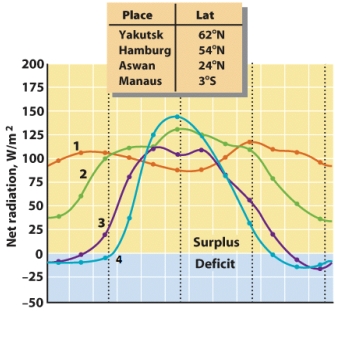
(Multiple Choice)
4.7/5 (86)
(86) Night air temperatures tend to be lower at higher elevations because there are fewer air molecules to absorb outgoing longwave radiation.
(True/False)
5.0/5 (77)
(77) The largest influence on annual temperature cycles is from differences in insolation received at different ________.
(Short Answer)
4.7/5 (86)
(86) The surface layer of a beach would heat up ____ than the adjacent water surface during the day, and cool down ____ during the night, during a summer day-night cycle.
(Multiple Choice)
4.8/5 (87)
(87) _____ can be transferred by the processes of conduction or convection.
(Multiple Choice)
4.8/5 (70)
(70) On high mountains, air temperatures will tend to be _______ the adjacent lowlands.
(Multiple Choice)
4.9/5 (72)
(72) The layer of the atmosphere above the troposphere that contains the ozone layer is called the ________.
(Short Answer)
4.8/5 (73)
(73) Temperature tends to ______ with elevation in the troposphere, and ________ with elevation in the stratosphere.
(Multiple Choice)
4.8/5 (85)
(85) A trend of decreasing air temperature with elevation is called a temperature inversion.
(True/False)
4.8/5 (89)
(89) Annual temperature ranges tend to _______ decreasing latitude.
(Multiple Choice)
5.0/5 (77)
(77) Aerosols are tiny particles in the atmosphere that are so small that the slightest air movement keeps them aloft.
(True/False)
4.9/5 (78)
(78) Which of these locations would be likely to experience the largest annual temperature range?
(Multiple Choice)
4.7/5 (78)
(78) A trend of increasing air temperature with elevation is called a temperature inversion.
(True/False)
4.8/5 (85)
(85) Which of these locations would experience the smallest annual variation in the length of day?
(Multiple Choice)
5.0/5 (84)
(84) Aerosols produced by human activities like fossil fuel burning are thought to be contributing to increases in global temperature.
(True/False)
4.8/5 (79)
(79) Temperature inversions often occur during the day, as the ground surface radiatively warms and in turn warms the layer of air immediately above it.
(True/False)
4.9/5 (79)
(79) 
Filters
- Essay(0)
- Multiple Choice(0)
- Short Answer(0)
- True False(0)
- Matching(0)