



 Chat with AI
Exam 3: Air Temperature

Exam 1: Discovering the Earths Dimensions104 Questions
Exam 2: The Earths Global Energy Balance129 Questions
Exam 3: Air Temperature157 Questions
Exam 4: Atmospheric Moisture and Precipitation132 Questions
Exam 5: Global Atmospheric and Oceanic Circulation138 Questions
Exam 6: Weather Systems130 Questions
Exam 7: Global Climates and Climate Change148 Questions
Exam 8: Earth From the Inside Out79 Questions
Exam 9: Plate Tectonics, Earthquakes, and Volcanoes79 Questions
Exam 10: Weathering and Mass Wasting56 Questions
Exam 11: Fresh Water of the Continents67 Questions
Exam 12: Land-Forms Made by Running Water59 Questions
Exam 13: Landforms Made by Wind and Waves65 Questions
Exam 14: Glacial and Periglacial Landforms105 Questions
Exam 15: Global Soils137 Questions
Exam 16: Biogeographic Processes105 Questions
Exam 17: Global Biogeography142 Questions
Select questions type


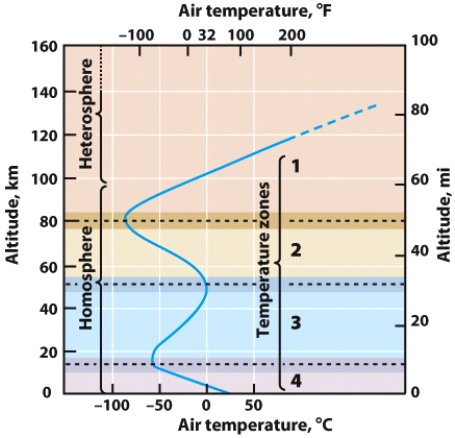
Which of these locations would experience the largest annual variation in the length of day?
(Multiple Choice)
4.9/5  (74)
(74) 
_______ is a very important mechanism for transporting large amounts of energy from one region of the earth to another.
(Multiple Choice)
4.8/5 (85)
(85) Which of the following is a source of information about past temperatures?
(Multiple Choice)
4.9/5 (68)
(68) The latest IPCC report projects that global temperatures will warm between 1.8ᵒ C and 4.0ᵒ C by the year 2100.
(True/False)
4.9/5 (77)
(77) Lines that connect points of equal temperature on a map are called:
(Multiple Choice)
4.8/5 (82)
(82) Examine the monthly mean air temperature patterns shown in this figure. The curve for the city of Yakutsk at 62ᵒ N latitude is labeled: 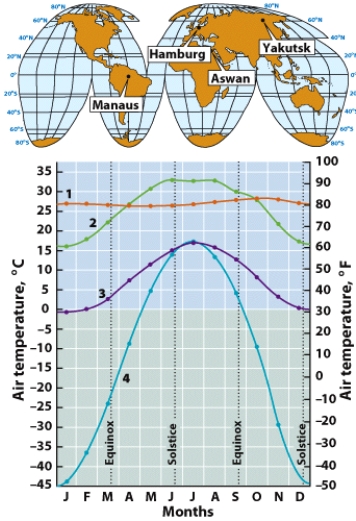
(Multiple Choice)
4.9/5 (78)
(78) 373 degrees is the boiling temperature for which temperature scale?
(Multiple Choice)
4.9/5 (72)
(72) Maritime locations tend to experience ___________ than continental interior locations at the same latitude.
(Multiple Choice)
4.9/5 (84)
(84) ______ flows from the ocean to the atmosphere when water evaporates.
(Multiple Choice)
4.9/5 (71)
(71) The range in monthly mean air temperatures is smaller at high latitudes and larger closer to the equator.
(True/False)
4.9/5 (84)
(84) Which of the temperature profiles on this figure most closely resembles the situation you would expect around 8:00 a.m.? 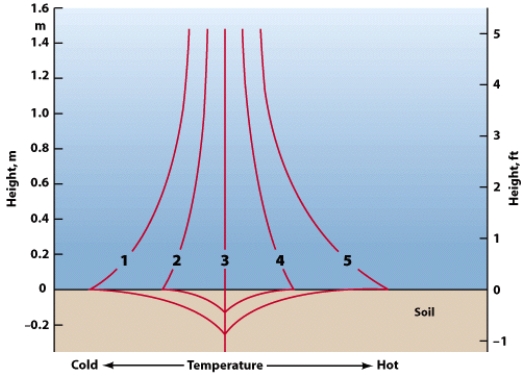
(Multiple Choice)
4.7/5 (89)
(89) Which of the following surfaces would tend to heat up least, given the same amount of insolation?
(Multiple Choice)
4.9/5 (79)
(79) Identify and explain the three major factors that control global air temperature patterns.
(Essay)
4.8/5 (70)
(70) Water heats and cools more slowly than land surfaces due to:
(Multiple Choice)
4.7/5 (83)
(83) 
Filters
- Essay(0)
- Multiple Choice(0)
- Short Answer(0)
- True False(0)
- Matching(0)