



 Chat with AI
Exam 14: The History of Life

Exam 1: The Nature of Science94 Questions
Exam 2: Evaluating Scientific Claims90 Questions
Exam 3: Chemistry of Life102 Questions
Exam 4: Life Is Cellular88 Questions
Exam 5: How Cells Work89 Questions
Exam 6: Cell Division95 Questions
Exam 7: Patterns of Inheritance83 Questions
Exam 8: Chromosomes and Human Genetics92 Questions
Exam 9: What Genes Are83 Questions
Exam 10: How Genes Work98 Questions
Exam 11: Evidence for Evolution86 Questions
Exam 12: Mechanisms of Evolution84 Questions
Exam 13: Adaptation and Species85 Questions
Exam 14: The History of Life97 Questions
Exam 15: Bacteria and Archaea91 Questions
Exam 16: Plants, Fungi, and Protists84 Questions
Exam 17: Animals and Human Evolution88 Questions
Exam 18: General Principles of Ecology81 Questions
Exam 19: Growth of Populations82 Questions
Exam 20: Communities of Organisms83 Questions
Exam 21: Ecosystems87 Questions
Select questions type


The first eukaryotes evolved approximately ________ years ago.
(Multiple Choice)
4.9/5  (85)
(85) Branches on the evolutionary tree are sometimes rearranged by scientists because
(Multiple Choice)
4.7/5 (79)
(79) Monotremes,like the duck-billed platypus,are egg-laying mammals covered in hair,have mammary and skin glands,have three ear ossicles,are diphyodont,and possess dentary-squamosal jaw articulation.Marsupials,such as kangaroos and koalas,are pouched mammals that have a vertical tympanic membrane in addition to possessing characteristics observed in monotremes.Eutherians,such as humans,are placental mammals that have a vertical tympanic membrane in addition to possessing characteristics observed in monotremes. What traits are shared derived traits for monotremes,marsupials,and eutherians?
(Multiple Choice)
4.8/5 (83)
(83) Which kind of organism makes up the oldest fossil found on Earth?
(Multiple Choice)
4.7/5 (81)
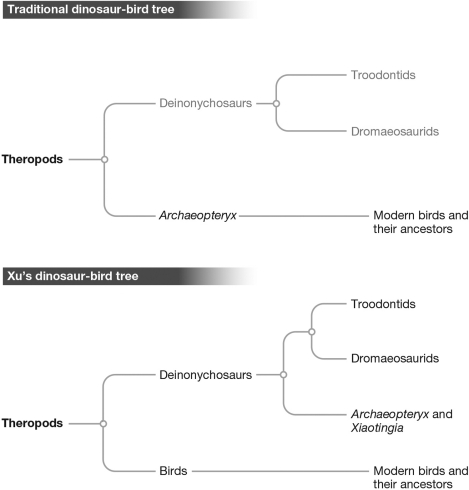
(81) According to the figure of Xu's dinosaur-bird tree shown below,was Archaeopteryx the ancestor of modern birds? Explain your answer.
(Essay)
4.8/5 (67)
(67) Any two groups of organisms will have ________ most recent common ancestor(s).
(Multiple Choice)
4.9/5 (89)
(89) Explain two ways that mass extinctions can have a profound impact on evolved biodiversity in the ecosystem.
(Essay)
4.8/5 (83)
(83) Correctly match the definition with the correct geologic time period.
-early dinosaurs; first mammals; mass extinction at end of period; 200-250 mya
(Multiple Choice)
4.8/5 (91)
(91) Correctly match the definition with the correct geologic time period.
-continents come together to form Pangaea; reptiles dominate life on land by 265 mya; mass extinction at end of period; 250-300 mya
(Multiple Choice)
4.8/5 (81)
(81) Match each adaptation with the most specific group in which that adaptation arose.
-production of chitin to strengthen and protect the body
(Multiple Choice)
4.8/5 (70)
(70) Match each adaptation with the most specific group in which that adaptation arose.
-development of a waxy cuticle to retain moisture
(Multiple Choice)
4.9/5 (84)
(84) Briefly explain how new scientific findings may change the arrangement of an evolutionary tree while enhancing our understanding of evolution.
(Essay)
4.9/5 (67)
(67) Use the figure shown below to match the Linnaean classifications with category names for humans.  -Primates
 (Multiple Choice)
4.8/5 (77)
(77) Gymnosperms and angiosperms are believed to be more closely related to one another than the other major plant groups because
(Multiple Choice)
4.8/5 (86)
(86) Which of the kingdoms below share a most recent,common ancestor? 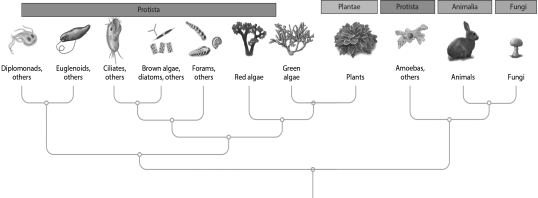
(Multiple Choice)
4.8/5 (87)
(87) Neighboring plant or fungi cells share a common cell wall,making multicellularity relatively simple.How do animal cells remain connected to one another?
(Multiple Choice)
4.9/5 (85)
(85) The appearance of eukaryotes may have been delayed until more ________ accumulated in Earth's atmosphere.
(Multiple Choice)
4.9/5 (80)
(80) Use the figure shown below to match the Linnaean classifications with category names for humans.
-Chordata
-Chordata (Multiple Choice)
4.8/5 (75)
(75) About 540 mya,there was an astonishing burst of evolutionary activity that correlated to the first appearance in the fossil record of most of the major living animal groups.Popularly known as the ________,this geologic time changed the face of life on Earth.
(Short Answer)
4.8/5 (77)
(77) 
Filters
- Essay(0)
- Multiple Choice(0)
- Short Answer(0)
- True False(0)
- Matching(0)