



 Chat with AI
Exam 17: Monetary Policy

Exam 1: Economics: Foundations and Models459 Questions
Exam 2: Trade-Offs, Comparative Advantage, and the Market System495 Questions
Exam 3: Where Prices Come From: The Interaction of Demand and Supply476 Questions
Exam 4: Market Efficiency and Market Failure464 Questions
Exam 5: The Economics of Health Care337 Questions
Exam 6: Firms, The Stock Market, and Corporate Governance456 Questions
Exam 7: Consumer Choice and Elasticity384 Questions
Exam 8: Technology,Production,and Costs274 Questions
Exam 9: Firms in Perfectly Competitive Markets297 Questions
Exam 10: Monopoly and Antitrust Policy279 Questions
Exam 11: Monopolistic Competition and Oligopoly410 Questions
Exam 12: GDP: Measuring Total Production and Income261 Questions
Exam 13: Unemployment and Inflation290 Questions
Exam 14: Economic Growth, The Financial System, and Business Cycles251 Questions
Exam 15: Aggregate Demand and Aggregate Supply Analysis286 Questions
Exam 16: Money,Banks,and the Federal Reserve System278 Questions
Exam 17: Monetary Policy280 Questions
Exam 18: Fiscal Policy292 Questions
Exam 19: Comparative Advantage, International Trade, and Exchange Rates443 Questions
Select questions type


Since World War II,the Federal Reserve has not been involved in carrying out monetary policy.
(True/False)
4.9/5  (75)
(75) The Fed can use contractionary monetary policy in an attempt to keep inflation from increasing.
(True/False)
4.8/5 (93)
(93) If money demand is extremely sensitive to changes in the interest rate,the money demand curve becomes almost horizontal.If the Fed expands the money supply under these circumstances,then the interest rate will
(Multiple Choice)
4.9/5 (98)
(98) In 2017,some banks in Europe had to make interest payments to borrowers rather than receive interest payments from borrowers.Which of the following statements describes this situation?
(Multiple Choice)
4.7/5 (91)
(91) If the amount you owe on your house is greater than the price of the house,you have
(Multiple Choice)
5.0/5 (82)
(82) The Taylor rule helps explain the relationship between the Fed's ________ and ________.
(Multiple Choice)
5.0/5 (87)
(87) Figure 17-14
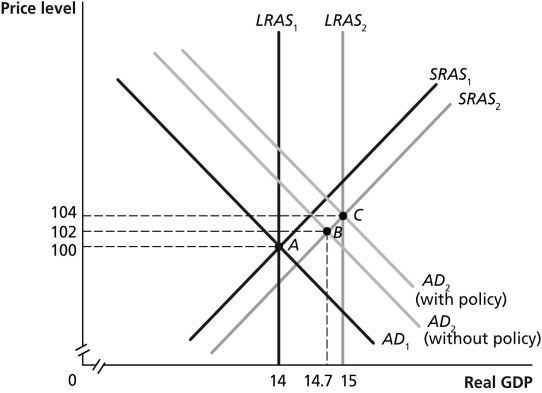 -Refer to Figure 17-14.In the figure above,suppose the economy in Year 1 is at point A and is expected in Year 2 to be at point B.Which of the following policies could the Federal Reserve use to move the economy to point C?
 (Multiple Choice)
4.9/5 (88)
(88) The Fed uses a "core" price index,one that excludes food and energy prices to measure inflation.It does so because
(Multiple Choice)
4.8/5 (66)
(66) Table 17-3
Year Potential Real GDP Real GDP Price Level 2018 \ 18.0 trillion \ 18.0 trillion 150 2019 18.5 trillion 18.8 trillion 154
-Refer to Table 17-3.Consider the hypothetical information in the table above for potential real GDP,real GDP,and the price level in 2018 and in 2019 if the Federal Reserve does not use monetary policy.If the Fed wants to keep real GDP at its potential level in 2019,it should
(Multiple Choice)
5.0/5 (79)
(79) The Fed has adopted an interest rate target for most of the time since World War II.
(True/False)
4.9/5 (88)
(88) Table 17-1
Year Potential Real GDP Real GDP Price Level 2018 \ 18.2 trillion \ 18.2 trillion 145 2019 18.6 trillion 18.5 trillion 147
-Refer to Table 17-1.The hypothetical information in the table shows what the values for real GDP and the price level will be in 2019 if the Fed does not use monetary policy.Which of the following policies makes sense if the Fed wants to keep real GDP at its potential level in 2019?
(Multiple Choice)
4.9/5 (70)
(70) A decrease in interest rates can ________ the demand for stocks as stocks become relatively ________ attractive investments as compared to bonds.
(Multiple Choice)
4.9/5 (79)
(79) The supporters of a monetary growth rule believe that active monetary policy
(Multiple Choice)
4.7/5 (79)
(79) The Federal Reserve responded to the 2008 financial crisis in several ways.Which of the following is one of the ways the Fed responded?
(Multiple Choice)
4.9/5 (81)
(81) Expansionary monetary policy enacted during a recession will cause the inflation rate to increase.
(True/False)
4.8/5 (70)
(70) Figure 17-10
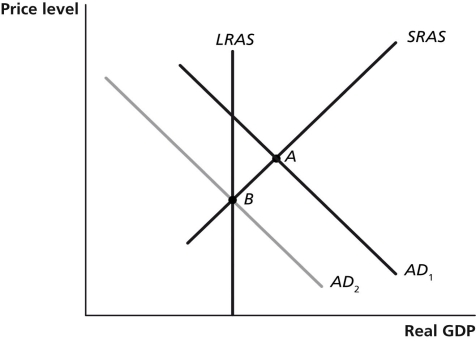 -Refer to Figure 17-10.In the figure above,suppose the economy is initially at point A.The movement of the economy to point B as shown in the graph illustrates the effect of which of the following policy actions by the Federal Reserve?
 (Multiple Choice)
4.9/5 (78)
(78) With a monetary growth rule as proposed by the monetarists,during a recession the rate of growth of the money supply would
(Multiple Choice)
4.9/5 (89)
(89) Contractionary monetary policy refers to the Fed's decreasing the money supply and decreasing interest rates to decrease real GDP.
(True/False)
4.9/5 (73)
(73) 
Filters
- Essay(0)
- Multiple Choice(0)
- Short Answer(0)
- True False(0)
- Matching(0)