



 Chat with AI
Exam 17: Monetary Policy

Exam 1: Economics: Foundations and Models459 Questions
Exam 2: Trade-Offs, Comparative Advantage, and the Market System495 Questions
Exam 3: Where Prices Come From: The Interaction of Demand and Supply476 Questions
Exam 4: Market Efficiency and Market Failure464 Questions
Exam 5: The Economics of Health Care337 Questions
Exam 6: Firms, The Stock Market, and Corporate Governance456 Questions
Exam 7: Consumer Choice and Elasticity384 Questions
Exam 8: Technology,Production,and Costs274 Questions
Exam 9: Firms in Perfectly Competitive Markets297 Questions
Exam 10: Monopoly and Antitrust Policy279 Questions
Exam 11: Monopolistic Competition and Oligopoly410 Questions
Exam 12: GDP: Measuring Total Production and Income261 Questions
Exam 13: Unemployment and Inflation290 Questions
Exam 14: Economic Growth, The Financial System, and Business Cycles251 Questions
Exam 15: Aggregate Demand and Aggregate Supply Analysis286 Questions
Exam 16: Money,Banks,and the Federal Reserve System278 Questions
Exam 17: Monetary Policy280 Questions
Exam 18: Fiscal Policy292 Questions
Exam 19: Comparative Advantage, International Trade, and Exchange Rates443 Questions
Select questions type


Contractionary monetary policy to prevent real GDP from rising above potential real GDP would cause the inflation rate to be ________ and real GDP to be ________.
(Multiple Choice)
4.8/5  (74)
(74) With global borrowing costs so low, economic analysts are warning that central banks need to be prepared to set negative interest rates during the next economic downturn. Several central banks in Europe set negative interest rates in 2014, as did the Japanese central bank in 2016, in an attempt to spur lending. The global market value of negative-yielding bonds rose to $8.6 trillion in mid-2017 due to low inflation and increased perceptions of geopolitical risk. The current U.S. economic expansion is the third longest since the 19th century, and credit markets are showing signs of reaching a cyclical peak. According to Harvard professor Kenneth Rogoff, low interest rates this late in an economic cycle are unprecedented, noting that the Fed cut interest rates by an average of 5.5 percentage points in the nine recessions since the 1950s, and this would be impossible today without negative interest rates.
Source: Sid Verma and Cecile Gutscher, "With Next Recession Looming, Central Banks Better Make Peace With Negative Rates," bloomberg.com, August 14, 2017.
-Refer to the Article Summary.Implementing a negative interest rate policy,as is discussed in the article summary,would be designed to ________ the price level and ________ real GDP.
(Multiple Choice)
4.8/5 (78)
(78) The Taylor rule accurately predicted the changes in the federal funds target during the period
(Multiple Choice)
4.9/5 (76)
(76) In the following table,fill in the columns for your return on investment if the price of your house increased or decreased by 20 percent,based on the down payments specified in the first column.
Return on Your Investment From
Down Payment A 20 Percent Increase in the Price of Your House A 20 Percent Decrease in the Price of Your House 100\% 20 10 5
(Essay)
4.9/5 (78)
(78) The main goal of monetary policy for recent Fed Chairmen has been to maintain high employment in labor markets.
(True/False)
4.9/5 (71)
(71) Use the money demand and money supply model to show graphically and explain the effect on interest rates of the Federal Reserve's open market purchase of Treasury securities.
(Essay)
5.0/5 (63)
(63) Which of the following explains why mortgages weren't considered securities prior to 1970?
(Multiple Choice)
4.9/5 (82)
(82) To reassure investors who were unwilling to buy mortgages in the secondary market,the U.S.Congress used two government sponsored enterprises,Fannie Mae and Freddie Mac,to stand between investors and banks that grant mortgages.Fannie Mae and Freddie Mac
(Multiple Choice)
4.8/5 (93)
(93) When the Fed embarked on a policy known as quantitative easing,they
(Multiple Choice)
4.8/5 (85)
(85) When calculating GDP,the Bureau of Economic Analysis releases its "advanced estimate" of a quarter's GDP approximately
(Multiple Choice)
4.7/5 (83)
(83) Figure 17-6
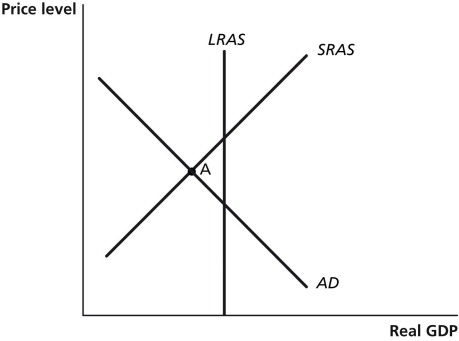 -Refer to Figure 17-6.In the figure above,if the economy is at point A,the appropriate monetary policy by the Federal Reserve would be to
 (Multiple Choice)
4.8/5 (66)
(66) Beginning in 2008,The Federal Reserve and the U.S.Treasury Department responded to the financial crisis by intervening in financial markets in unprecedented ways.Briefly summarize the 4 key actions of the Fed and Treasury.
(Essay)
4.8/5 (88)
(88) The monetary policy target the Federal Reserve focuses primarily on today is
(Multiple Choice)
4.8/5 (76)
(76) Suppose the equilibrium real federal funds rate is 5 percent,the target rate of inflation is 3 percent,the current inflation rate is 5 percent,and real GDP is 4 percent above potential real GDP.If the weights for the inflation gap and the output gap are both 1/2,then according to the Taylor rule the federal funds target rate equals
(Multiple Choice)
5.0/5 (71)
(71) During the turmoil in the market for subprime mortgages in 2007 and 2008,the Fed increased the volume of discount loans.The goal of the Fed was to
(Multiple Choice)
4.9/5 (74)
(74) Expansionary monetary policy refers to the ________ to increase real GDP.
(Multiple Choice)
4.9/5 (76)
(76) What is a mortgage? What were the important developments in the mortgage market during the years after 1970?
(Essay)
4.8/5 (75)
(75) Inflation targeting refers to conducting ________ policy so as to commit the central bank to achieving a ________.
(Multiple Choice)
4.8/5 (90)
(90) 
Filters
- Essay(0)
- Multiple Choice(0)
- Short Answer(0)
- True False(0)
- Matching(0)