



 Chat with AI
Exam 17: Monetary Policy

Exam 1: Economics: Foundations and Models459 Questions
Exam 2: Trade-Offs, Comparative Advantage, and the Market System495 Questions
Exam 3: Where Prices Come From: The Interaction of Demand and Supply476 Questions
Exam 4: Market Efficiency and Market Failure464 Questions
Exam 5: The Economics of Health Care337 Questions
Exam 6: Firms, The Stock Market, and Corporate Governance456 Questions
Exam 7: Consumer Choice and Elasticity384 Questions
Exam 8: Technology,Production,and Costs274 Questions
Exam 9: Firms in Perfectly Competitive Markets297 Questions
Exam 10: Monopoly and Antitrust Policy279 Questions
Exam 11: Monopolistic Competition and Oligopoly410 Questions
Exam 12: GDP: Measuring Total Production and Income261 Questions
Exam 13: Unemployment and Inflation290 Questions
Exam 14: Economic Growth, The Financial System, and Business Cycles251 Questions
Exam 15: Aggregate Demand and Aggregate Supply Analysis286 Questions
Exam 16: Money,Banks,and the Federal Reserve System278 Questions
Exam 17: Monetary Policy280 Questions
Exam 18: Fiscal Policy292 Questions
Exam 19: Comparative Advantage, International Trade, and Exchange Rates443 Questions
Select questions type


For purposes of monetary policy,the Federal Reserve has targeted the interest rate known as the
(Multiple Choice)
4.9/5  (83)
(83) When the Federal Reserve increases the money supply,people spend more because interest rates fall.
(True/False)
5.0/5 (82)
(82) Monetarists think that the Fed should use ________ as a target when conducting monetary policy.
(Multiple Choice)
4.8/5 (93)
(93) When Congress established the Federal Reserve in 1913,what was its main responsibility? When did Congress broaden the Fed's responsibilities?
(Essay)
4.9/5 (72)
(72) Using the money demand and money supply model,an open market purchase of Treasury securities by the Federal Reserve would cause the equilibrium interest rate to
(Multiple Choice)
4.8/5 (87)
(87) Table 17-7
Year Potential Real GDP Real GDP Price Level 2018 \ 19.2 trillion \ 19.2 trillion 154 2019 19.8 trillion 19.6 trillion 156
-Refer to Table 17-7.Suppose the table above illustrates the values of real and potential GDP and the price level if the Fed did not vote to change their current policy to be more contractionary or expansionary.Suppose that the Fed used an appropriate policy and was successful in keeping real GDP at potential in 2019.Draw an aggregate demand and supply curve to illustrate your answer.
(Essay)
4.8/5 (93)
(93) Suppose the Fed decreases the money supply.In response households and firms will ________ short term assets and this will drive ________ interest rates.
(Multiple Choice)
4.9/5 (93)
(93) Suppose that households became mistrustful of the banking system and decide to decrease their checking account balances and increase their holdings of currency.Using the money demand and money supply model and assuming everything else is held constant,the equilibrium interest rate should
(Multiple Choice)
4.7/5 (91)
(91) The Federal Reserve responded to the 2008 financial crisis in several ways.Which of the following is not one of the ways the Fed responded?
(Multiple Choice)
4.9/5 (92)
(92) Suppose the equilibrium real federal funds rate is 3 percent,the target rate of inflation is 3 percent,the current inflation rate is 1 percent,and real GDP is 8 percent below potential real GDP.If the weights for the inflation gap and the output gap are both 1/2,then according to the Taylor rule the federal funds target rate equals
(Multiple Choice)
4.9/5 (81)
(81) The smaller the fraction of an investment financed by borrowing
(Multiple Choice)
4.8/5 (71)
(71) Figure 17-7
 -Refer to Figure 17-7.Suppose the Fed lowers its target for the federal funds rate.Using the basic AD-AS model in the figure above,this situation would be depicted as a movement from
 (Multiple Choice)
5.0/5 (92)
(92) What actions should the Fed take if it believes the economy is about to fall into recession?
(Essay)
4.7/5 (87)
(87) What is a banking panic,and what role did banking panics play in the decision by Congress to establish the Federal Reserve?
(Essay)
4.8/5 (90)
(90) The Federal Reserve can directly affect its monetary policy ________,which then affect its monetary policy ________.
(Multiple Choice)
4.8/5 (81)
(81) Which of the following is true about the Federal Reserve and its ability to prevent recessions? The Federal Reserve
(Multiple Choice)
4.9/5 (73)
(73) Which of the following will lead to a decrease in the equilibrium interest rate in the economy?
(Multiple Choice)
4.9/5 (72)
(72) Figure 17-4
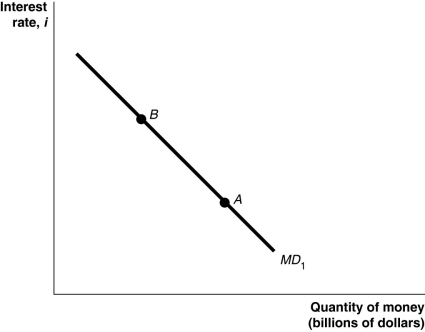 -Refer to Figure 17-4.In the figure above,a movement from point A to point B would be caused by
 (Multiple Choice)
4.9/5 (82)
(82) 
Filters
- Essay(0)
- Multiple Choice(0)
- Short Answer(0)
- True False(0)
- Matching(0)