



 Chat with AI
Exam 17: Monetary Policy

Exam 1: Economics: Foundations and Models459 Questions
Exam 2: Trade-Offs, Comparative Advantage, and the Market System495 Questions
Exam 3: Where Prices Come From: The Interaction of Demand and Supply476 Questions
Exam 4: Market Efficiency and Market Failure464 Questions
Exam 5: The Economics of Health Care337 Questions
Exam 6: Firms, The Stock Market, and Corporate Governance456 Questions
Exam 7: Consumer Choice and Elasticity384 Questions
Exam 8: Technology,Production,and Costs274 Questions
Exam 9: Firms in Perfectly Competitive Markets297 Questions
Exam 10: Monopoly and Antitrust Policy279 Questions
Exam 11: Monopolistic Competition and Oligopoly410 Questions
Exam 12: GDP: Measuring Total Production and Income261 Questions
Exam 13: Unemployment and Inflation290 Questions
Exam 14: Economic Growth, The Financial System, and Business Cycles251 Questions
Exam 15: Aggregate Demand and Aggregate Supply Analysis286 Questions
Exam 16: Money,Banks,and the Federal Reserve System278 Questions
Exam 17: Monetary Policy280 Questions
Exam 18: Fiscal Policy292 Questions
Exam 19: Comparative Advantage, International Trade, and Exchange Rates443 Questions
Select questions type


An argument in favor of the Federal Reserve adopting inflation targeting is that in the long run,the Fed can have an impact on inflation but not on real GDP.
(True/False)
4.9/5  (87)
(87) Although the Federal Reserve had traditionally made discount loans only to ________,in response to the financial crisis in 2008 the Fed made primary dealers eligible for discount loans as well.
(Multiple Choice)
4.9/5 (85)
(85) If the Fed raises the interest rate,this will ________ inflation and ________ real GDP in the short run.
(Multiple Choice)
4.9/5 (73)
(73) In which of the following situations would the Fed conduct contractionary monetary policy?
(Multiple Choice)
4.8/5 (88)
(88) In November 2008,the Fed began its first round of quantitative easing.In total,the Fed conducted ________ rounds of quantitative easing before ending the program in October 2014.
(Multiple Choice)
4.9/5 (72)
(72) Table 17-2
Year Potential Real GDP Real GDP Price Level 2018 \ 18.0 trillion \ 18.0 trillion 150 2019 18.5 trillion 18.2 trillion 152
-Refer to Table 17-2.Consider the hypothetical information in the table above for potential real GDP,real GDP,and the price level in 2018 and in 2019 if the Federal Reserve does not use monetary policy.If the Fed wants to keep real GDP at its potential level in 2019,it should
(Multiple Choice)
4.7/5 (81)
(81) An increase in the interest rate should ________ the demand for dollars and the value of the dollar,and net exports should ________.
(Multiple Choice)
4.8/5 (71)
(71) Figure 17-11
 -Refer to Figure 17-11.In the dynamic model of AD-AS in the figure above,if the economy is at point A in year 1 and is expected to go to point B in year 2,the Federal Reserve would most likely
 (Multiple Choice)
4.8/5 (77)
(77) By the height of the housing bubble in 2005 and early 2006,lenders had greatly loosened the standards for obtaining a mortgage loan,with many mortgages being granted to sub-prime borrowers ________ and "Alt-A" borrowers ________.
(Multiple Choice)
4.9/5 (73)
(73) Table 17-4
Year Potential Real GDP Real GDP Price Level 2018 \ 18.1 trillion \ 18.1 trillion 150 2019 18.4 trillion 18.3 trillion 153
-Refer to Table 17-4.Suppose the following table illustrates the values of real and potential GDP and the price level if the Fed does not vote to change their current policy to be more contractionary or expansionary.If the Fed wants to keep real GDP at its potential level in 2019,should the Fed use a contractionary or expansionary policy? How should it conduct open market operations to achieve its goal?
(Essay)
4.9/5 (69)
(69) A borrower defaults on a loan when he stops making payments on the loan.
(True/False)
4.9/5 (86)
(86) If the Federal Reserve targets the interest rate and the money demand curve shifts to the left,then the Fed
(Multiple Choice)
4.8/5 (78)
(78) What actions should the Fed take if it believes the economy is about to experience a high rate of inflation?
(Essay)
4.8/5 (85)
(85) If the Fed lowers its target for the federal funds rate,this indicates that
(Multiple Choice)
4.8/5 (71)
(71) If the Fed orders an expansionary monetary policy,describe what will happen to the following variables relative to what would have happened without the policy:
a.The money supply
b.Interest rates
c.Investment
d.Consumption
e.Net Exports
f.The aggregate demand curve
g.Real GDP
h.The price level
(Essay)
4.9/5 (69)
(69) Figure 17-2
 -Refer to Figure 17-2.In the figure above,the movement from point A to point B in the money market would be caused by
 (Multiple Choice)
4.9/5 (74)
(74) Figure 17-12
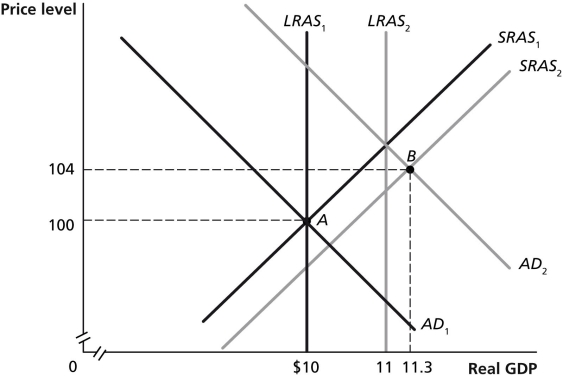 -Refer to Figure 17-12.In the dynamic AD-AS model,if the economy is at point A in year 1 and is expected to go to point B in year 2,the Federal Reserve would most likely
 (Multiple Choice)
4.9/5 (78)
(78) Firms that participate in regular open market transactions with the Federal Reserve are called
(Multiple Choice)
4.8/5 (70)
(70) When housing prices ________,as they did beginning in 2006 following the housing market bubble,consumption spending on furniture,appliances,and home improvements decline as many households find it ________ to borrow against the value of their homes.
(Multiple Choice)
4.9/5 (79)
(79) 
Filters
- Essay(0)
- Multiple Choice(0)
- Short Answer(0)
- True False(0)
- Matching(0)