



 Chat with AI
Exam 12: The Milky Way Galaxy

Exam 1: Here and Now97 Questions
Exam 2: A Users Guide to the Sky116 Questions
Exam 3: Cycles of the Sun and Moon154 Questions
Exam 4: The Origin of Modern Astronomy144 Questions
Exam 5: Light and Telescopes156 Questions
Exam 6: Atoms and Spectra125 Questions
Exam 7: The Sun146 Questions
Exam 8: The Family of Stars190 Questions
Exam 9: The Formation and Structure of Stars136 Questions
Exam 10: The Deaths of Stars127 Questions
Exam 11: Neutron Stars and Black Holes99 Questions
Exam 12: The Milky Way Galaxy117 Questions
Exam 13: Galaxies: Normal and Active151 Questions
Exam 14: Modern Cosmology112 Questions
Exam 15: The Origin of the Solar System108 Questions
Exam 16: Earth and Moon: Bases for Comparative Planetology98 Questions
Exam 17: Mercury, Venus, and Mars83 Questions
Exam 18: The Outer Solar System136 Questions
Exam 19: Meteorites, Asteroids, and Comets91 Questions
Exam 20: Astrobiology: Life on Other Worlds97 Questions
Select questions type


How did Harlow Shapley use the period-luminosity relationship of RR Lyrae variables to determine the size of the Milky Way galaxy
(Multiple Choice)
4.7/5  (73)
(73) Figure 12-1
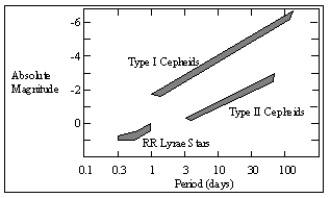 -Refer to Figure 12-1. A Type I Cepheid has been located in an open cluster. The period of the Cepheid variable is 30 days and the variables apparent visual magnitude, m, is 10. First, use 12-1 to estimate the absolute visual magnitude, M . Calculate the distance to this open cluster Hint:
 (Multiple Choice)
4.9/5 (74)
(74) 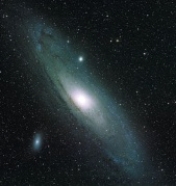 -What is the orientation of the galaxy shown above relative to Earth
 (Multiple Choice)
4.9/5 (69)
(69) Why does the average chemical composition of stars now forming differ from that of older stars
(Essay)
4.9/5 (82)
(82) Discuss how Harlow Shapley determined the structure of the Milky Way galaxy from his study of globular clusters.
(Essay)
5.0/5 (74)
(74) Where are the Large Magellanic Cloud and Small Magellanic Cloud located
(Multiple Choice)
5.0/5 (78)
(78) The rapid rotation in the outer disk suggests that our galaxy is more massive than previously thought.
(True/False)
4.8/5 (68)
(68) Which of the following is not a characteristic of the stars of the disk component of our galaxy
(Multiple Choice)
4.9/5 (73)
(73) What is the difference between a population I star and a population II star
(Essay)
4.9/5 (76)
(76) Who first determined that the energy/s emitted by (luminosity of) Cepheid variable stars is larger the longer their period of variation is
(Multiple Choice)
5.0/5 (77)
(77) The above light curve shows a period that indicates ________________________. 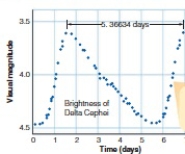
(Multiple Choice)
4.7/5 (81)
(81) Why are Cepheid variable stars important in our study of the Milky Way galaxy
(Essay)
4.8/5 (83)
(83) 
Filters
- Essay(0)
- Multiple Choice(0)
- Short Answer(0)
- True False(0)
- Matching(0)