



 Chat with AI
Exam 12: The Milky Way Galaxy

Exam 1: Here and Now97 Questions
Exam 2: A Users Guide to the Sky116 Questions
Exam 3: Cycles of the Sun and Moon154 Questions
Exam 4: The Origin of Modern Astronomy144 Questions
Exam 5: Light and Telescopes156 Questions
Exam 6: Atoms and Spectra125 Questions
Exam 7: The Sun146 Questions
Exam 8: The Family of Stars190 Questions
Exam 9: The Formation and Structure of Stars136 Questions
Exam 10: The Deaths of Stars127 Questions
Exam 11: Neutron Stars and Black Holes99 Questions
Exam 12: The Milky Way Galaxy117 Questions
Exam 13: Galaxies: Normal and Active151 Questions
Exam 14: Modern Cosmology112 Questions
Exam 15: The Origin of the Solar System108 Questions
Exam 16: Earth and Moon: Bases for Comparative Planetology98 Questions
Exam 17: Mercury, Venus, and Mars83 Questions
Exam 18: The Outer Solar System136 Questions
Exam 19: Meteorites, Asteroids, and Comets91 Questions
Exam 20: Astrobiology: Life on Other Worlds97 Questions
Select questions type


The age of the Milky Way galaxy has been estimated to be at least 13 billion years based on
(Multiple Choice)
4.8/5  (73)
(73) The pink color in the following visual image is from __________. 
(Multiple Choice)
4.9/5 (81)
(81) Our galaxy is suspected to be surrounded by a galactic halo or corona because the disk of the galaxy
(Multiple Choice)
4.8/5 (80)
(80) Henrietta Leavitt discovered the period-luminosity relationship for ____________________.
(Short Answer)
4.7/5 (96)
(96) The units of proper motion are km/s because proper motion is the motion of stars across the sky.
(True/False)
4.7/5 (64)
(64) The center of our galaxy lies in the direction of (but far beyond) the stars in the constellation of
(Multiple Choice)
4.9/5 (87)
(87) The center of the Milky Way galaxy must be less than 1 AU in diameter and contain at least 4 million solar masses. Therefore, the center of the Milky Way galaxy must be a ____________________,
(Short Answer)
4.8/5 (85)
(85) The production of elements heavier than helium by fusion in stars and during supernova explosions is called ______________________.
(Short Answer)
4.8/5 (65)
(65) Figure 12-1
 -Refer to Figure 12-1. A Type II Cepheid has been located in a distant globular cluster with a period of 10 days. What is the star's absolute magnitude
 (Multiple Choice)
4.8/5 (69)
(69) The pink color tracing the spiral arms are from emission nebulae. 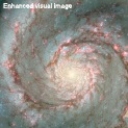
(True/False)
4.8/5 (85)
(85) The rotation curve of the galaxy provides evidence for the existence of the ____________________ which extends beyond the halo of the galaxy.
(Short Answer)
4.8/5 (92)
(92)  -What is the orientation of the galaxy shown above relative to us on Earth
 (Multiple Choice)
4.7/5 (79)
(79) Stars motion within the disk of the Milky Way galaxy are ordered in that they the all go in the same direction, counter-clockwise, as viewed from above (e.g., as viewed from above the north rotational axis of the Sun),
(True/False)
4.9/5 (87)
(87) The traditional "top-down" hypothesis of the formation of our galaxy cannot explain
(Multiple Choice)
4.9/5 (72)
(72)  -The galaxy shown above is ___________.
Which of the following can't be associated with the spiral arms of a galaxy
(Multiple Choice)
4.8/5 (73)
(73) 
Filters
- Essay(0)
- Multiple Choice(0)
- Short Answer(0)
- True False(0)
- Matching(0)