



 Chat with AI
Exam 12: The Milky Way Galaxy

Exam 1: Here and Now97 Questions
Exam 2: A Users Guide to the Sky116 Questions
Exam 3: Cycles of the Sun and Moon154 Questions
Exam 4: The Origin of Modern Astronomy144 Questions
Exam 5: Light and Telescopes156 Questions
Exam 6: Atoms and Spectra125 Questions
Exam 7: The Sun146 Questions
Exam 8: The Family of Stars190 Questions
Exam 9: The Formation and Structure of Stars136 Questions
Exam 10: The Deaths of Stars127 Questions
Exam 11: Neutron Stars and Black Holes99 Questions
Exam 12: The Milky Way Galaxy117 Questions
Exam 13: Galaxies: Normal and Active151 Questions
Exam 14: Modern Cosmology112 Questions
Exam 15: The Origin of the Solar System108 Questions
Exam 16: Earth and Moon: Bases for Comparative Planetology98 Questions
Exam 17: Mercury, Venus, and Mars83 Questions
Exam 18: The Outer Solar System136 Questions
Exam 19: Meteorites, Asteroids, and Comets91 Questions
Exam 20: Astrobiology: Life on Other Worlds97 Questions
Select questions type


How did Harlow Shapley determine where the center of the galaxy lies
(Multiple Choice)
4.9/5  (92)
(92) In the diagram below, the approximate absolute magnitude of a Type II Cepheid with a period of 30 days is ____________________. 
(Short Answer)
4.7/5 (76)
(76) 
Population II stars
I.are primarily found in the disk of the galaxy.
II.contain more heavy metals than population I stars.
III.are primarily old low-mass stars.
IV.are located in globular clusters.
(Multiple Choice)
4.9/5 (78)
(78) The disk of the Milky Way is approximately 20,000 ly in diameter.
(True/False)
4.9/5 (81)
(81) The blue shaded region shown in the H-R diagram above is known as the Cepheid variable strip. 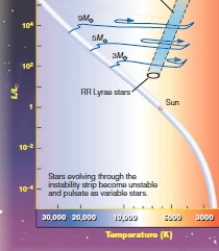
(True/False)
4.8/5 (77)
(77) More massive stars are _________ luminous and __________ than less massive stars, thus they pulsate _____________.
(Multiple Choice)
4.8/5 (86)
(86) In the edge-on sketch of a spiral galaxy, pick the letter corresponding most nearly to the location of globular clusters. 
(Multiple Choice)
4.8/5 (82)
(82) Which mass star experiences more pulsations than the others shown at the time the systems were plotted in the following H-R diagram 
(Multiple Choice)
4.9/5 (78)
(78) Population II stars contain more metals than Population I stars.
(True/False)
4.8/5 (89)
(89)  -You observe a variable star and find its period to be about 6 days and its MV to be -3.4. Which object best describes the system or type of system you are observing using the above graph
 (Multiple Choice)
4.9/5 (80)
(80) O and B stars are examples of ________________ that are used to outline the arms in a galaxy like the Milky Way galaxy.
(Short Answer)
4.8/5 (90)
(90) The Herschels' grindstone model of the Milky Way star system was too small because
(Multiple Choice)
4.9/5 (79)
(79) Who first used RR Lyrae variable stars to determine distances in our Milky Way galaxy
(Multiple Choice)
4.8/5 (86)
(86) The ____________________ of the galaxy contains population I stars, open clusters, and gas clouds.
(Short Answer)
4.9/5 (77)
(77) _______________ is the rate at which a star moves across the sky.
(Short Answer)
4.7/5 (73)
(73) M dwarf main-sequence stars pass through the instability strip as shown above. 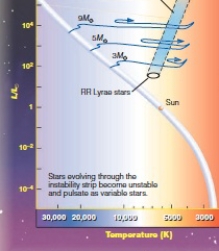
(True/False)
4.8/5 (87)
(87) 
Filters
- Essay(0)
- Multiple Choice(0)
- Short Answer(0)
- True False(0)
- Matching(0)