



 Chat with AI
Exam 11: Neutron Stars and Black Holes

Exam 1: Here and Now97 Questions
Exam 2: A Users Guide to the Sky116 Questions
Exam 3: Cycles of the Sun and Moon154 Questions
Exam 4: The Origin of Modern Astronomy144 Questions
Exam 5: Light and Telescopes156 Questions
Exam 6: Atoms and Spectra125 Questions
Exam 7: The Sun146 Questions
Exam 8: The Family of Stars190 Questions
Exam 9: The Formation and Structure of Stars136 Questions
Exam 10: The Deaths of Stars127 Questions
Exam 11: Neutron Stars and Black Holes99 Questions
Exam 12: The Milky Way Galaxy117 Questions
Exam 13: Galaxies: Normal and Active151 Questions
Exam 14: Modern Cosmology112 Questions
Exam 15: The Origin of the Solar System108 Questions
Exam 16: Earth and Moon: Bases for Comparative Planetology98 Questions
Exam 17: Mercury, Venus, and Mars83 Questions
Exam 18: The Outer Solar System136 Questions
Exam 19: Meteorites, Asteroids, and Comets91 Questions
Exam 20: Astrobiology: Life on Other Worlds97 Questions
Select questions type


Observations from the Compton Gamma Ray Observatory showed that gamma-ray bursters were located throughout the sky. This told us that
(Multiple Choice)
4.7/5  (62)
(62) In the lighthouse model shown above, the light from the lighthouse sweeps out a region in the sky, representing a disk around a pulsar. 
(True/False)
4.8/5 (77)
(77) At extremely high densities and temperatures, electrons can be forced to fuse with protons. This reaction produces
(Multiple Choice)
4.8/5 (84)
(84) _________ are neutron stars that have magnetic fields 100 times stronger than the average neutron star.
(Multiple Choice)
4.8/5 (97)
(97) A(n) ____________________ periodically emits large amounts of X-ray radiation as material accretes around a neutron star or black hole.
(Short Answer)
4.8/5 (88)
(88) A _________ has a radius of about 10 km and is supported by the pressure associated with degenerate neutrons.
(Multiple Choice)
4.8/5 (78)
(78) The peculiar system SS 433
I.is emitting beams of energy and matter.
II.is producing a spectrum with both a red and a blue shift.
III.probably contains an accretion disk.
IV.is the result of a planetary nebula.
(Multiple Choice)
4.8/5 (87)
(87) The ____________________ of a black hole is the radius from the black hole at which the escape velocity is equal to the speed of light.
(Short Answer)
4.8/5 (88)
(88) If the inner accretion disk around a black hole has a temperature of K, at what wavelength will it radiate the most energy (Hint: From Wien's law, λT =3,000,000 where λ is in nm and T is in K.)
(Multiple Choice)
4.8/5 (86)
(86) Cygnus X-1 and LMC X-3 are black holes if the masses of the unseen companions perhaps may be
(Multiple Choice)
4.8/5 (78)
(78) Gamma-ray bursts seem to be associated with violent events involving _______________.
(Multiple Choice)
4.7/5 (69)
(69) The stability of a neutron star is expected only if a neutron star is a ____________.
(Multiple Choice)
4.9/5 (73)
(73) If the Sun and stars are supported by gas pressure, what supports a neutron star
(Short Answer)
4.8/5 (100)
(100) in the following graph of a pulsar's motion in a binary from 0 to 2.5 hours, the radial velocity represents how fast the compact object is traveling away from Earth. 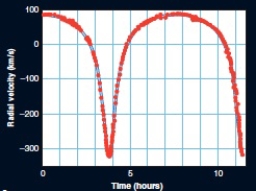
(True/False)
4.9/5 (72)
(72) 
Filters
- Essay(0)
- Multiple Choice(0)
- Short Answer(0)
- True False(0)
- Matching(0)