



 Chat with AI
Exam 11: Neutron Stars and Black Holes

Exam 1: Here and Now97 Questions
Exam 2: A Users Guide to the Sky116 Questions
Exam 3: Cycles of the Sun and Moon154 Questions
Exam 4: The Origin of Modern Astronomy144 Questions
Exam 5: Light and Telescopes156 Questions
Exam 6: Atoms and Spectra125 Questions
Exam 7: The Sun146 Questions
Exam 8: The Family of Stars190 Questions
Exam 9: The Formation and Structure of Stars136 Questions
Exam 10: The Deaths of Stars127 Questions
Exam 11: Neutron Stars and Black Holes99 Questions
Exam 12: The Milky Way Galaxy117 Questions
Exam 13: Galaxies: Normal and Active151 Questions
Exam 14: Modern Cosmology112 Questions
Exam 15: The Origin of the Solar System108 Questions
Exam 16: Earth and Moon: Bases for Comparative Planetology98 Questions
Exam 17: Mercury, Venus, and Mars83 Questions
Exam 18: The Outer Solar System136 Questions
Exam 19: Meteorites, Asteroids, and Comets91 Questions
Exam 20: Astrobiology: Life on Other Worlds97 Questions
Select questions type


The escape velocity of an object depends on
I.the mass of that object.
II.the mass of the object trying to escape.
III.the distance from the center of the object and the escaping object.
IV.the speed of light.
(Multiple Choice)
4.8/5  (67)
(67) The Schwarzschild radius of a 1-  black hole is approximately
 (Multiple Choice)
4.9/5 (76)
(76) The ____________________ theory describes pulsars as rotating neutron stars with strong magnetic fields that confine high-speed charged particles in two beams emanating from the magnetic poles of the neutron star.
(Short Answer)
4.9/5 (78)
(78) The figure shows an image of an isolated black hole. A black hole emits 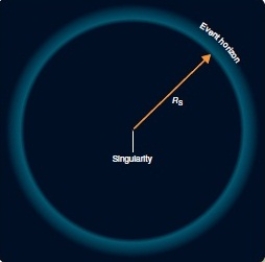
(Multiple Choice)
4.9/5 (68)
(68) If the accretion disk around a black hole emits X-rays outside the event horizon, the X-rays can escape.
(True/False)
4.8/5 (72)
(72) Unseen objects in our galaxy have been found by the bending effect they have on more distant stars' light passing near them. These small objects that don't emit light are calculated to have masses of about 10× the mass of the Sun. Which is the best choice for these objects
(Multiple Choice)
5.0/5 (72)
(72) Theory predicts that neutron stars may not exceed 3 solar masses.
(True/False)
4.8/5 (78)
(78) The material that accretes onto a neutron star or black hole is expected to emit X-rays because
(Multiple Choice)
4.9/5 (81)
(81) Energy lost by an isolated pulsar is carried away by a _____________.
(Short Answer)
4.8/5 (91)
(91) Rank the degenerate pressures from least supportive to most supportive:
(Multiple Choice)
4.8/5 (82)
(82) A star on the main sequence has 7 solar masses. The star will evolve into a ____________ and its core will be supported by ______________.
(Multiple Choice)
4.9/5 (93)
(93) A scientific theory can be proven true if the correct experiments are performed.
(True/False)
4.9/5 (84)
(84) The ____________________ of a black hole in a binary system can emit X-rays and allow us to detect the presence of the black hole.
(Short Answer)
4.9/5 (87)
(87) 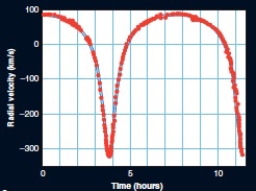 -Using the graph above of a pulsar in a binary orbit, what is the orbital period
 (Multiple Choice)
4.8/5 (67)
(67) As material flows into a black hole as viewed from well outside the event horizon
(Multiple Choice)
4.8/5 (87)
(87) 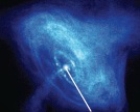 -The white line is pointing to which object in the X-ray image above
 (Multiple Choice)
4.9/5 (79)
(79) 
Filters
- Essay(0)
- Multiple Choice(0)
- Short Answer(0)
- True False(0)
- Matching(0)